Analysis of External Flow Dynamics for Flow Over a Smooth Cube
DOI:
https://doi.org/10.37934/afhme.6.1.113aKeywords:
Computational fluid dynamics, flow separation, drag coefficient, bluff body, smooth cube, external flow, Reynolds-averaged Navier–Stokes, k–omega turbulence modelAbstract
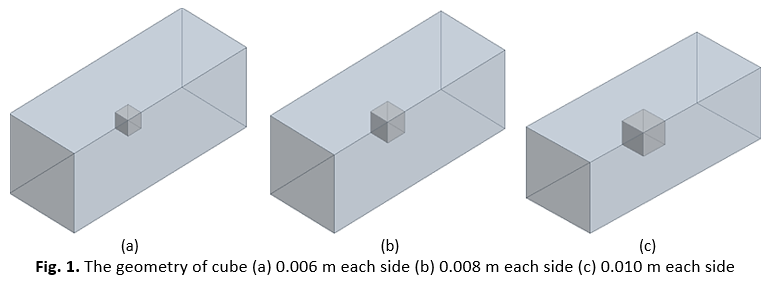
The analysis of external flow around bluff bodies such as cubes is fundamental in fluid dynamics and engineering design. When air flows over sharp edges and corners, it tends to separate from the surface, which greatly affects how much drag the object experiences, the shape of the airflow behind it, and how pressure is spread around it. This study investigates how airflow separates and creates wakes around the edges of smooth cubes of different sizes when exposed to various velocities. Not fully understanding this flow can result in less efficient designs, greater drag, and higher energy use in engineering applications. The aim of this project is to investigate how air flows around smooth cubes, especially looking at how the flow separates, and to measure the drag force and drag coefficient under different conditions. Three different cube sizes 0.006 m, 0.008 m, and 0.010 m were studied, each tested at three airflow speeds: 10 m/s, 20 m/s, and 30 m/s. Using CFD in ANSYS Fluent, the steady, incompressible Navier Stokes equations were solved with the standard k ω turbulence model. The study looked at how velocity and pressure changed, examined airflow patterns, and measured drag performance for all the setups. Results showed that both the drag force and drag coefficient grew as the cube size and airflow speed increased. The largest cube (0.01 m) experienced the highest drag force, while the smallest cube (0.006 m) faced the least resistance. Flow separation consistently happened at the back corners and side edges, with longer and stronger wakes forming when the airflow was faster and the cubes were larger. The CFD analysis met the study’s goals by measuring drag and clearly showing how the cube’s shape and airflow speed work together to affect the flow patterns around it.