

When Portfolio Diversity Pays: Resource Orchestration Pathways to Resilience and Sustainable Supply Chain Performance

Authors

  • Lubna Khan Teh Hong Piow Faculty of Business and Finance, Universiti Tunku Abdul Rahman, Malaysia
  • Au Yong Hui Nee Teh Hong Piow Faculty of Business and Finance, Universiti Tunku Abdul Rahman, Malaysia
  • Foo Meow Yee Faculty/Institute of Accountancy and Management, Universiti Tunku Abdul Rahman, Malaysia

Keywords:

Resource Orchestration, Supply Chain Resilience, Sustainable Supply Chain Performance, Supplier Portfolio Diversity, Customer Portfolio Diversity, Digital Technology, PLS-SEM and fsQCA

Abstract

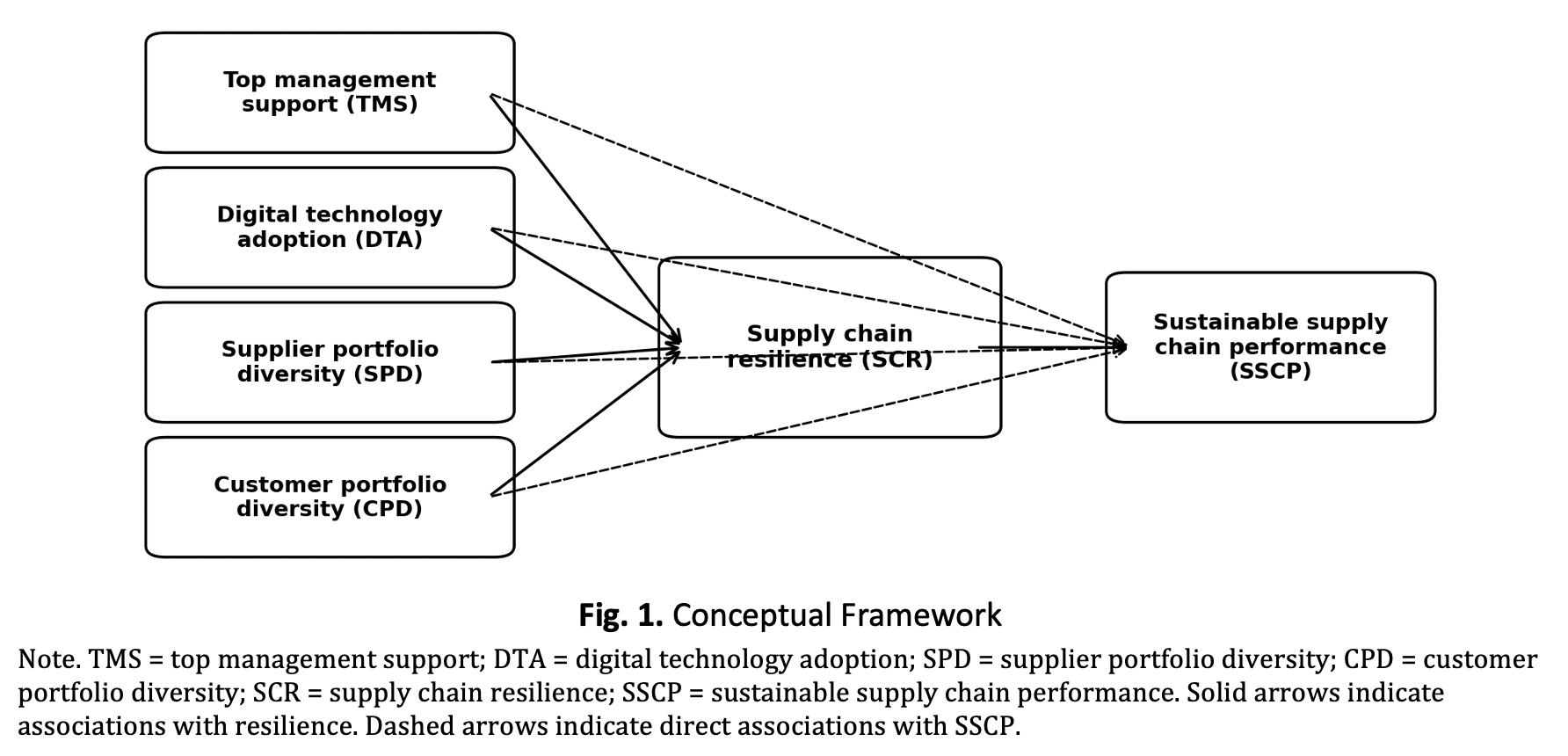
Supply chain portfolio diversity is often treated as a hedge against disruption, but a broader set of suppliers and customers can also create monitoring, coordination, and information burdens. The unresolved issue is therefore not whether diversity is beneficial in principle, but when firms can convert portfolio breadth into a usable strategic option. Drawing on resource orchestration logic, this study examines how top management support, digital technology adoption, supplier portfolio diversity, and customer portfolio diversity are associated with sustainable supply chain performance through supply chain resilience. Survey data from 345 Malaysian manufacturing firms were analysed using partial least squares structural equation modelling and fuzzy set qualitative comparative analysis. The structural model shows that all four resource domains are positively associated with resilience and sustainable performance. Supplier portfolio diversity has the strongest association with resilience (β = .401), while resilience has the largest association with sustainable supply chain performance (β = .556). Significant complementary indirect effects are present for all four resource domains. The configurational analysis identifies two sufficient pathways to high performance: a managerial supplier resilience pathway and a digital market resilience pathway. Their combined solution consistency is .909 and coverage is .558. No single condition reaches the .90 necessity threshold. Low performance follows different combinations, most often involving weak digital adoption, limited supplier portfolio diversity, and weak resilience. Conceptually, the study distinguishes average resource productivity from configurational indispensability and shows that comparable performance can be supported by alternative managerial and digital coordination complements. The findings show that portfolio diversity creates value through different resource architectures rather than through a single universal formula.

Author Biography

Au Yong Hui Nee, Teh Hong Piow Faculty of Business and Finance, Universiti Tunku Abdul Rahman, Malaysia

auyonghn@utar.edu.my

Downloads

Published

2026-09-16

Issue

Section

Articles