
The Effect of Organizational Culture on Employee Productivity in Selected Ministries, Departments and Agencies in Nigeria: A Systematic Review and Meta-Analysis

Authors

  • Abdulmalik Ibrahim School of Business and Social Sciences, Albukhary International Univeristy, Kedah, Malaysia
  • Abubakar Muhammad Ali School of Business and Social Sciences, Albukhary International Univeristy, Kedah, Malaysia
  • Muhammad Abba Mandara School of Business and Social Sciences, Albukhary International Univeristy, Kedah, Malaysia
  • Norizan Azizan School of Business and Social Sciences, Albukhary International Univeristy, Kedah, Malaysia

Keywords:

Organizational culture, employee productivity, ministries, departments and agencies, systematic review, meta-analysis, public sector

Abstract

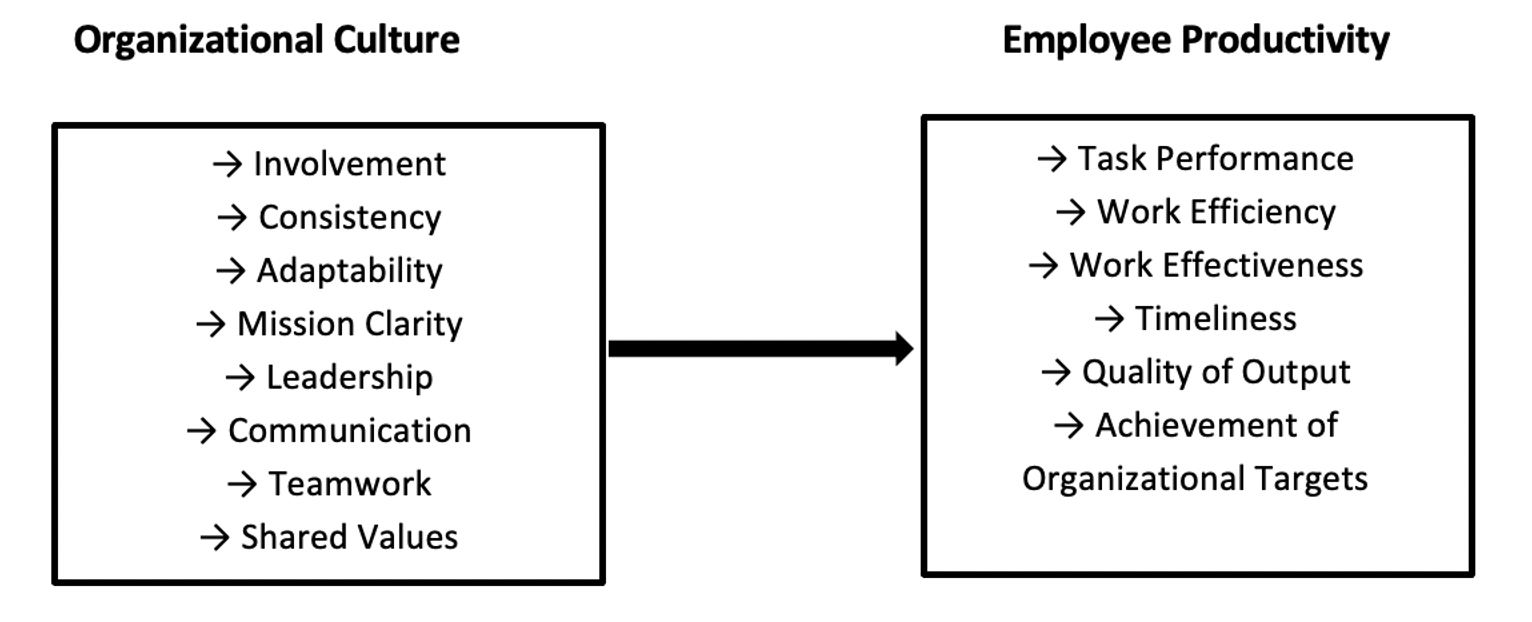
Organizational culture has increasingly been recognized as an important determinant of employee behaviour, motivation, commitment and productivity. In Nigeria's public sector, Ministries, Departments and Agencies (MDAs) operate within institutional environments characterized by bureaucratic procedures, hierarchical structures, regulatory requirements, political influences and changing expectations concerning public service delivery. Although numerous empirical studies have examined the relationship between organizational culture and employee performance in Nigerian organizations, their findings vary in terms of strength, direction, cultural dimensions, institutional context and measures of employee productivity. This study synthesizes the available empirical evidence on the effect of organizational culture on employee productivity in selected Nigerian MDAs using a systematic review and meta-analytic approach. The review is structured in accordance with the Preferred Reporting Items for Systematic Reviews and Meta-Analyses (PRISMA) 2020 framework. Relevant empirical studies were identified through systematic searches of academic databases and supplementary sources using combinations of organizational culture, employee productivity, employee performance, public sector, Ministries, Departments and Agencies, and Nigeria. Studies were screened according to predefined inclusion and exclusion criteria, with emphasis on quantitative empirical studies conducted in Nigerian public-sector institutions. The synthesis focuses on organizational culture as the explanatory construct and employee productivity or closely related employee-performance outcomes as the dependent construct. Existing evidence generally indicates a positive association between supportive organizational cultures and employee productivity. Studies conducted in Nigerian public institutions, including NAFDAC and selected public-sector organizations, report significant relationships between cultural practices, shared values, organizational norms and employee performance/productivity. However, considerable differences exist across institutional settings and cultural dimensions. The study argues that culture characterized by employee involvement, consistency, adaptability, mission clarity, effective communication, teamwork, recognition and supportive leadership is more likely to facilitate employee productivity than rigid, dysfunctional or poorly communicated organizational cultures. The study contributes by consolidating fragmented Nigerian evidence and identifying methodological and contextual gaps that warrant future research. It concludes that public-sector reform in Nigeria should treat organizational culture as a strategic component of productivity enhancement rather than focusing exclusively on structural and technological interventions.

Author Biographies

Abdulmalik Ibrahim, School of Business and Social Sciences, Albukhary International Univeristy, Kedah, Malaysia

abdulmalikibrahim83@gmail.com

Abubakar Muhammad Ali, School of Business and Social Sciences, Albukhary International Univeristy, Kedah, Malaysia

abubakaralimhd143 @gmail.com

Muhammad Abba Mandara, School of Business and Social Sciences, Albukhary International Univeristy, Kedah, Malaysia

muhammadabbamandara01@gmail.com

Norizan Azizan, School of Business and Social Sciences, Albukhary International Univeristy, Kedah, Malaysia

norizan.azizan@aiu.edu.my

Downloads

Published

2026-10-06

Issue

Section

Articles