
Interpreting the Hadith on Leprosy Through the Lens of Intentionality: A Textual Linguistic Approach

Authors

  • Muhammad Izuan Abd Gani Program of Arabic Language and Islamic Literature, Fakulti Pengajian Bahasa Utama, Universiti sains Islam Malaysia, Nilai, Malaysia
  • Mohd Adil Mufti Mohamad Samsudin International Islamic College Bangkok (IICB), KRIRK University, Bangkok, Thailand
  • Ahmad Jalaluddin Al-Islami Moh Shin Arabic Language Unit, Fakulti Pengajian Bahasa Utama, Universiti Sains Islam Malaysia, Nilai, Malaysia
  • Anis Baedoloh Universiti Teknologi MARA (UiTM), Shah Alam, Malaysia

Keywords:

Text linguistics; Intentionality; Prophetic Discourse; Leprosy

Abstract

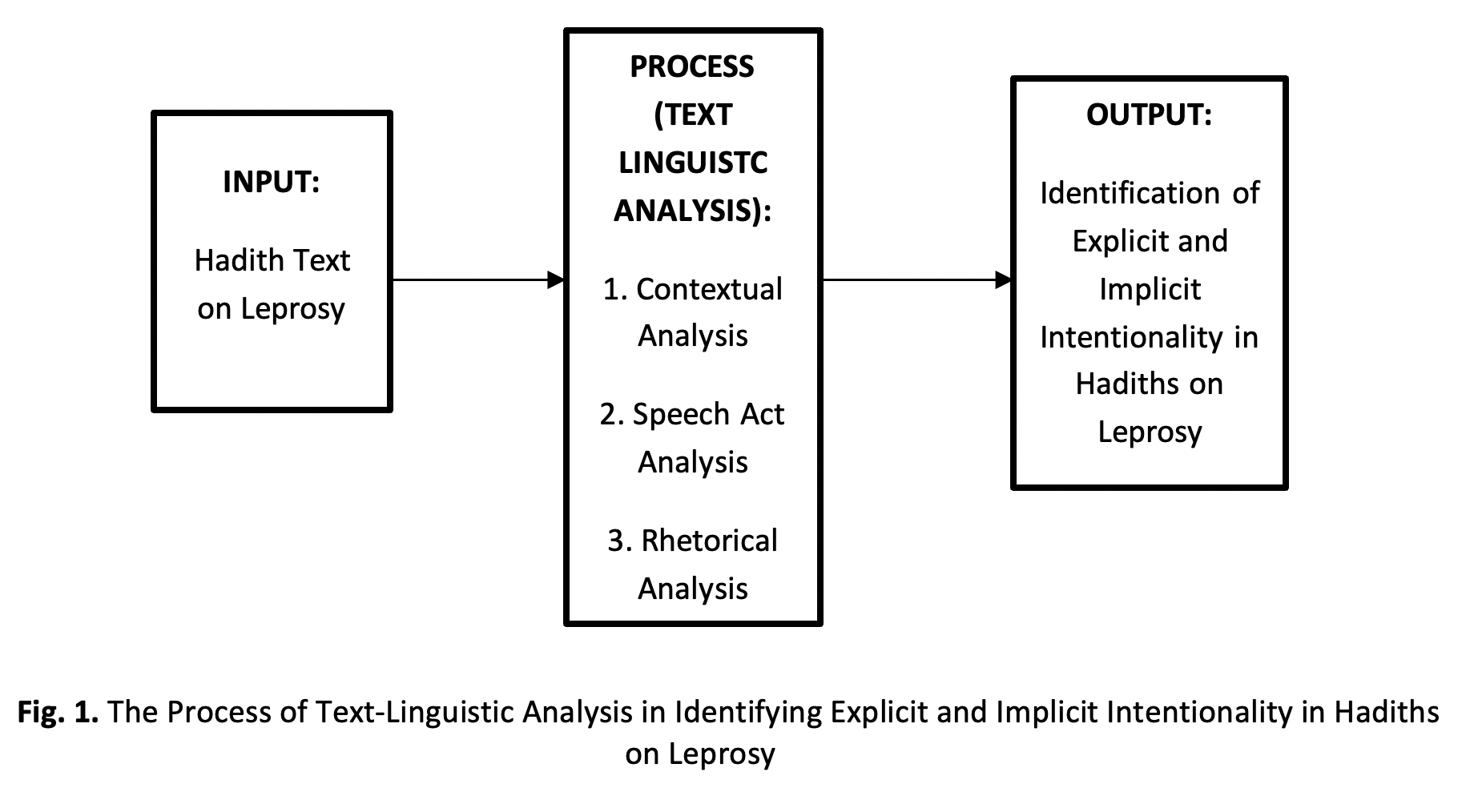
The hadith text constitutes a form of discourse that demands a meticulous and context-sensitive analytical approach, owing to its status as a sacred discourse that transcends literal boundaries. Interpretations limited to surface-level meanings, without considering pragmatic factors and extratextual context, risk obscuring the intended purpose of the Prophet’s utterances. This poses a significant challenge in grasping the communicative message and implications of the hadith within its original situational and socio-cultural context, particularly in narrations related to health and illness, such as those concerning leprosy. This study aims to examine the element of intentionality in the interpretation of hadiths on leprosy from a textual linguistic perspective, focusing on how explicit and implicit meanings are constructed within the communicative framework of the Prophet’s speech. Employing a qualitative approach, the research analyzes textual structure, linguistic context, and speech acts present in selected hadiths. Data are derived from classical hadith compilations and contemporary scholarship in textual linguistics. The analysis reveals that intentionality plays a central role in shaping the rhetorical message of the hadith, where the directive to avoid individuals with leprosy is not merely literal but conveys a broader preventive and social welfare objective. The findings further suggest that an understanding of the cultural background, prevailing health concerns, and communicative modes of the Prophetic era is essential to uncovering the intended meaning. In conclusion, the application of textual linguistic analysis offers a more comprehensive and critical framework for interpreting hadiths, opening new methodological pathways for engaging with Islamic texts that embody practical wisdom and purposeful action.

Author Biographies

Muhammad Izuan Abd Gani, Program of Arabic Language and Islamic Literature, Fakulti Pengajian Bahasa Utama, Universiti sains Islam Malaysia, Nilai, Malaysia

izuanis@usim.edu.my

Mohd Adil Mufti Mohamad Samsudin , International Islamic College Bangkok (IICB), KRIRK University, Bangkok, Thailand

adilmufti@usim.edu.my

Ahmad Jalaluddin Al-Islami Moh Shin, Arabic Language Unit, Fakulti Pengajian Bahasa Utama, Universiti Sains Islam Malaysia, Nilai, Malaysia

jalaluddinmohshin@gmail.com

Anis Baedoloh, Universiti Teknologi MARA (UiTM), Shah Alam, Malaysia

anisbaedoloh@gmail.com

Downloads

Published

2025-12-26

Issue

Section

Articles