




Does The Age of AI Influence Character Building of Primary School Students? A Qualitative Study among Malaysian Teachers

Authors

  • Zaheril Zainudin Faculty of Education and Liberal Arts, INTI International University, Malaysia
  • Nurmuma Kamarina Jamil Faculty of Education and Liberal Studies, City University of Malaysia
  • Hasnah Embi Tadika Sri Comel Manja, Bandar Sri Damansara, Malaysia
  • Fatin Maisarah Jamil Tadika Sri Comel Manja, Bandar Sri Damansara, Malaysia

DOI:

https://doi.org/10.37934/arsbs.42.1.156174

Keywords:

Artificial intelligence in education, character education, moral development, primary school teachers, Malaysia

Abstract

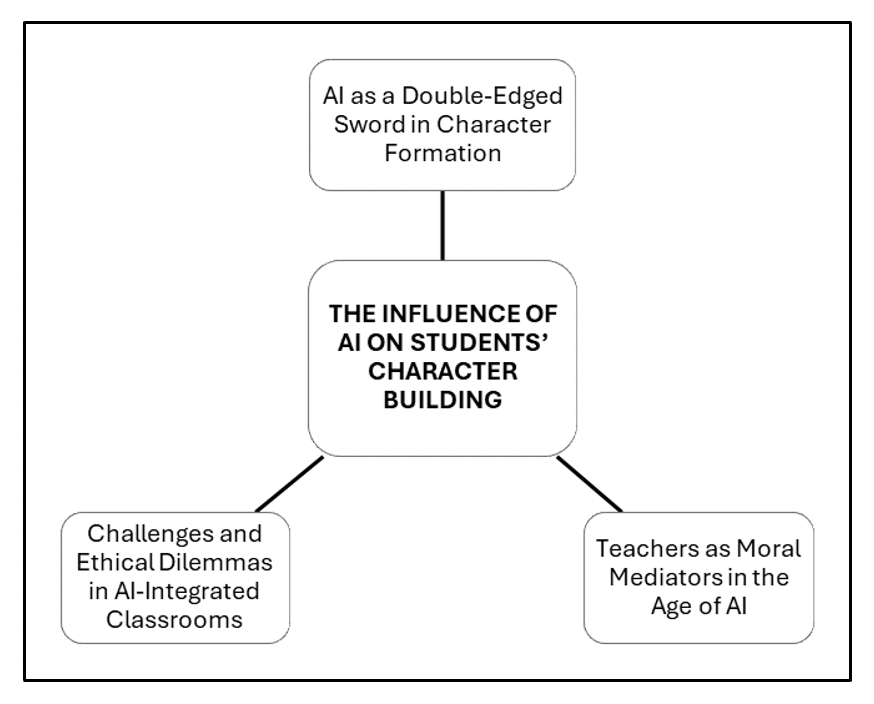
The rapid integration of artificial intelligence (AI) into primary education has transformed learning environments, raising critical questions about its influence on students’ character building. While existing studies largely emphasize academic outcomes and technological efficiency, limited empirical attention has been given to the moral, emotional, and social implications of AI use among young learners, particularly in Southeast Asian contexts. This qualitative study explores Malaysian primary school teachers’ perceptions of how AI affects students’ character development in the Age of AI. Drawing on Bandura’s Social Cognitive Theory and Kohlberg’s Stages of Moral Development, the study adopts a phenomenological approach to capture teachers’ lived experiences. Data were collected through semi-structured interviews with twelve teachers from six government primary schools in Negeri Sembilan and Selangor, all of whom had experience integrating AI-based tools into classroom instruction. Thematic analysis revealed three overarching themes: (1) AI as a double-edged sword that simultaneously enhances learning motivation while weakening empathy, patience, and moral reflection; (2) teachers’ evolving role as moral mediators who actively contextualize and humanize AI-assisted learning; and (3) ethical and structural challenges, including limited professional training, curriculum constraints, and fears of dehumanization. The findings suggest that AI’s influence on character building is not inherently deterministic but highly dependent on pedagogical intent and moral guidance. This study contributes to the emerging discourse on AI ethics and character education by highlighting teachers’ central role in sustaining moral development within AI-mediated classrooms. The study recommends embedding AI ethics into primary curricula, strengthening teachers’ ethical digital pedagogy, and adopting human-centered approaches to ensure that technological advancement aligns with moral and cultural values.

Author Biography

Zaheril Zainudin, Faculty of Education and Liberal Arts, INTI International University, Malaysia

zaheril.zainudin@newinti.com.my

Downloads

Published

2026-02-15

Issue

Section

Articles