



Global Research Trends on Islamophobia: A Bibliometric and Science Mapping Analysis (2000–2025)

Authors

  • Ramlan Mustapha Academy of Contemporary Islamic Studies, Universiti Teknologi MARA, Kampus Raub Pahang, Malaysia
  • Tengku Nazatul Shima Tengku Paris Academy of Language Studies, Universiti Teknologi MARA, Cawangan Pahang, Kampus Raub, Raub, Malaysia
  • Muhammad Hafis Mohd Hussain Academy of Contemporary Islamic Studies, Universiti Teknologi MARA, Kampus Raub Pahang, Malaysia
  • Sri Andayani Universitas Muhammadiyah Aceh, Indonesia

DOI:

https://doi.org/10.37934/arsbs.42.1.175195

Keywords:

Islamophobia, bibliometric analysis, science mapping, anti-Muslim discrimination, racialization, religious prejudice

Abstract

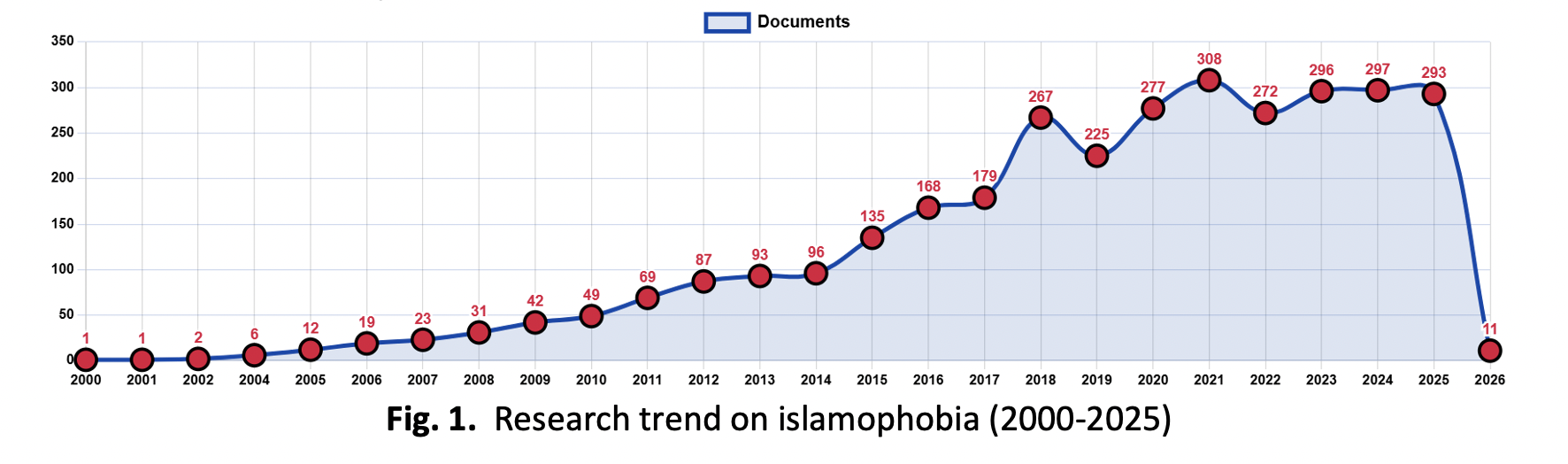
This bibliometric and science mapping study examines global research trends on Islamophobia from 2000 to 2025, analyzing publication patterns, thematic evolution, institutional contributions, authorship networks, and international collaborations using Bibliopro software. Employing comprehensive databases and advanced bibliometric techniques, the study analyzed 2,856 documents to map the intellectual landscape of Islamophobia scholarship. Findings reveal exponential growth in publications from 2010 onwards, reaching peak productivity in 2021 with 308 documents, reflecting heightened global attention to anti-Muslim discrimination following major geopolitical events and the rise of far-right populism. Keyword co-occurrence analysis demonstrates that Islamophobia research has evolved into a multidimensional field encompassing racialization frameworks, intersectional analyses, socioeconomic dimensions, digital manifestations, and comparative studies with other forms of prejudice. The United Kingdom emerged as the central hub for international collaborations, while Malaysia, through its five major universities, has established itself as a significant regional center contributing insider perspectives from Muslim-majority contexts. Leading scholars including Allen, C., Poynting, S., Abbas, T., and Awan, I. demonstrate varying strategies balancing publication volume with citation impact, with Poynting achieving the highest average citation rate (51.94 citations per document) and Allen accumulating the most total citations (895). The study identifies fragmented collaborative networks among top researchers, geographical imbalances despite growing Asian contributions, and opportunities for enhanced cross-institutional partnerships. Network visualizations reveal Islamophobia as a central conceptual node with dense connections to race, religion, discrimination, and identity, while temporal analysis shows dramatic keyword evolution with "Islamophobia" experiencing exponential growth from 52 occurrences in 2014 to 175 in 2021. This analysis provides a comprehensive overview of the field's evolution, current state, and future directions, demonstrating that Islamophobia studies have matured into a sophisticated research domain essential for understanding religious tolerance, social cohesion, and democratic pluralism in diverse societies.

Author Biography

Ramlan Mustapha, Academy of Contemporary Islamic Studies, Universiti Teknologi MARA, Kampus Raub Pahang, Malaysia

ramlan@uitm.edu.my

Downloads

Published

2026-02-16

Issue

Section

Articles