





System-Level Determinants of Chest Pain Triage Delay and the Impact of Structured Risk Stratification: A Mixed-Methods Quasi-Experimental Study in Malaysian Emergency Departments

Authors

  • Roslina Mohammad Faculty of Artificial Intelligence, Universiti Teknologi Malaysia, Kuala Lumpur 54100, Malaysia
  • Rafiziakil Mohamad Faculty of Artificial Intelligence, Universiti Teknologi Malaysia, Kuala Lumpur 54100, Malaysia
  • Mohamed Azlan Suhot Faculty of Artificial Intelligence, Universiti Teknologi Malaysia, Kuala Lumpur 54100, Malaysia

DOI:

https://doi.org/10.37934/arsbs.42.1.196206

Keywords:

Chest Pain Triage, Emergency Department Delay, Risk Stratification, Chest Pain Score, Acute Coronary Syndrome

Abstract

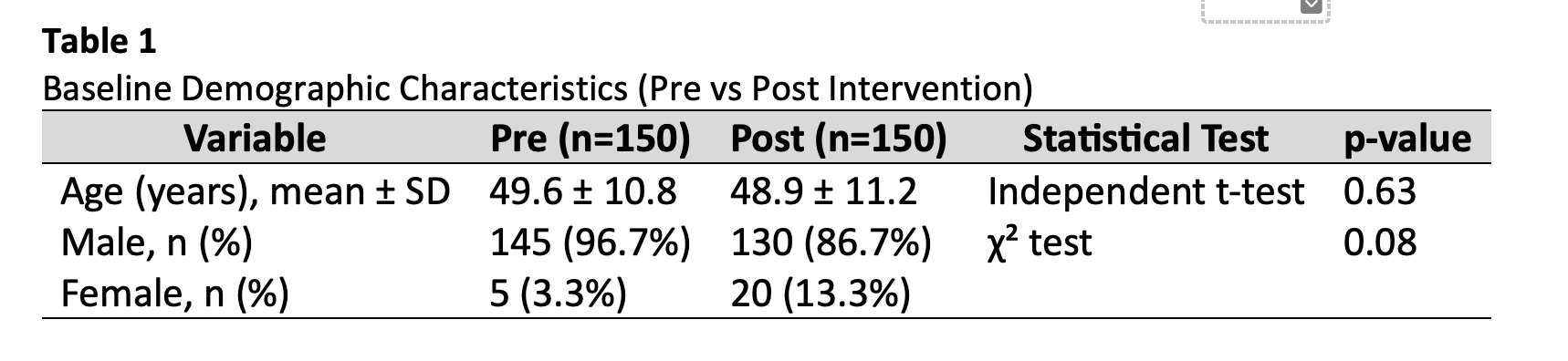
Chest pain is a high-risk presentation in Emergency Departments (EDs) that requires rapid risk stratification to prevent adverse cardiovascular outcomes. Although international guidelines recommend electrocardiogram (ECG) acquisition within 10 minutes of arrival, achieving this benchmark consistently remains challenging, particularly in resource-limited healthcare systems. Empirical data examining structural readiness and workflow determinants of triage delay in Malaysian EDs remain limited. This study aimed to identify factors contributing to delays in the triage process of chest pain patients and to evaluate the impact of implementing a structured Chest Pain Score on waiting time and prioritization accuracy. A mixed-methods quasi-experimental pre–post design was conducted in a tertiary Malaysian ED, supported by nationwide structural mapping of 21 public hospitals. A total of 300 adult patients with chest pain were included (pre-intervention n = 150; post-intervention n = 150). Quantitative outcomes included waiting time from primary to secondary triage, distribution of waiting time categories, and incidence of under-triage. Statistical analysis employed independent t-tests, chi-square tests, and effect size estimation. Qualitative data from workflow observations and semi-structured interviews were analyzed using NVivo’s thematic analysis. The baseline mean waiting time was 24.8 ± 10.6 minutes, significantly exceeding the 10-minute benchmark (p < 0.001). Structural mapping revealed that only 47.6% of hospitals had ECG access at secondary triage. Forty-three under-triage cases were documented over six months (mean 7.17 ± 2.04 per month). Following implementation of the Chest Pain Score, mean waiting time decreased to 6.3 ± 3.8 minutes (t(298) = 18.92, p < 0.001), with a very large effect size (Cohen’s d = 2.18). Post-intervention, 96.7% of patients were assessed within 14 minutes, and no patient experienced delays ≥30 minutes. Thematic analysis identified queue-based workflow design, overcrowding, staffing shortages, and cognitive overload as primary determinants of delay. These findings demonstrate that triage delay reflects multi-layered structural and operational inefficiencies rather than isolated clinical error. Embedding structured risk stratification into triage workflows significantly reduces the magnitude and variability of delays and may represent a scalable strategy to improve time-sensitive cardiovascular care in emergency systems.

Author Biography

Roslina Mohammad, Faculty of Artificial Intelligence, Universiti Teknologi Malaysia, Kuala Lumpur 54100, Malaysia

mroslina.kl@utm.my

Downloads

Published

2026-02-23

Issue

Section

Articles