Forecasting Equity Crowdfunding Performance in Malaysia: A Comparative Analysis of Holt-Winters and ARIMA Models
Keywords:
Equity Crowdfunding (ECF), Autoregressive Integrated Moving Average (ARIMA), Holt-Winters Additive Model, exponential smoothingAbstract
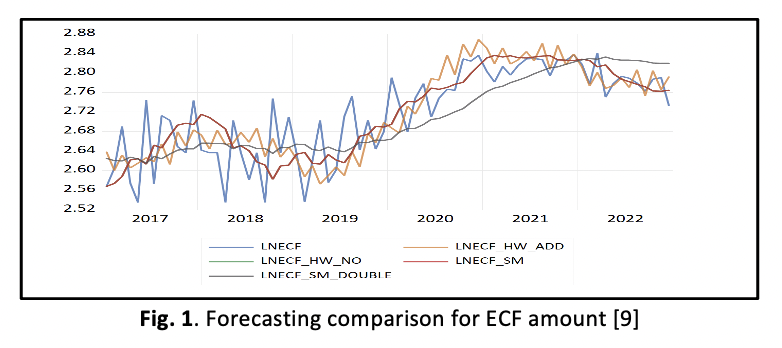
The concept of equity crowdfunding (ECF) has been seen as a potential funding platform in Malaysia especially among SMEs and startups. This alternative financing mechanism is one of the funding initiatives implemented by the government to facilitate access to capital for growing businesses. Despite its increasing significance, its future performance remains uncertain due to the dynamic nature of financial market and the changing regulatory environment. Broader macroeconomic variables such as gross domestic product (GDP), inflation rate, unemployment rate and interest rate may play an essential role in shaping the performance of the ECF. Such external factors add further uncertainty and instability within the market. Therefore, the capacity to create accurate forecasting of ECF performance is vital to predict trends in the market, risks, and assist strategic decision making for the policymakers, investors, and platform operators. In line with this need, the study aims to forecast the performance of ECF based on statistical time-series models which can be beneficial to the stakeholders. The monthly data from 2017 to 2022 were collected from the Department of Statistics Malaysia (DOSM) and Securities Commission Malaysia (SC), analysed using Holt-Winters Exponential Smoothing model and the Box-Jenkins Autoregressive Integrated Moving Average (ARIMA) method. The measure of model performance was based on Root Mean Square Error (RMSE), Mean Absolute Error (MAE), and Mean Absolute Percentage Error (MAPE). The results indicated that although Holt-Winters fit the short-term changes, ARIMA was better suited to overview changes in the systems and long-run trends, illustrating the dynamics of the crowdfunding ecosystem. These finding demonstrate the evolving role of ECF as both a financing channel and an indicator of economy changes. Therefore, this research can contribute to the theoretical knowledge while leading to a valuable application of the current findings by practitioners in policymaking, investors, and the operation of ECF platforms.