Development of A Smart Food Warmer with Real-Time Temperature and Humidity Monitoring
Keywords:
Smart food warmer, ESP32, hysteresis control, temperature and humidity, food safety, DHT22, portableAbstract
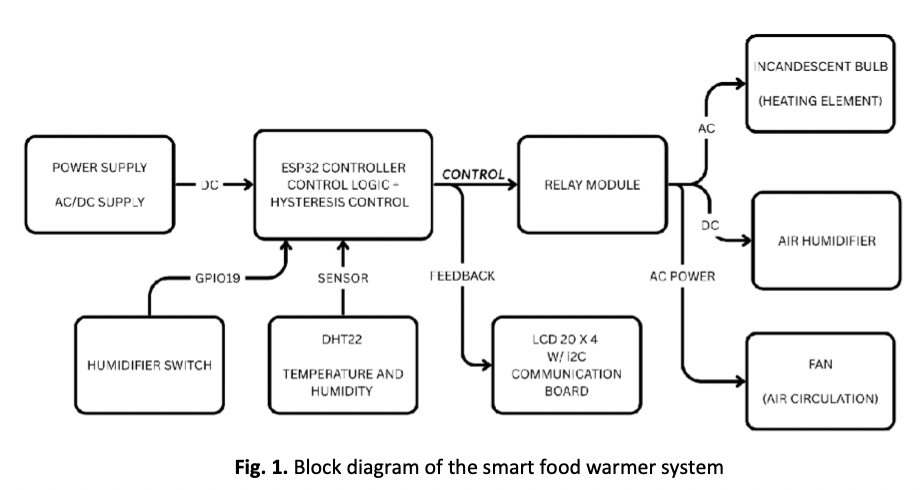
Conventional food warmers often offer limited environmental control, leading to food overheating, severe dehydration, quality degradation, and excessive energy consumption. Objective: To address these limitations, this study developed and evaluated a portable smart food warmer that automatically regulates internal temperature and relative humidity using an ESP32 microcontroller and a DHT22 sensor. Method: The closed-loop prototype was developed using the Engineering Design Process and integrated a 20×4 liquid crystal display, an incandescent bulb, a circulation fan, a humidifier module, and a manual humidity bypass switch. Results: Experimental evaluations demonstrated that the hysteresis control loop successfully maintained temperature stability within the target 55–60°C range, limiting thermal fluctuations to ±1.0-±1.5°C. The selected 300 W incandescent bulb achieved the target holding temperature of 60°C in 1 minute 15 seconds. At the same time, the humidity subsystem successfully regulated the chamber's relative humidity between 50% and 75%, with a moisture recovery time of 4 minutes 10 seconds. Energy consumption across ten tested heating-element wattages was highly comparable, ranging from 0.00567 to 0.00700 kWh per heating cycle, with the 300 W configuration consuming 0.00625 kWh. Conclusion: The findings confirm that integrating embedded systems and automated control can significantly improve food warming performance, offering a practical, reliable, and cost-effective solution that preserves food quality, protects public health, and enhances energy efficiency in real-world applications.