Indonesia and Lessons Learned from Implementing the Free Nutritious Meals Program
Keywords:
Free nutritious meals, children, malnutrition, governanceAbstract
Free Nutritious Meals (MBG) is a flagship program of the President-elect of the Republic of Indonesia, Prabowo Subianto. This program, which targets school-age children, was initiated to prevent malnutrition, which can lead to reduced height and head circumference and, in turn, affect intelligence. By 2025, the Indonesian government aims to reach 82.9 million beneficiaries, served by 9,406 Nutrition Fulfillment Service Units (SPPG). More than 1.1 billion MBG portions have been distributed as of October 2025. However, as 2025 draws to a close, several problems continue to plague the program. Cases of poisoning related to governance are believed to be one of the leading causes. This study compared programs running in Brazil, China, and Japan. The study's results show that the government must increase public participation in the program's provision, implementation, and evaluation. The goal is to ensure oversight of the process to improve children's nutrition, who are the future of the nation.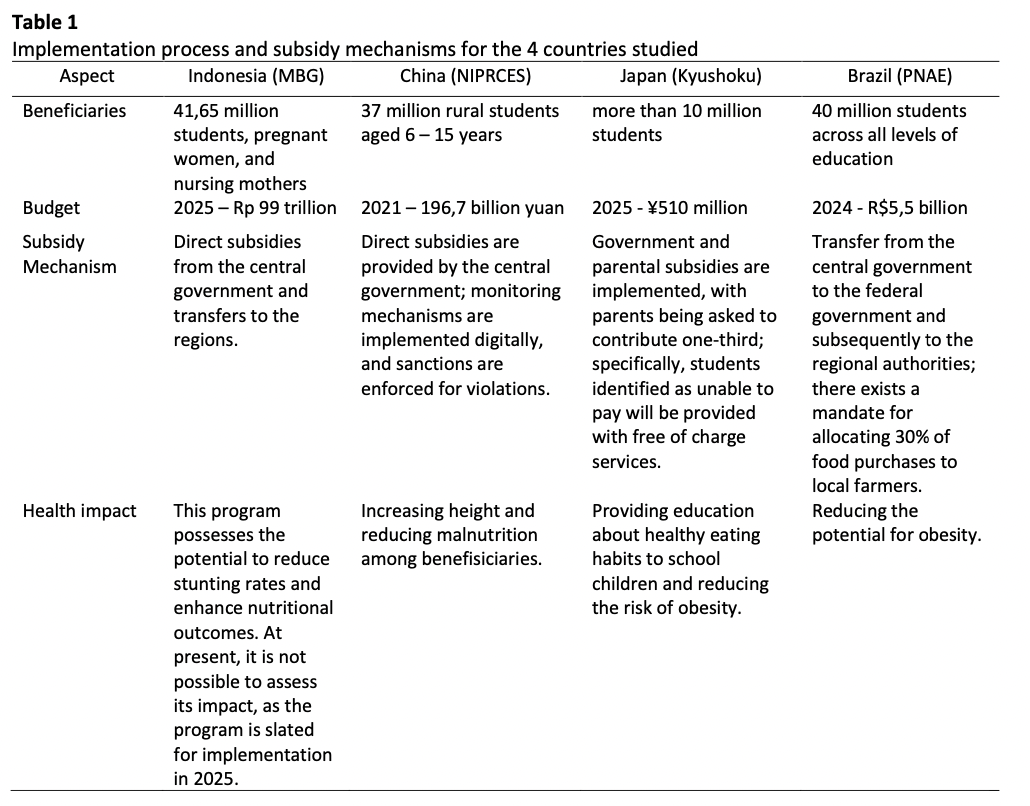
Downloads
Published
2026-02-10
How to Cite
Parikesit, B. S., Yudithadewi, D., & Yuliastanti, E. (2026). Indonesia and Lessons Learned from Implementing the Free Nutritious Meals Program. Journal of Health and Quality of Life, 9(1), 1–12. Retrieved from https://karyailham.com.my/index.php/jhqol/article/view/937
Issue
Section
Articles