Inclusive Educational Building Design for Hearing-Impaired Students
Keywords:
Inclusive education, hearing‑impaired students, sensory accessibilityAbstract
Creating inclusive educational environments is crucial for supporting hearing impaired learners. While Malaysian schools traditionally emphasize physical accessibility, sensory design elements such as lighting, acoustics, and visual communication are often implemented inconsistently. This study evaluated the inclusiveness of educational building designs by analysing key architectural and sensory features experienced by hearing-impaired users. A quantitative survey was conducted with 17 respondents who assessed five main design dimensions; spatial layout, lighting quality, acoustic comfort, visual communication aids, and accessibility and circulation. Descriptive statistics for all 20 items showed mean scores ranging from 4.05 to 4.20, indicating a generally high level of satisfaction with the inclusiveness of the built environment. Lighting quality and accessibility received the highest ratings with mean scores of 4.19 each, while higher standard deviations, particularly for visual communication aids at 1.01, revealed inconsistencies in implementation across different spaces. Correlation analysis further demonstrated that acoustic comfort strongly relates to learning ease (r = 0.68, p < 0.001), and lighting quality strongly correlates with the effectiveness of visual communication (r = 0.62, p < 0.01). These findings highlight the importance of integrating sensory-friendly features such as optimized lighting, enhanced acoustics, clear sightlines, and consistent visual support tools to enhance learner engagement and contribute to equitable inclusive educational environments aligned with Malaysia’s inclusive education goals.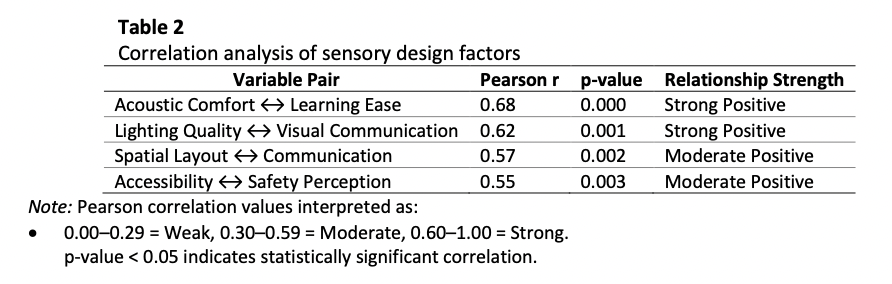
Downloads
Published
2026-02-10
How to Cite
Mahmud, S., Tuan Yaakub, N. M. I., & Che Salleh, S. (2026). Inclusive Educational Building Design for Hearing-Impaired Students. Journal of Health and Quality of Life, 9(1), 19–26. Retrieved from https://karyailham.com.my/index.php/jhqol/article/view/939
Issue
Section
Articles