A Bibliometric and Qualitative Synthesis on Climate Change and Occupational Health Research
Keywords:
Climate change, occupational health, worker vulnerability, bibliometric analysis, knowledge evolutionAbstract
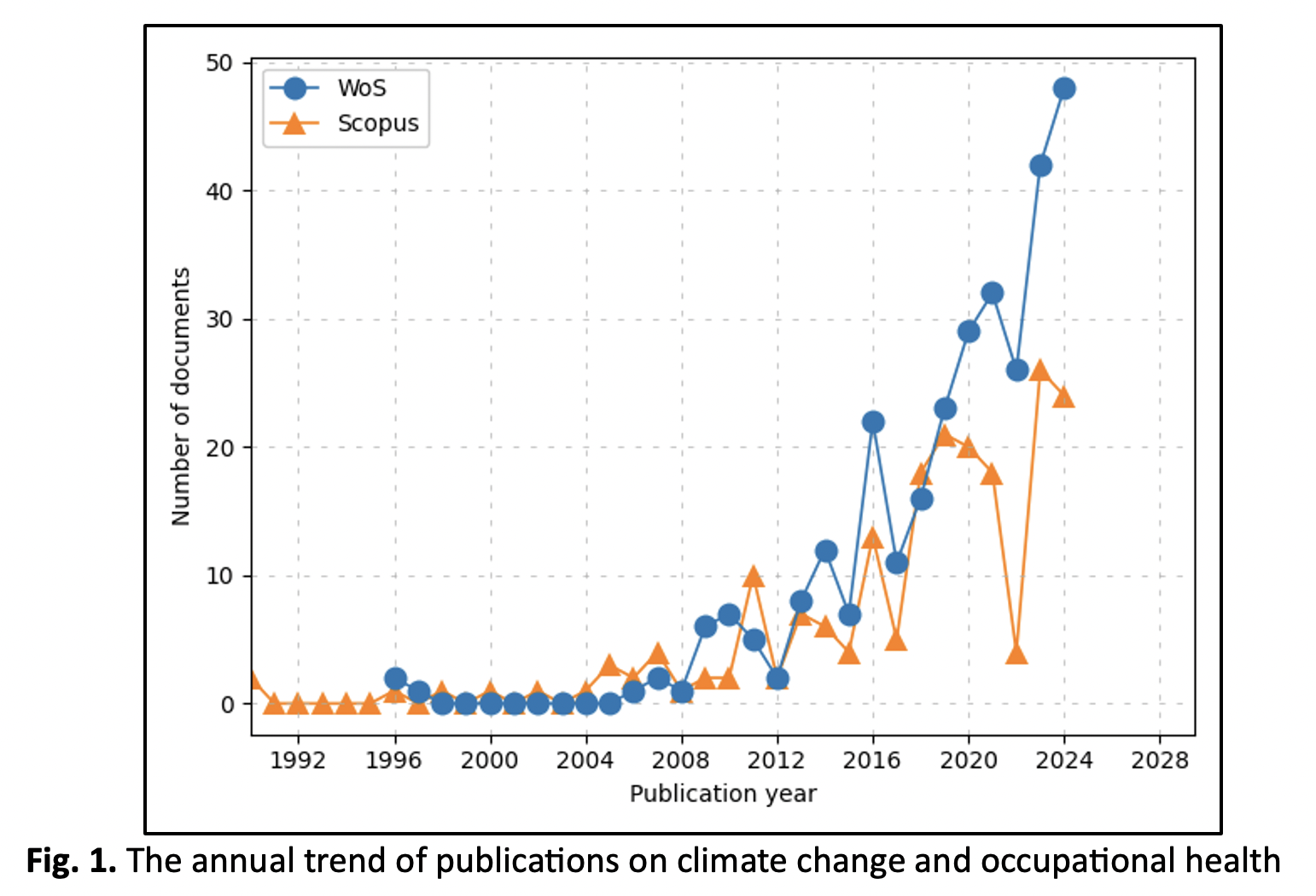
Research on climate change and occupational health has grown as climatic risks increasingly threaten workers. Despite this growth, the literature remains dispersed, and there is still limited clarity on how the field has evolved conceptually and methodologically. This study, therefore, aims to map the global trajectory of publications on climate change and occupational health while also synthesising the dominant themes and modelling practices that underpin current knowledge. This study employs an integrated approach that combines bibliometric analysis with interpretive qualitative synthesis. Publications from Scopus and the Web of Science (WoS) were retrieved using Title, Abstract, and Keyword searches, cleaned, and merged using ScientoPy, and then refined to a final dataset of 571 records. The bibliometric phase examined annual publication output, major contributing countries and institutions, keyword patterns and modelling approaches. The qualitative phase involved examining studies associated with the ten most frequent keywords and the models identified in ScientoPy’s extended results. The findings reveal a clear and sustained increase in scientific attention, with publication activity accelerating sharply after 2016 and peaking in 2024. The United States, Australia, the United Kingdom, Canada, and Italy appear to be the most active contributors, supported by several leading institutions. Heat-related terms dominate the keyword landscape, though recent years have seen growing interest in adaptation and broader environmental health concerns. The modelling review identifies Distributed Lag Non-Linear Models as the most widely used tool, supported by building simulations, human thermal models, regional climate models and socio-ecological frameworks. The current study suggests that research on climate change and occupational health is maturing. Nevertheless, the subject remains fragmented, suggesting that future studies should rely more on epidemiological, engineering, physiological, and socio-ecological insights to protect workers better as climate constraints intensify.