Design and Development Aethertrace: An AI-Powered Chat-Log Analysis for Digital Forensics Investigations
Keywords:
Digital forensics, chat-log analysis, artificial intelligence, system design and development, AetherTraceAbstract
The rapid expansion of digital communication platforms has created a massive volume of chat-log evidence that exceeds the capacity for manual forensic review. This research evaluates the efficacy of an automated framework designed to improve the efficiency of identifying suspicious communication patterns in large-scale chat datasets. The system is grounded in the Digital Forensic Process Model, which integrates machine learning directly into the investigation and analysis phases to automate evidence discovery. The study employed a quantitative experimental design using the Plagiarism Analysis, Author Identification, and Near-Duplicate Detection 2012 dataset consisting of 66,000 conversation documents. Data analysis involved a comparative evaluation of Logistic Regression, Multi-Layer Perceptron, and Bidirectional Long Short-Term Memory architectures against a 33 per cent testing split. Bidirectional Long Short-Term Memory and Logistic Regression models both achieved predictive performance for predatory behavior with F1-scores of 0.70. While all models maintained overall accuracy above 0.98, the XGBoost model exhibited significantly lower performance in identifying specific predatory cues with an F1-score of only 0.57. Conversely, XGBoost and Logistic Regression demonstrated the greatest precision in avoiding misclassification with a false positive rate of only 0.2 per cent. This research is original for its novel integration of model interpretability tools to decompose specific linguistic cues during automated forensic triage. These findings provide forensic practitioners with a scalable method to reduce investigation backlogs while maintaining the transparency required for judicial admissibility.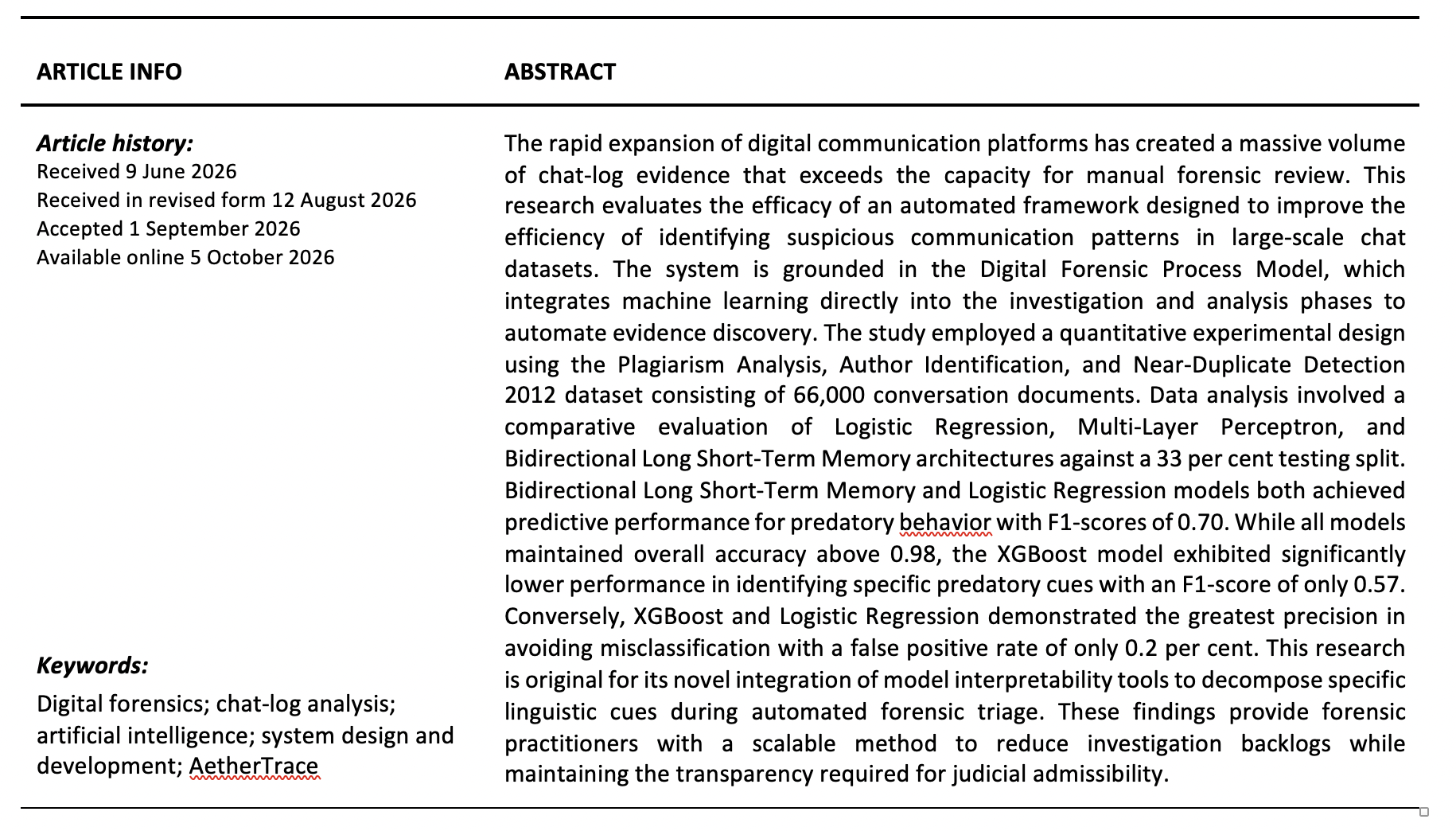
Downloads
Published
2026-10-05
How to Cite
Thivya Kumari Thorais, Nur Fasihah Mohd Esa, & Asmaa Mahfoud Hezam Al-Hakimi. (2026). Design and Development Aethertrace: An AI-Powered Chat-Log Analysis for Digital Forensics Investigations. International Journal of Advanced Research in Computational Thinking and Data Science, 10(1), 1–13. Retrieved from http://karyailham.com.my/index.php/ctds/article/view/1314
Issue
Section
Articles