Thermal and Energy Performance Analysis under Off-Design Conditions of Open Recirculating Cooling Tower at PT Petrokimia Gresik
Keywords:
Cooling tower, off-design conditions, heat duty, coefficient of performance, evaporation loss, retention time, chemical treatment, open recirculating systemAbstract
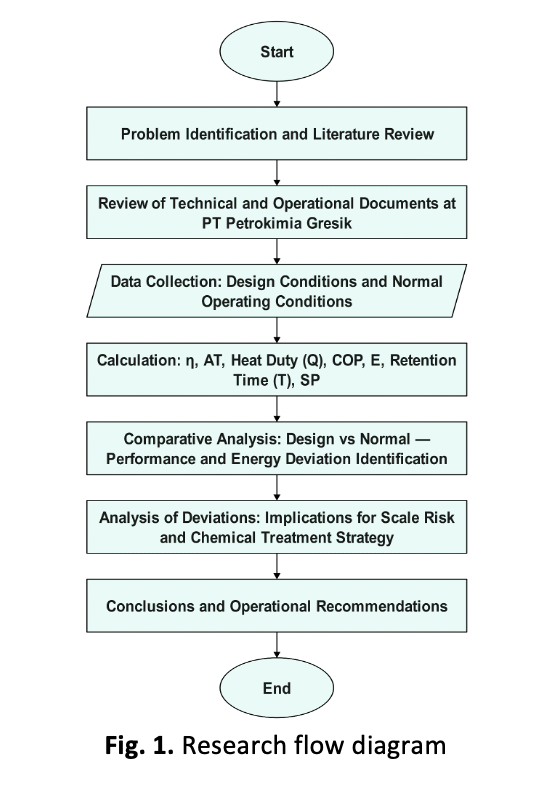
This study analyzes the deviation of normal operating conditions from design parameters in the Open Recirculating Cooling Water System at PT Petrokimia Gresik Production Unit III A, and its implications for thermal performance, energy efficiency, and water quality control strategy. Operational data were collected during a field internship in February 2026 [10]. Three cooling tower units were examined: T-6520 (5 cells, Power Generation Plant), T-6530 (4 cells, process plant), and T-6510 (2 cells, ammonium sulfate plant). Under normal operating conditions, the recirculating flow rate decreases by 16.5% for T-6520 and T-6530 (from 6,000 to 5,010 m³/hr) and by 13.3% for T-6510 (from 2,000 to 1,735 m³/hr). Although cooling efficiency remains unchanged at 76.0% and 71.4%, the total heat duty of the system decreases from 158.6 MW under design conditions to 133.2 MW under normal conditions, a difference of 25.4 MW. The coefficient of performance decreases proportionally: T-6520 from 47.6 to 39.7 (a reduction of 16.5%) and T-6530 from 52.8 to 44.1 (a reduction of 16.5%), despite no change in electrical power consumption. The evaporation loss formula applied in field practice at PT Petrokimia Gresik yields a coefficient approximately 2.1 times greater than the standard ASHRAE formula, reflecting the higher relative humidity of Indonesia's tropical climate. Retention time increases under normal conditions, with T-6520 rising from 53 to 63 hours (an increase of 18.9%) and T-6530 from 69 to 83 hours (an increase of 20.3%), indicating elevated risks of CaCO₃ scale formation and biofilm growth, thereby confirming the need to maintain a consistent chemical treatment program.