The Effectiveness of Implementing the Timed Pair Share Strategy (TmPS) on Active Teacher and Student Engagement in the Teaching and Learning (Pdpc) Process
Keywords:
Timed Pair Share, active engagement, student participation, cooperative learning, secondary school educationAbstract
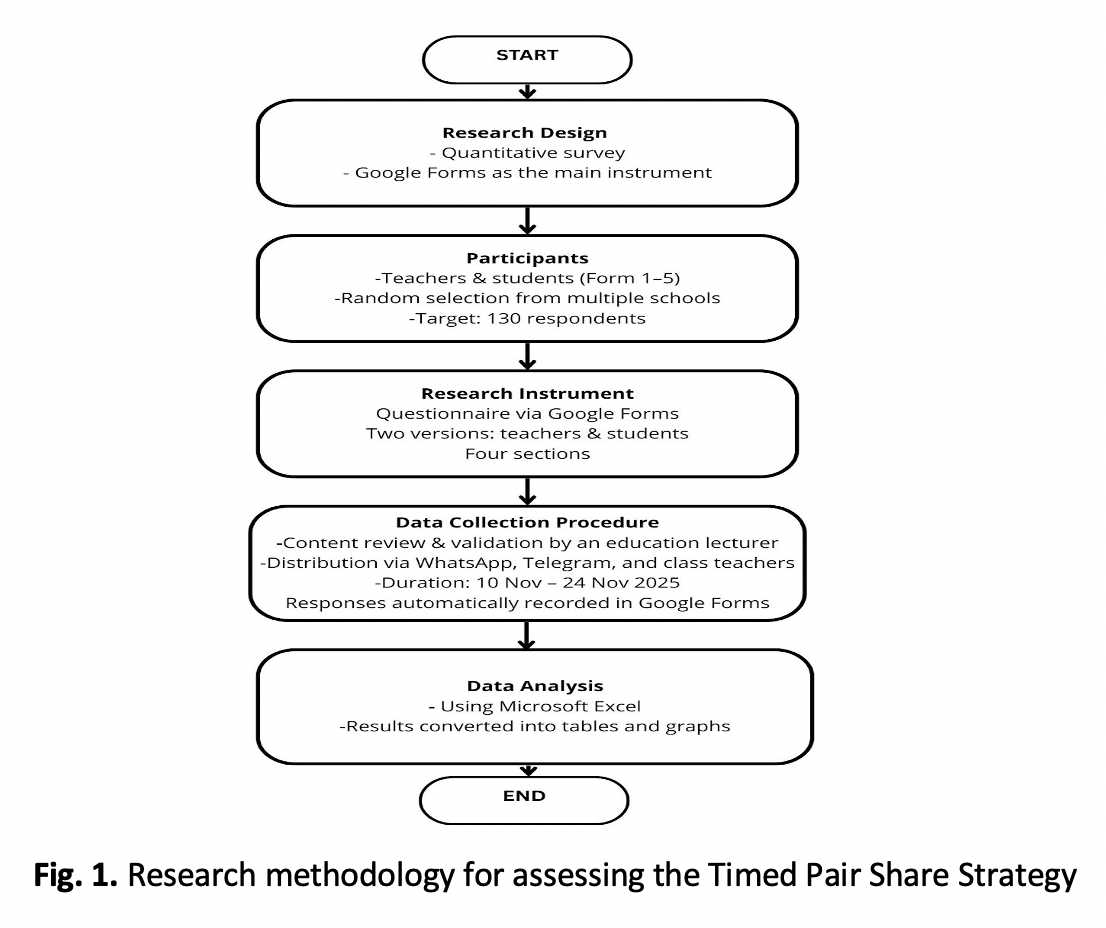
This study investigates the effectiveness of the Timed Pair Share strategy (TmPS), a cooperative learning approach designed to enhance students’ active engagement through structured partner discussions. While cooperative learning is recognised for improving interaction and critical thinking, limited research has explored the specific impact of TmPS in authentic classroom settings. The study examines students’ engagement levels before and after implementation, assesses its effectiveness in promoting active participation among teachers and students, and identifies challenges such as time constraints, unequal proficiency, and inconsistent application. A quantitative survey of 130 secondary school teachers and students was conducted, with data analysed descriptively using tables and graphs. The results show that before implementing TmPS, 70% teachers agreed that few students actively responded, while 64% reported limited attention, and 62% noted low interest in group work. After implementation, 68% students agreed it improved their self-confidence, while 59% students agreed TmPS facilitated their understanding, and only 36% students agreed that earlier lessons were boring, indicating that pre-intervention learning was acceptable but not interactive. After implementation, engagement improved, with 62% teachers agreeing that the strategy enhanced assessment, while 58% confirmed better time management, and 53% agreed that it made PdpC student-centred easier. Students also affirmed its impact, with 77% students reporting increased focus and 70% students indicating increased motivation, while only 66% students said TmPS was helpful. Overall, TmPS effectively improved engagement. Despite these gains, challenges remained. 68% teachers agreed that TmPS required careful time management, 62% teachers reported that some students relied too much on their partners, and 51% teachers agreed that students took a longer time to respond. Among students, 57% agreed that discussion time was insufficient, 52% struggled with generating ideas, and only 29% reported difficulty collaborating. The findings indicate that TmPS effectively enhances student engagement, interaction, and communication when implemented with careful planning and monitoring. Its success relies on strategic pairing, effective time allocation, and teacher facilitation to ensure balanced participation. Despite challenges, TmPS promotes student-centred learning and meaningful dialogue, supporting both confidence and active involvement in the teaching and learning process.