Development of Energy Monitoring System for Container-Type Plant Factory
DOI:
https://doi.org/10.37934/progee.32.1.19Keywords:
Energy monitoring, Plant Factory, IoTAbstract
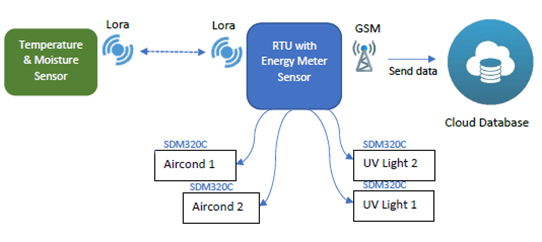
This paper presents the development of an intelligent, web-based energy monitoring system for container-type plant factories, aimed at optimising energy consumption and promoting sustainability in controlled-environment agriculture. The system integrates the Internet of Things (IoT) and Industry 4.0 technologies to provide real-time energy monitoring and control across subsystems such as lighting, climate control, and irrigation. A comparative analysis of the sensor-based system and a fixed control strategy showed that the sensor-based system significantly reduced energy consumption, achieving savings of approximately 1.27 kWh/day without compromising thermal comfort. Statistical analysis revealed a mean energy consumption of 7.41 kWh for the sensor-based system, compared to 8.68 kWh for the fixed system, indicating higher efficiency and flexibility. Economic evaluation demonstrates the financial viability of the system, with an estimated payback period of 4.3 years and a return on investment (ROI) of 131% over a 10-year period. This positions the system as a cost-effective solution for small to medium-scale plant factories, supporting broader sustainability goals by reducing operational costs and carbon footprints, in alignment with the Energy Efficiency and Conservation Act (EECA) 2024. The system also incorporates robust reliability and security features, including redundancy in key components, automated fault diagnosis, and end-to-end encryption, ensuring long-term operational stability. This study highlights the potential of IoT-enabled energy monitoring to enhance sustainability in agriculture, providing a scalable, economically feasible solution for the future of food production. Future work will focus on integrating renewable energy sources and predictive analytics to further optimise energy management.
References
[1] F. Shrouf, J. Ordieres, and G. Miragliotta, Smart factories in Industry 4.0: A Review of the Concept and of Energy Management Approached in Production based on the Internet of Things Paradigm, in: 2014 IEEE International Conference on Industrial Engineering and Engineering Management, IEEE, 2014: pp. 697–701. https://doi.org/10.1109/ieem.2014.7058728.
[2] P. Pawar, and P. Vittal K, Design and Development of Advanced Smart Energy Management System Integrated with IoT Framework in Smart Grid Environment. Journal of Energy Storage 25 (2019) 100846. https://doi.org/10.1016/j.est.2019.100846.
[3] J.C. Kabugo, S.-L. Jämsä-Jounela, R. Schiemann, and C. Binder, Industry 4.0 Based Process Data Analytics Platform: A Waste-to-Energy Plant Case Study. International Journal of Electrical Power & Energy Systems 115 (2020) 105508. https://doi.org/10.1016/j.ijepes.2019.105508.
[4] L. Tang, and Y. Meng, Data Analytics and Optimization for Smart Industry. Frontiers of Engineering Management 8 (2021) 157–171. https://doi.org/10.1007/s42524-020-0126-0.
[5] M. Wei, S.H. Hong, and M. Alam, An IoT-Based Energy-Management Platform for Industrial Facilities. Applied Energy 164 (2016) 607–619. https://doi.org/10.1016/j.apenergy.2015.11.107.
[6] Y. Wu, H.-N. Dai, H. Wang, Z. Xiong, and S. Guo, A Survey of Intelligent Network Slicing Management for Industrial IoT: Integrated Approaches for Smart Transportation, Smart Energy, and Smart Factory. IEEE Communications Surveys & Tutorials 24 (2022) 1175–1211. https://doi.org/10.1109/comst.2022.3158270.
[7] J. Wan, B. Chen, S. Wang, M. Xia, D. Li, and C. Liu, Fog Computing for Energy-Aware Load Balancing and Scheduling in Smart Factory. IEEE Transactions on Industrial Informatics 14 (2018) 4548–4556. https://doi.org/10.1109/tii.2018.2818932.
[8] S.K. Rathor, and D. Saxena, Energy Management System for Smart Grid: An Overview and Key Issues. International Journal of Energy Research 44 (2020) 4067–4109. https://doi.org/10.1002/er.4883.
[9] H. Shahinzadeh, J. Moradi, G.B. Gharehpetian, H. Nafisi, and M. Abedi, Internet of Energy (IoE) in Smart Power Systems, in: 2019 5th Conference on Knowledge Based Engineering and Innovation (KBEI), IEEE, 2019. https://doi.org/10.1109/kbei.2019.8735086.
[10] N. Mohamed, J. Al-Jaroodi, and S. Lazarova-Molnar, Leveraging the Capabilities of Industry 4.0 for Improving Energy Efficiency in Smart Factories. IEEE Access: Practical Innovations, Open Solutions 7 (2019) 1–1. https://doi.org/10.1109/access.2019.2897045.
[11] V. Kumar, K.V. Sharma, N. Kedam, A. Patel, T.R. Kate, and U. Rathnayake, A Comprehensive Review on Smart and Sustainable Agriculture Using IoT Technologies. Smart Agricultural Technology 8 (2024) 100487. https://doi.org/10.1016/j.atech.2024.100487.
Downloads
Published
Issue
Section
License
Copyright (c) 2026 Progress in Energy and Environment

This work is licensed under a Creative Commons Attribution-NonCommercial 4.0 International License.