Electrocoagulation Technology for Oil Removal in Food Wastewater: Research Trends and Patent Landscape Analysis
Keywords:
Electrocoagulation, Oil-water Separation, Food Industry, Wastewater Treatment, Pollutant RemovalAbstract
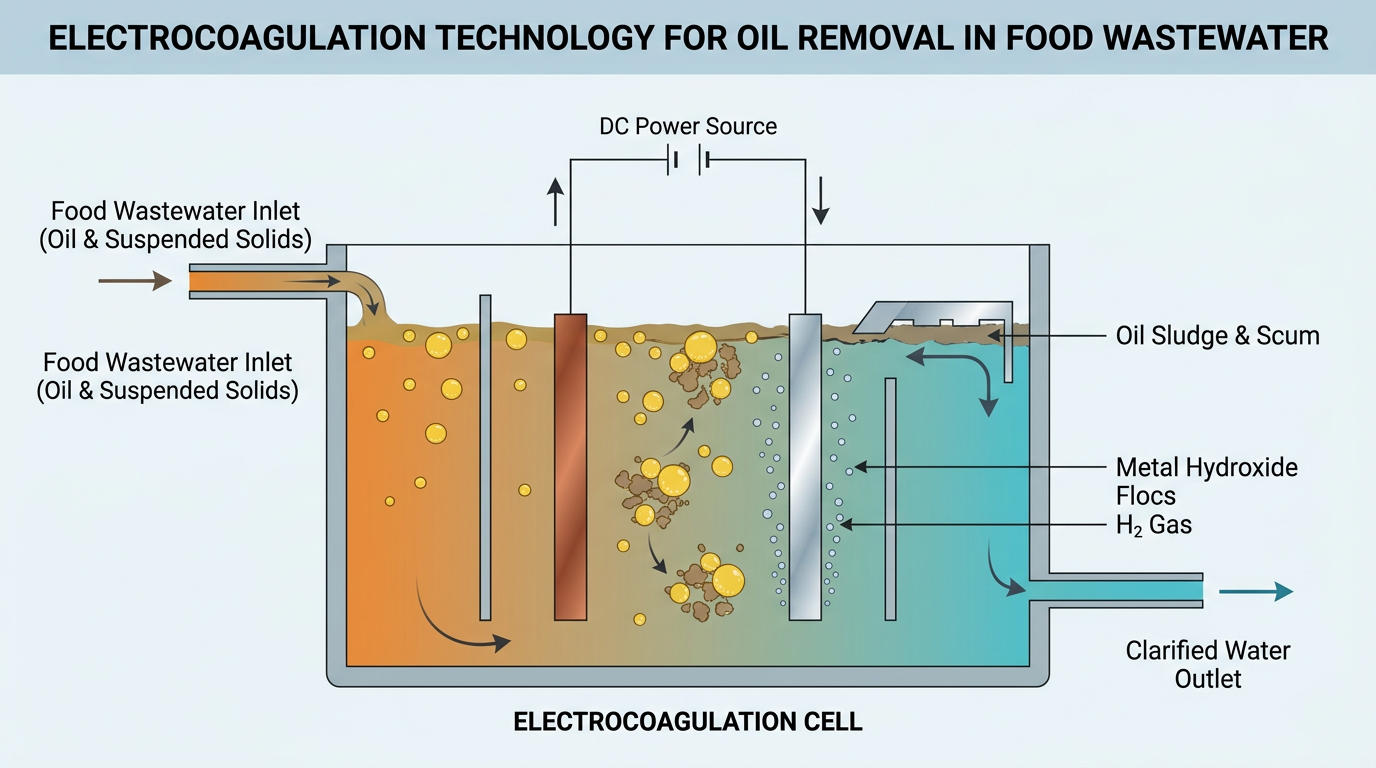
The increasing demand for edible oils in food processing has resulted in substantial oily wastewater generation, posing challenges to global water security. This review examines electrocoagulation technology for treating oil pollutants in food industry wastewater through analysis of peer-reviewed journal articles and a broader patent landscape analysis across all industrial sectors. Electrocoagulation generally achieved high oil removal efficiency across the reviewed studies, though COD removal performance was more variable, indicating strong effectiveness for oil separation but inconsistent overall organic load reduction. Literature analysis revealed that key operational parameters include electrode material, electrolysis time, pH, supporting electrolyte concentration, applied voltage, and initial oil concentration. Patent analysis revealed a growing commercial interest, with the United States leading, followed by international patent applications (via the World Intellectual Property Organisation, WIPO) and China. Patent trends show a steady growth from 2017 onwards. Several challenges including electrode passivation, energy consumption, and by-product/sludge management, which limit widespread applications need to be addressed. Recommendations to enhance commercial viability include integration of not only renewable energy and Artificial Intelligence (AI) for energy optimisation but also life cycle assessments/life cycle cost analysis to objectively evaluate environmental and economic impacts and sludge valorisation for circular economy applications. This is to bridge laboratory research and commercial implementation for sustainable food wastewater treatment.
References
[1] MarketsandMarkets, Edible Oils Market Worth $268.9 Billion by 2027 - Exclusive Report by MarketsandMarketsTM. Cision PR Newswire (2023). https://www.prnewswire.com/news-releases/edible-oils-market-worth-268-9-billion-by-2027--exclusive-report-by-marketsandmarkets-301752780.html (accessed 13 May 2026).
[2] D. Robinson, Water Pollution: Causes and Solutions. Earth.org (2022). https://earth.org/what-are-the-causes-of-water-pollution/ (accessed 4 May 2026).
[3] J. Ma, X. Fu, W. Xia, R. Zhang, K. Fu, G. Wu, B. Jia, S. Li, and J. Li, Removal of Emulsified Oil from Water by Using Recyclable Chitosan Based Covalently Bonded Composite Magnetic Flocculant: Performance and Mechanism. Journal of Hazardous Materials 419 (2021) 126529. https://doi.org/10.1016/j.jhazmat.2021.126529.
[4] E. Yonguep, K.F. Kapiamba, K.J. Kabamba, and M. Chowdhury, Formation, Stabilization and Chemical Demulsification of Crude Oil-in-Water Emulsions: A Review. Petroleum Research 7 (2022) 459–472. https://doi.org/10.1016/j.ptlrs.2022.01.007.
[5] A. Genc, and B. Bakirci, Destabilization and Treatment of Emulsified Oils in Wastewaters by Electrocoagulation. Water Environment Research: A Research Publication of the Water Environment Federation 88 (2016) 2008–2014. https://doi.org/10.2175/106143016X14733681695203.
[6] A. Kadier, Z. Al-Qodah, G.K. Akkaya, D. Song, J.M. Peralta-Hernández, J.-Y. Wang, C. Phalakornkule, M. Bajpai, N.M. Niza, V. Gilhotra, M.E. Bote, Q. Ma, C.C. Obi, and C.A. Igwegbe, A State-of-the-Art Review on Electrocoagulation (EC): An Efficient, Emerging, and Green Technology for Oil Elimination from Oil and Gas Industrial Wastewater Streams. Case Studies in Chemical and Environmental Engineering 6 (2022) 100274. https://doi.org/10.1016/j.cscee.2022.100274.
[7] D. Syam Babu, T.S. Anantha Singh, P.V. Nidheesh, and M. Suresh Kumar, Industrial Wastewater Treatment by Electrocoagulation Process. Separation Science and Technology 55 (2020) 3195–3227. https://doi.org/10.1080/01496395.2019.1671866.
[8] N. Chawaloesphosiya, J. Mongkolnauwarat, C. Prommajun, K. Wongwailikhit, and P. Painmanakul, Treatment of Cutting-Oily Wastewater by Electrocoagulation-Flotation (ECF) Process: Modeling Approach. Environmental Engineering Research 20 (2015) 392–396. https://doi.org/10.4491/eer.2015.085.
[9] A. Shokri, and M.S. Fard, A Critical Review in Electrocoagulation Technology Applied for Oil Removal in Industrial Wastewater. Chemosphere 288 (2022) 132355. https://doi.org/10.1016/j.chemosphere.2021.132355.
[10] M.A. Jasim, and F. Yasir Al Jaberi, Treatment of Oily Wastewater by Electrocoagulation Technology: A General Review (2018-2022): Review Paper. Journal of Electrochemical Science and Engineering 13(2) (2022) 361–372. https://doi.org/10.5599/jese.1472.
[11] H. Muvel, M.K. Jindal, P.K. Tewari, and V. Anand, Advancements in Electrocoagulation for Oily Wastewater Treatment: Mechanisms, Efficiency, and Applications. Journal of Water Process Engineering 68 (2024) 106291. https://doi.org/10.1016/j.jwpe.2024.106291.
[12] P. Drogui, M. Asselin, S.K. Brar, H. Benmoussa, and J.-F. Blais, Electrochemical Removal of Pollutants from Agro-Industry Wastewaters. Separation and Purification Technology 61 (2008) 301–310. https://doi.org/10.1016/j.seppur.2007.10.013.
[13] M. Kobya, and S. Delipinar, Treatment of the Baker’s Yeast Wastewater by Electrocoagulation. Journal of Hazardous Materials 154 (2008) 1133–1140. https://doi.org/10.1016/j.jhazmat.2007.11.019.
[14] W. Qasim, and A.V. Mane, Characterization and Treatment of Selected Food Industrial Effluents by Coagulation and Adsorption Techniques. Water Resources and Industry 4 (2013) 1–12. https://doi.org/10.1016/j.wri.2013.09.005.
[15] R. Sridhar, V. Sivakumar, J. Prakash Maran, and K. Thirugnanasambandham, Influence of Operating Parameters on Treatment of Egg Processing Effluent by Electrocoagulation Process. International Journal of Environmental Science and Technology 11 (2014) 1619–1630. https://doi.org/10.1007/s13762-013-0301-5.
[16] M. Ji, X. Jiang, and F. Wang, A Mechanistic Approach and Response Surface Optimization of the Removal of Oil and Grease from Restaurant Wastewater by Electrocoagulation and Electroflotation. Desalination and Water Treatment 55 (2015) 2044–2052. https://doi.org/10.1080/19443994.2014.929034.
[17] H. Ates, N. Dizge, and H.C. Yatmaz, Combined Process of Electrocoagulation and Photocatalytic Degradation for the Treatment of Olive Washing Wastewater. Water Science and Technology: A Journal of the International Association on Water Pollution Research 75 (2017) 141–154. https://doi.org/10.2166/wst.2016.498.
[18] A. Mirshafiee, A. Rezaee, and R.S. Mamoory, A Clean Production Process for Edible Oil Removal from Wastewater Using an Electroflotation with Horizontal Arrangement of Mesh Electrodes. Journal of Cleaner Production 198 (2018) 71–79. https://doi.org/10.1016/j.jclepro.2018.06.201.
[19] K. Sardari, J. Askegaard, Y.-H. Chiao, S. Darvishmanesh, M. Kamaz, and S.R. Wickramasinghe, Electrocoagulation Followed by Ultrafiltration for Treating Poultry Processing Wastewater. Journal of Environmental Chemical Engineering 6 (2018) 4937–4944. https://doi.org/10.1016/j.jece.2018.07.022.
[20] G. Varank, S. Yazici Guvenc, and A. Demir, A Comparative Study of Electrocoagulation and Electro-Fenton for Food Industry Wastewater Treatment: Multiple Response Optimization and Cost Analysis. Separation Science and Technology 53 (2018) 2727–2740. https://doi.org/10.1080/01496395.2018.1470643.
[21] S. Veli, L. Ozbay, B. Ozbay, A. Arslan, and E. Cebi, Optimization of Process Variables for Treatment of Food Industry Effluents by Electrocoagulation. Global NEST Journal 20 (2018) 551–557. https://doi.org/10.30955/gnj.002640.
[22] S. Yılmaz, E.E. Gerek, Y. Yavuz, and A.S. Koparal, Treatment of Vinegar Industry Wastewater by Electrocoagulation with Monopolar Aluminum and Iron Electrodes and Toxicity Evaluation. Water Science and Technology: A Journal of the International Association on Water Pollution Research 78 (2018) 2542–2552. https://doi.org/10.2166/wst.2019.013.
[23] R. Niazmand, M. Jahani, and S. Kalantarian, Treatment of Olive Processing Wastewater by Electrocoagulation: An Effectiveness and Economic Assessment. Journal of Environmental Management 248 (2019) 109262. https://doi.org/10.1016/j.jenvman.2019.109262.
[24] A. Temitope Adegoke, and E. Temitayo Abayomi, A Preliminary Study on the Treatment of Restaurant Wastewater Using Electrocoagulation Technique. Journal of Degraded and Mining Lands Management 7 (2020) 2029–2033. https://doi.org/10.15243/jdmlm.2020.072.2029.
[25] K. H. El-Ezaby, M. I. El-Gammal, A. Y. Shaaban, Electrocoagulation treatment for wastewaters from some restaurants in New Damietta City-Egypt, Journal of Environmental Sciences, 49 (2020) 87–98. https://doi.org/10.21608/joese.2020.177139
[26] Y.D. Shahamat, M.R. Khani, H. Mahdizadeh, K. Kannan, L.R. Kalankesh, B. Kamarehei, and M.M. Baneshi, Olive Mill Wastewater (Omw) Treatment by Hybrid Processes of Electrocoagulation/Catalytic Ozonation and Biodegradation. Environmental Engineering and Management Journal 19 (2020) 1401–1410. https://doi.org/10.30638/eemj.2020.130.
[27] P.V. Ngobeni, L. Gutu, M. Basitere, T. Harding, and D. Ikumi, Poultry Slaughterhouse Wastewater Treatment Using an Integrated Biological and Electrocoagulation Treatment System: Process Optimisation Using Response Surface Methodology. Sustainability 14 (2022) 9561. https://doi.org/10.3390/su14159561.
[28] M. C. Potrich, E. D. S. A. Duarte, M. D. S. Sikora, R. D. Costa da Rocha, Electrocoagulation for nutrients removal in the slaughterhouse wastewater: comparison between iron and aluminum electrodes treatment, Environmental Technology 43 (2022) 751–765. https://doi.org/10.1080/09593330.2020.1804464.
[29] M.C. Potrich, E. de S.A. Duarte, M. de S. Sikora, and R.D. Costa da Rocha, Electrocoagulation for Nutrients Removal in the Slaughterhouse Wastewater: Comparison between Iron and Aluminum Electrodes Treatment. Environmental Technology 43 (2022) 751–765. https://doi.org/10.1080/09593330.2020.1804464.
[30] S. Elia, M. Stylianou, and A. Agapiou, Combined EC/EO Processes for Treating Goat Cheese Whey Wastewater. Sustainable Chemistry and Pharmacy 32 (2023) 100963. https://doi.org/10.1016/j.scp.2022.100963.
[31] A. Şen, C. Akarsu, Z. Bilici, H. Arslan, and N. Dizge, Treatment of Tomato Paste Wastewater by Electrochemical and Membrane Processes: Process Optimization and Cost Calculation. Water Science and Technology: A Journal of the International Association on Water Pollution Research 89 (2024) 1879–1890. https://doi.org/10.2166/wst.2024.079.
[32] J.A.L. Soo, N.F. Shoparwe, L.S. Tan, P.L. Kiew, A.K. Nurulbahiyah, and Y.F. Yeong, Electrochemical and Kinetic Insights into Waste Cooking Oil Removal via Electrocoagulation: Parameter Interactions and Mechanism Elucidation. International Journal of Environmental Science and Technology 22 (2025) 12295–12306. https://doi.org/10.1007/s13762-025-06428-y.
[33] C. An, G. Huang, Y. Yao, and S. Zhao, Emerging Usage of Electrocoagulation Technology for Oil Removal from Wastewater: A Review. The Science of the Total Environment 579 (2017) 537–556. https://doi.org/10.1016/j.scitotenv.2016.11.062.
[34] H. Asgharnejad, E. Khorshidi Nazloo, M. Madani Larijani, N. Hajinajaf, and H. Rashidi, Comprehensive Review of Water Management and Wastewater Treatment in Food Processing Industries in the Framework of Water-Food-Environment Nexus. Comprehensive Reviews in Food Science and Food Safety 20 (2021) 4779–4815. https://doi.org/10.1111/1541-4337.12782.
[35] A.Y. Kilany, S.A. Nosier, M. Hussein, M.H. Abdel-Aziz, and G.H. Sedahmed, Combined Oil Demulsification and Copper Removal from Copper Plating Plant Effluents by Electrocoagulation in a New Cell Design. Separation and Purification Technology 248 (2020) 117056. https://doi.org/10.1016/j.seppur.2020.117056.
[36] R. Daghrir, P. Drogui, J. François Blais, and G. Mercier, Hybrid Process Combining Electrocoagulation and Electro-Oxidation Processes for the Treatment of Restaurant Wastewaters. Journal of Environmental Engineering 138 (2012) 1146–1156. https://doi.org/10.1061/(asce)ee.1943-7870.0000579.
[37] T.J. Mohammed, and H.A. Al-Zuheri, Enhancing Oily Wastewater Treatment in Petroleum Industry Using Magnetite Nanoparticles. Arabian Journal for Science and Engineering 45 (2020) 7573–7585. https://doi.org/10.1007/s13369-020-04713-1.
[38] P.P. Das, Anweshan, and M.K. Purkait, Treatment of Cold Rolling Mill (CRM) Effluent of Steel Industry. Separation and Purification Technology 274 (2021) 119083. https://doi.org/10.1016/j.seppur.2021.119083.
[39] O. Chavalparit, and M. Ongwandee, Optimizing Electrocoagulation Process for the Treatment of Biodiesel Wastewater Using Response Surface Methodology. Journal of Environmental Sciences (China) 21 (2009) 1491–1496. https://doi.org/10.1016/s1001-0742(08)62445-6.
[40] A. Aitbara, M. Cherifi, S. Hazourli, and J.-P. Leclerc, Continuous Treatment of Industrial Dairy Effluent by Electrocoagulation Using Aluminum Electrodes. Desalination and Water Treatment 57 (2016) 3395–3404. https://doi.org/10.1080/19443994.2014.989411.
[41] M. Afsharnia, and M. Saeidi, Evaluating the Effectiveness of Electrocoagulation (EC) Process in Reducing the COD of Simulated Urban Runoffs. International Journal of Electrochemical Science 13 (2018) 5172–5183. https://doi.org/10.20964/2018.06.08.
[42] P. Mahammedrafi, An experimental study of electrocoagulation process applied for influence of fluoride ions on hardness removal, International Journal of Engineering Research and Application 8 (2018) 33–38. https://www.ijera.com/papers/Vol8_issue2/Part-1/F0802013338.pdf .
[43] T. Shahriari, and B. Saeb, Assessment of Effective Operational Parameters on Dyeing Wastewater Treatment by Electrocoagulation Process. Pollution 3(3) (2017) 517–526.
[44] H. Setyawati, D. Galuh, and E. Yunita, Effect of Electrode Distance and Voltage on CR, COD, and TSS Reduction in Waste Water Tanning Industry using Electrocoagulator Batch. Journal of Sustainable Technology and Applied Science 2 (2021) 24–30. https://doi.org/10.36040/jstas.v2i1.3574.
[45] S.G. da Cruz, A.J.B. Dutra, and M.B.M. Monte, The Influence of Some Parameters on Bubble Average Diameter in an Electroflotation Cell by Laser Diffraction Method. Journal of Environmental Chemical Engineering 4 (2016) 3681–3687. https://doi.org/10.1016/j.jece.2016.05.017.
[46] D. Ankoliya, A. Mudgal, M.K. Sinha, V. Patel, and J. Patel, Application of Electrocoagulation Process for the Treatment of Dairy Wastewater: A Mini Review. Materials Today: Proceedings 77 (2023) 117–124. https://doi.org/10.1016/j.matpr.2022.10.254.
[47] S.O.A. Nassar, M.S. Yusoff, H. Halim, N.H. Mokhtar Kamal, M.J.K. Bashir, T.S.B.A. Manan, H.A. Aziz, and A. Mojiri, Ultrasonic (US)-Assisted Electrocoagulation (EC) Process for Oil and Grease (O&G) Removal from Restaurant Wastewater. Separations 10 (2023) 61. https://doi.org/10.3390/separations10010061.
[48] M. Masthura, The Effect of Applied Voltage in the Electrocoagulation Process of Reducing Pond and River Water Turbidity. Elkawnie: Journal of Islamic Science and Technology 6 (2020) 156. https://doi.org/10.22373/ekw.v6i1.5538.
[49] Electrochemical Disinfection. E2METRIX PFAS Solutions | Onsite PFAS Destruction (2025). https://e2metrix.com/products-solutions/ecothor/ (accessed 4 May 2026).
[50] Muddy Rivers Technologies Inc., Amprey, n.d. https://muddyriver.ca/solutions/amprey/ (accessed April 27, 2025)
[51] A. Xu, Y.-H. Wu, Z. Chen, G. Wu, Q. Wu, F. Ling, W.E. Huang, and H.-Y. Hu, Towards the New Era of Wastewater Treatment of China: Development History, Current Status, and Future Directions. Water Cycle 1 (2020) 80–87. https://doi.org/10.1016/j.watcyc.2020.06.004.
[52] A. Soo, and H.K. Shon, A Nutrient Circular Economy Framework for Wastewater Treatment Plants. Desalination 592 (2024) 118090. https://doi.org/10.1016/j.desal.2024.118090.
[53] F. Fotovat, and M. Hosseini, Treatment of Oily Wastewater by Electrocoagulation: Simultaneous Optimization of Oil Removal Efficiency and Specific Energy Consumption. Journal of Water Process Engineering 55 (2023) 104221. https://doi.org/10.1016/j.jwpe.2023.104221.
[54] A.Y. Çetinkaya, Integration of Electrocoagulation and Solar Energy for Sustainable Wastewater Treatment: A Thermodynamic and Life Cycle Assessment Study. Environmental Monitoring and Assessment 197 (2025) 224. https://doi.org/10.1007/s10661-025-13662-x.
[55] T.M. Olatunde, A.C. Okwandu, D.O. Akande, and Z.Q. Sikhakhane, Reviewing the Role of Artificial Intelligence in Energy Efficiency Optimization. Engineering Science & Technology Journal 5 (2024) 1243–1256. https://doi.org/10.51594/estj.v5i4.1015.
[56] Z. Mao, X. Li, X. Zhang, D. Li, J. Lu, J. Li, and F. Zheng, Optimization of Effluent Quality and Energy Consumption of Aeration Process in Wastewater Treatment Plants Using Artificial Intelligence. Journal of Water Process Engineering 63 (2024) 105384. https://doi.org/10.1016/j.jwpe.2024.105384.
[57] P. Patel, S. Gupta, and P. Mondal, Life Cycle Assessment (LCA) of Greywater Treatment Using ZnCl2 Impregnated Activated Carbon and Electrocoagulation Processes: A Comparative Study. Industrial & Engineering Chemistry Research 62 (2023) 3259–3270. https://doi.org/10.1021/acs.iecr.2c03353.
[58] S. Uludag-Demirer, N. Olson, R. Ives, J. P. Nshimyimana, C. A. Rusinek, J. B. Rose, W. Liao, Techno-Economic Analysis of Electrocoagulation on Water Reclamation and Bacterial/Viral Indicator Reductions of a High-Strength Organic Wastewater—Anaerobic Digestion Effluent. Sustainability, 12 (2020) 2697. https://doi.org/10.3390/su12072697.
[59] S. Uludag-Demirer, N. Olson, R. Ives, J.P. Nshimyimana, C.A. Rusinek, J.B. Rose, and W. Liao, Techno-Economic Analysis of Electrocoagulation on Water Reclamation and Bacterial/Viral Indicator Reductions of a High-Strength Organic Wastewater—Anaerobic Digestion Effluent. Sustainability 12 (2020) 2697. https://doi.org/10.3390/su12072697.
[60] F.Y. AlJaberi, S.M. Alardhi, S.A. Ahmed, A.D. Salman, T. Juzsakova, I. Cretescu, P.-C. Le, W.J. Chung, S.W. Chang, and D.D. Nguyen, Can Electrocoagulation Technology Be Integrated with Wastewater Treatment Systems to Improve Treatment Efficiency? Environmental Research 214 (2022) 113890. https://doi.org/10.1016/j.envres.2022.113890.
[61] A. Shahedi, A.K. Darban, F. Taghipour, and A. Jamshidi-Zanjani, A Review on Industrial Wastewater Treatment via Electrocoagulation Processes. Current Opinion in Electrochemistry 22 (2020) 154–169. https://doi.org/10.1016/j.coelec.2020.05.009.
[62] A. Tahreen, M.S. Jami, and F. Ali, Role of Electrocoagulation in Wastewater Treatment: A Developmental Review. Journal of Water Process Engineering 37 (2020) 101440. https://doi.org/10.1016/j.jwpe.2020.101440.
[63] A. Al-Yaqoobi M., and M. Al-Rikabey N., Electrochemical Harvesting of Chlorella Sp.: Electrolyte Concentration and Interelectrode Distance. Chemical Industry and Chemical Engineering Quarterly 29 (2023) 23–29. https://doi.org/10.2298/ciceq210815010a.
Downloads
Additional Files
Published
Issue
Section
License
Copyright (c) 2026 Progress in Energy and Environment

This work is licensed under a Creative Commons Attribution-NonCommercial 4.0 International License.