Impact of Floating Photovoltaic Shading on Light Penetration and Aquatic Primary Productivity
DOI:
https://doi.org/10.37934/progee.32.1.3042Keywords:
Floating Photovoltaics, Light Attenuation, Aquatic Primary Productivity, Freshwater Ecosystems, Ecological ImpactsAbstract
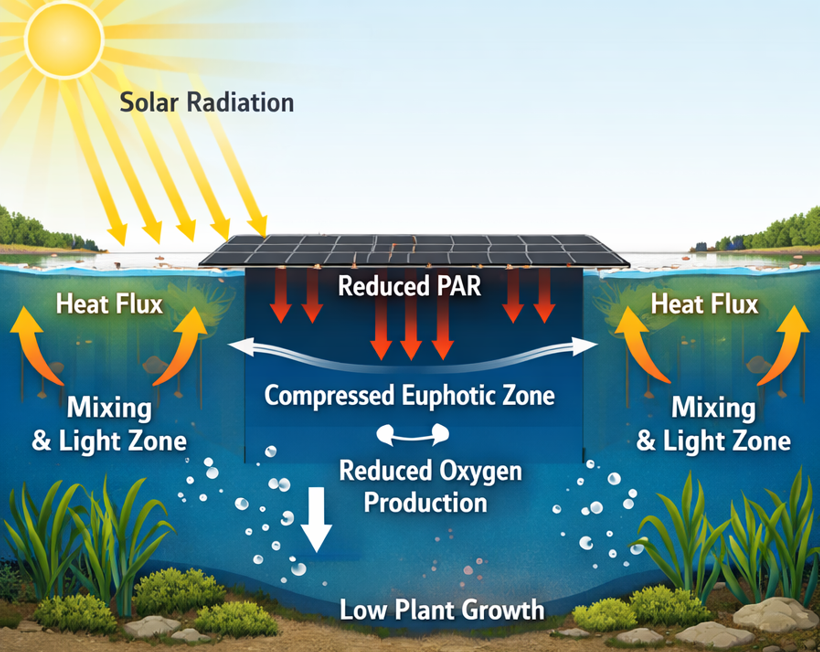
Floating photovoltaic (FPV) systems are gaining global momentum as a space-efficient solution for renewable energy generation, particularly on inland freshwater bodies such as reservoirs, lakes, and ponds. While their engineering and energy performance have been well documented, their ecological impacts, particularly those related to underwater light dynamics remain insufficiently understood. This review examines one key mechanism: the attenuation of photosynthetically active radiation (PAR) by FPV systems and its consequences for aquatic primary productivity. By altering light availability, FPV arrays can suppress the growth of phytoplankton, submerged macrophytes, and benthic algae, with broader implications for oxygen levels, nutrient cycling, and food web structure. We present a conceptual framework that links FPV design and placement to physical light shading, biological responses, and potential system-wide effects. Drawing on evidence from modelling and field studies in reservoirs, natural lakes, and aquaculture ponds, we highlight how ecological outcomes depend on coverage extent, water clarity, and hydrodynamic conditions. While moderate shading may offer benefits in nutrient-rich waters, excessive coverage risks undermining key ecological functions. The review identifies critical knowledge gaps and offers design and policy recommendations to support ecologically informed FPV deployment that balances energy generation with freshwater ecosystem integrity.
References
[1] Z. Sun, X. Chen, Y. He, J. Li, J. Wang, H. Yan, and Y. Zhang, Toward Efficiency Limits of Crystalline Silicon Solar Cells: Recent Progress in High‐efficiency Silicon Heterojunction Solar Cells. Advanced Energy Materials 12 (2022) 2200015. https://doi.org/10.1002/aenm.202200015.
[2] J.X. Zhai, L. Xie, and S. Shafian, Advancements in Perovskite/CIGS Tandem Solar Cells: Material Synergies, Device Configurations, and Economic Viability for Sustainable Energy. Nanotechnology Reviews 14 (2025) 20250196. https://doi.org/10.1515/ntrev-2025-0196.
[3] X. Zhang, L. Wang, S. Shafian, P. Wang, Y. Zhao, P. Wang, B. Wu, J. Zhai, J. Chen, L. Sun, Y. Hua, and L. Xie, Crosslinking-Driven Chemical Homogeneity Enhances Performance of Pre-Seeded Perovskite Solar Cells. Small 21 (2025) e2408362. https://doi.org/10.1002/smll.202408362.
[4] H. Kim, Y.-J. Kong, W.-S. Kim, S. Shafian, and K. Kim, Enhancing Reproducibility in Organic Solar Cell Fabrication via Static Sequential Deposition with Cross-Linked Polymer Donor and Nonfullerene Acceptor. ACS Applied Polymer Materials 6 (2024) 5814–5821. https://doi.org/10.1021/acsapm.4c00477.
[5] F.N. Mohd Salehin, P. Chelvanathan, A.A. Goje, N.A. Ludin, M.A. Ibrahim, and S. Shafian, Design of Blue, Green and Red Colorful Semitransparent Films Using Ag/SnO2/Ag Color Filter for Integrated into Solar Cells. Results in Physics 70 (2025) 108172. https://doi.org/10.1016/j.rinp.2025.108172.
[6] S. Qi, C. Ge, P. Wang, B. Wu, Y. Zhao, R. Zhao, S. Shafian, Y. Hua, and L. Xie, Improving Perovskite Solar Cell Performance and Stability via Thermal Imprinting-Assisted Ion Exchange Passivation. ACS Applied Materials & Interfaces 16 (2024) 51037–51045. https://doi.org/10.1021/acsami.4c08538.
[7] S. Lee, Y.S. Yoon, S. Shafian, J.Y. Kim, and K. Kim, Sequential Co-Deposition of Perovskite Film: An Effective Way of Tailoring Bandgap in All Vacuum Processed Perovskite Solar Cells. Small Methods 9 (2025) e2500104. https://doi.org/10.1002/smtd.202500104.
[8] H. Kim, Y. Heo, Y. Na, S. Shafian, B. Kim, and K. Kim, Cross-Linking-Integrated Sequential Deposition: A Method for Efficient and Reproducible Bulk Heterojunctions in Organic Solar Cells. ACS Applied Materials & Interfaces 16 (2024) 55873–55880. https://doi.org/10.1021/acsami.4c13237.
[9] A. Sahu, N. Yadav, and K. Sudhakar, Floating Photovoltaic Power Plant: A Review. Renewable and Sustainable Energy Reviews 66 (2016) 815–824. https://doi.org/10.1016/j.rser.2016.08.051.
[10] R. Cazzaniga, M. Cicu, M. Rosa-Clot, P. Rosa-Clot, G.M. Tina, and C. Ventura, Floating Photovoltaic Plants: Performance Analysis and Design Solutions. Renewable and Sustainable Energy Reviews 81 (2018) 1730–1741. https://doi.org/10.1016/j.rser.2017.05.269.
[11] L. Essak, and A. Ghosh, Floating Photovoltaics: A Review. Clean Technologies 4 (2022) 752–769. https://doi.org/10.3390/cleantechnol4030046.
[12] M.H. Oeishee, and M.M. Rahman, A Review of Floating Photovoltaic Systems: Prospects, Challenges, and Sustainability Considerations. Global Challenges (Hoboken, NJ) 10 (2026) e00581. https://doi.org/10.1002/gch2.202500581.
[13] S.K.A. Dzamesi, W. Ahiataku-Togobo, S. Yakubu, P. Acheampong, M. Kwarteng, R. Samikannu, and E. Azeave, Comparative Performance Evaluation of Ground-Mounted and Floating Solar PV Systems. Energy for Sustainable Development: The Journal of the International Energy Initiative 80 (2024) 101421. https://doi.org/10.1016/j.esd.2024.101421.
[14] J. Selj, S. Wieland, and I. Tsanakas, Floating Photovoltaic Power Plants: A Review of Energy Yield, Reliability, and Maintenance, International Energy Agency Photovoltaic Power Systems Programme, 2025. https://doi.org/10.69766/kdya8846.
[15] M. Manolache, A.I. Manolache, and G. Andrei, Floating Solar Energy Systems: A Review of Economic Feasibility and Cross-Sector Integration with Marine Renewable Energy, Aquaculture and Hydrogen. Journal of Marine Science and Engineering 13 (2025) 1404. https://doi.org/10.3390/jmse13081404.
[16] D.W. Meek, J.L. Hatfield, T.A. Howell, S.B. Idso, and R.J. Reginato, A Generalized Relationship between Photosynthetically Active Radiation and Solar Radiation. Agronomy Journal 76 (1984) 939–945. https://doi.org/10.2134/agronj1984.00021962007600060018x.
[17] I.G. Anemaet, M. Bekker, and K.J. Hellingwerf, Algal Photosynthesis as the Primary Driver for a Sustainable Development in Energy, Feed, and Food Production. Marine Biotechnology (New York, N.Y.) 12 (2010) 619–629. https://doi.org/10.1007/s10126-010-9311-1.
[18] J.E. Petersen, C.-C. Chen, and W.M. Kemp, Scaling Aquatic Primary Productivity: Experiments under Nutrient- and Light-Limited Conditions. Ecology 78 (1997) 2326–2338. https://doi.org/10.1890/0012-9658(1997)078%5B2326:sappeu%5D2.0.co;2.
[19] A.L. Heinrichs, O.J. Hardorp, H. Hillebrand, T. Schott, and M. Striebel, Direct and Indirect Cumulative Effects of Temperature, Nutrients, and Light on Phytoplankton Growth. Ecology and Evolution 14 (2024) e70073. https://doi.org/10.1002/ece3.70073.
[20] Y. Wang, X. Xu, D. Li, Y. Lu, X. Zhang, C. Yang, Q. Jin, and G. Wang, Effect of Light and Nutrients on Interspecific Interactions between Submerged Macrophytes: Implications for Restoration of Multispecies Aquatic Vegetation in Eutrophic Lakes. Journal of Oceanology and Limnology 41 (2023) 1821–1833. https://doi.org/10.1007/s00343-022-2230-y.
[21] Y. Vadeboncoeur, and R. Lowe, Benthic Algae and Cyanobacteria of the Littoral Zone, in: Wetzel’s Limnology, Elsevier, 2024: pp. 817–857. https://doi.org/10.1016/b978-0-12-822701-5.00025-2.
[22] D. Chirwa, R. Goyal, and E. Mulenga, Floating Solar Photovoltaic (FSPV) Potential in Zambia: Case Studies on Six Hydropower Power Plant Reservoirs. Renewable Energy Focus 44 (2023) 344–356. https://doi.org/10.1016/j.ref.2023.01.007.
[23] V. E.Villafane, K. Sundback, F.L. Figueroa, and E.W. Helbling, Photosynthesis in the Aquatic Environment as Affected by UVR, in: E.W. Helbling, H. Zagarese (Eds), UV Effects in Aquatic Organisms and Ecosystems, The Royal Society of Chemistry, Cambridge, 2003: pp. 357–398. https://doi.org/10.1039/9781847552266-00357.
[24] G. Exley, T. Page, S.J. Thackeray, A.M. Folkard, R.-M. Couture, R.R. Hernandez, A.E. Cagle, K.R. Salk, L. Clous, P. Whittaker, M. Chipps, and A. Armstrong, Floating Solar Panels on Reservoirs Impact Phytoplankton Populations: A Modelling Experiment. Journal of Environmental Management 324 (2022) 116410. https://doi.org/10.1016/j.jenvman.2022.116410.
[25] S. Yang, Y. Zhang, D. Tian, Z. Liu, and Z. Ma, Water-Surface Photovoltaic Systems Have Affected Water Physical and Chemical Properties and Biodiversity. Communications Earth & Environment 5 (2024) 632. https://doi.org/10.1038/s43247-024-01811-y.
[26] R.L.G. Nobre, C. Vagnon, S. Boulêtreau, F. Colas, F. Azémar, L. Tudesque, N. Parthuisot, P. Millet, and J. Cucherousset, Floating Photovoltaics Strongly Reduce Water Temperature: A Whole-Lake Experiment. Journal of Environmental Management 375 (2025) 124230. https://doi.org/10.1016/j.jenvman.2025.124230.
[27] T. Eglin, H. Rodriguez-Perez, and V. De Billy, Ecological Impacts of Floating Photovoltaics on Lake Ecosystems: Eco-Design and Research Perspectives. Knowledge and Management of Aquatic Ecosystems (2025) 27. https://doi.org/10.1051/kmae/2025023.
[28] K. Ilgen, C.B. Goulart, S. Hilgert, D. Schindler, K. van de Weyer, R. de Carvalho Bueno, T. Bleninger, R. Lastrico, L. Gfüllner, A. Graef, S. Fuchs, and J. Lange, Hydrological and Ecological Effects of Floating Photovoltaic Systems: A Model Comparison Considering Mussel, Periphyton, and Macrophyte Growth. Knowledge and Management of Aquatic Ecosystems (2025) 11. https://doi.org/10.1051/kmae/2025008.
[29] P.-A. Château, R.F. Wunderlich, T.-W. Wang, H.-T. Lai, C.-C. Chen, and F.-J. Chang, Mathematical Modeling Suggests High Potential for the Deployment of Floating Photovoltaic on Fish Ponds. The Science of the Total Environment 687 (2019) 654–666. https://doi.org/10.1016/j.scitotenv.2019.05.420.
[30] T.-W. Wang, P.-H. Chang, Y.-S. Huang, T.-S. Lin, S. Yang, S.-L. Yeh, C.-H. Tung, S.-R. Kuo, H.-T. Lai, and C.-C. Chen, Effects of Floating Photovoltaic Systems on Water Quality of Aquaculture Ponds. Aquaculture Research 53 (2022) 1304–1315. https://doi.org/10.1111/are.15665.
Downloads
Published
Issue
Section
License
Copyright (c) 2026 Progress in Energy and Environment

This work is licensed under a Creative Commons Attribution-NonCommercial 4.0 International License.