Semitransparent Floating Photovoltaics for Mitigating Shading Effects in Opaque Floating Solar Systems
Keywords:
Floating Photovoltaics, Semitransparent Photovoltaic, Light Penetration, Ecological ImpactsAbstract
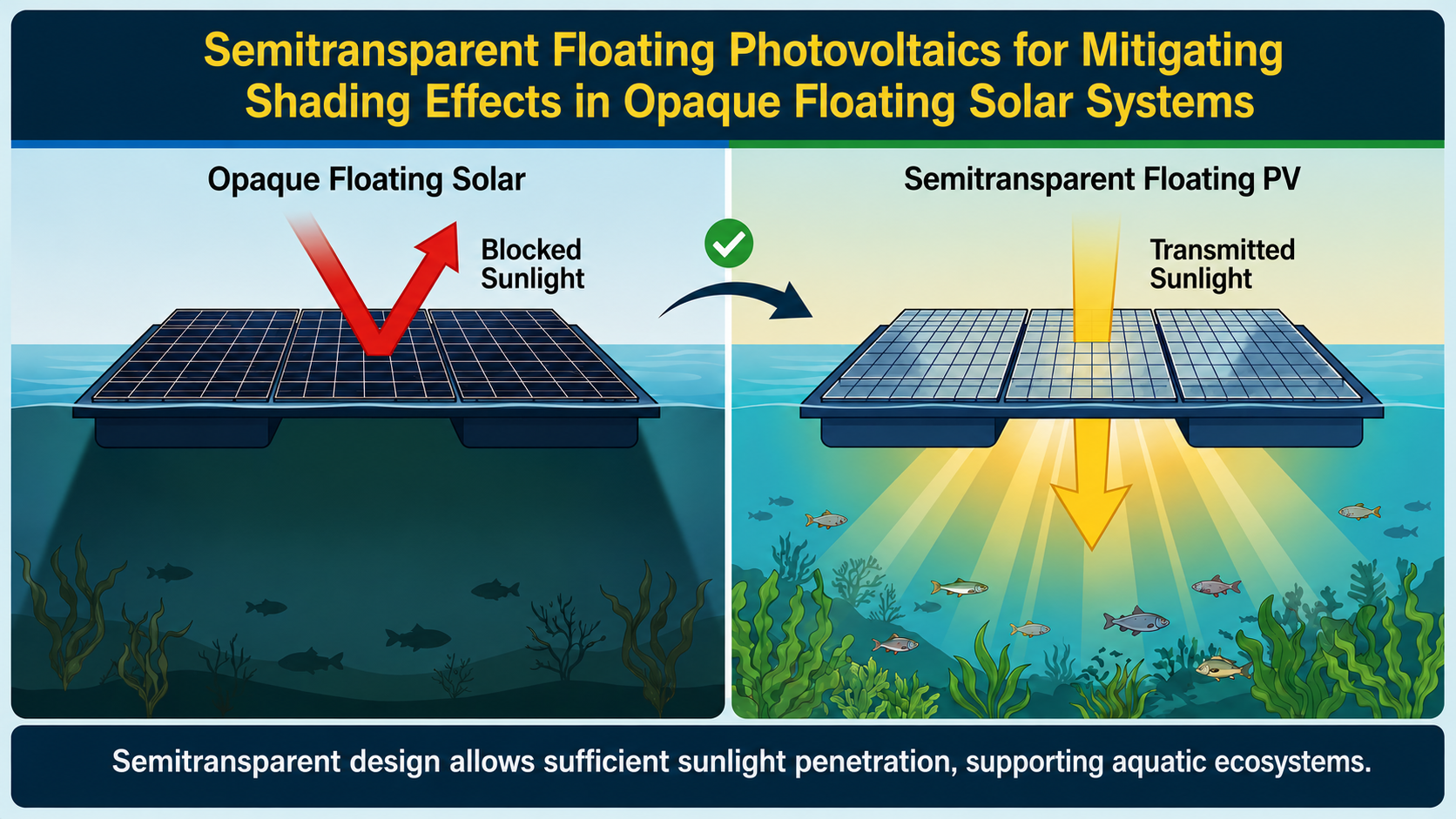
Floating photovoltaic (FPV) systems have emerged as a promising solution to expand solar energy deployment without competing for valuable land resources. However, the rapid expansion of conventional FPV systems based on opaque crystalline silicon modules has raised concerns regarding their environmental impacts on aquatic ecosystems, particularly due to excessive shading and altered light penetration. Semitransparent PV technologies offer an alternative approach by enabling partial light transmission while maintaining electricity generation. This review examines semitransparent FPV as a sustainable shading alternative to conventional opaque FPV systems. The design principles of semitransparent PV devices and floating PV systems are first reviewed to establish their technical foundations. Recent studies on semitransparent FPV applications are then discussed, with a focus on light management and interactions with aquatic ecosystems. Evidence suggests that spectrally selective light transmission can support beneficial photosynthetic activity while mitigating adverse ecological impacts associated with excessive shading. The review concludes by outlining key technical challenges and research gaps that must be addressed to enable the sustainable deployment of semitransparent FPV systems.
References
[1] J. Xue, Photovoltaic Agriculture - New Opportunity for Photovoltaic Applications in China. Renewable and Sustainable Energy Reviews 73 (2017) 1–9. https://doi.org/10.1016/j.rser.2017.01.098.
[2] S. Shafian. Silicon Solar Cells for Indoor Photovoltaic Applications. Future Energy and Environment Letters 3 (2025) 50–57. https://doi.org/10.37934/feel.3.1.5057.
[3] S. Shafian, A Review of Bifacial Perovskite Solar Cells. Future Energy and Environment Letters 3 (2025) 36–49. https://doi.org/10.37934/feel.3.1.3649.
[4] S.K.A. Dzamesi, W. Ahiataku-Togobo, S. Yakubu, P. Acheampong, M. Kwarteng, R. Samikannu, and E. Azeave, Comparative Performance Evaluation of Ground-Mounted and Floating Solar PV Systems. Energy for Sustainable Development: The Journal of the International Energy Initiative 80 (2024) 101421. https://doi.org/10.1016/j.esd.2024.101421.
[5] M. Manolache, A.I. Manolache, and G. Andrei, Floating Solar Energy Systems: A Review of Economic Feasibility and Cross-Sector Integration with Marine Renewable Energy, Aquaculture and Hydrogen. Journal of Marine Science and Engineering 13 (2025) 1404. https://doi.org/10.3390/jmse13081404.
[6] S. Benjamins, B. Williamson, S.-L. Billing, Z. Yuan, M. Collu, C. Fox, L. Hobbs, E.A. Masden, E.J. Cottier-Cook, and B. Wilson, Potential Environmental Impacts of Floating Solar Photovoltaic Systems. Renewable and Sustainable Energy Reviews 199 (2024) 114463. https://doi.org/10.1016/j.rser.2024.114463.
[7] V. Vidović, G. Krajačić, N. Matak, G. Stunjek, and M. Mimica, Review of the Potentials for Implementation of Floating Solar Panels on Lakes and Water Reservoirs. Renewable and Sustainable Energy Reviews 178 (2023) 113237. https://doi.org/10.1016/j.rser.2023.113237.
[8] H.M. Pouran, M. Padilha Campos Lopes, T. Nogueira, D. Alves Castelo Branco, and Y. Sheng, Environmental and Technical Impacts of Floating Photovoltaic Plants as an Emerging Clean Energy Technology. iScience 25 (2022) 105253. https://doi.org/10.1016/j.isci.2022.105253.
[9] Y. Kim, J. Son, S. Shafian, K. Kim, and J.K. Hyun, Semitransparent Blue, Green, and Red Organic Solar Cells Using Color Filtering Electrodes. Advanced Optical Materials 6 (2018) 1800051. https://doi.org/10.1002/adom.201800051.
[10] S. Shafian, J. Son, Y. Kim, J.K. Hyun, and K. Kim, Active-Material-Independent Color-Tunable Semitransparent Organic Solar Cells. ACS Applied Materials & Interfaces 11 (2019) 18887–18895. https://doi.org/10.1021/acsami.9b03254.
[11] F.N. Mohd Salehin, P. Chelvanathan, A.A. Goje, N.A. Ludin, M.A. Ibrahim, and S. Shafian, Design of Blue, Green and Red Colorful Semitransparent Films Using Ag/SnO2/Ag Color Filter for Integrated into Solar Cells. Results in Physics 70 (2025) 108172. https://doi.org/10.1016/j.rinp.2025.108172.
[12] S. Shafian, Semitransparent and Colorful Solar Cell for Architectural Application. Future Energy and Environment Letters 2 (2025) 13–32. https://doi.org/10.37934/feel.2.1.1332.
[13] S. Shafian, Semitransparent Solar Cells for Agriculture Application. Future Energy and Environment Letters 3 (2025) 1–18. https://doi.org/10.37934/feel.3.1.118.
[14] N. Zhang, G. Chen, Y. Xu, X. Xu, and L. Yu, Power Generation, Evaporation Mitigation, and Thermal Insulation of Semitransparent Polymer Solar Cells: A Potential for Floating Photovoltaic Applications. ACS Applied Energy Materials 2 (2019) 6060–6070. https://doi.org/10.1021/acsaem.9b01176.
[15] S. Shafian, Optical and Structural Analysis of Layer Thickness Effects on Transmission in Semitransparent Colorful Organic Photovoltaics. Paper Asia 41 (2025) 1–10. https://doi.org/10.59953/paperasia.v41i4b.569.
[16] H. Kim, Y.-J. Kong, W.-S. Kim, S. Shafian, and K. Kim, Enhancing Reproducibility in Organic Solar Cell Fabrication via Static Sequential Deposition with Cross-Linked Polymer Donor and Nonfullerene Acceptor. ACS Applied Polymer Materials 6 (2024) 5814–5821. https://doi.org/10.1021/acsapm.4c00477.
[17] H. Kim, Y. Heo, Y. Na, S. Shafian, B. Kim, and K. Kim, Cross-Linking-Integrated Sequential Deposition: A Method for Efficient and Reproducible Bulk Heterojunctions in Organic Solar Cells. ACS Applied Materials & Interfaces 16 (2024) 55873–55880. https://doi.org/10.1021/acsami.4c13237.
[18] Y. Kim, H. Ryu, W.-S. Kim, S. Shafian, and K. Kim, Improving Performance of Fully Vacuum-Evaporated Perovskite Photovoltaics via Dry Additive Strategy. Small Methods 10 (2026) e01434. https://doi.org/10.1002/smtd.202501434.
[19] S. Lee, Y.S. Yoon, S. Shafian, J.Y. Kim, and K. Kim, Sequential Co-Deposition of Perovskite Film: An Effective Way of Tailoring Bandgap in All Vacuum Processed Perovskite Solar Cells. Small Methods 9 (2025) e2500104. https://doi.org/10.1002/smtd.202500104.
[20] J. Zhai, H. Bì, S. Zhang, L. Xie, B. Wu, P. Wang, S. Ge, S. Shafian, J. Chen, W. Zhang, Y. Zhang, N.-G. Park, and Y. Hua, Dynamic Reconfiguration of Hydrogen-Bonded Networks to Modulate Perovskite Crystallization. Energy & Environmental Science 19 (2026) 1180–1191. https://doi.org/10.1039/d5ee07159c.
[21] X. Zhang, L. Wang, S. Shafian, P. Wang, Y. Zhao, P. Wang, B. Wu, J. Zhai, J. Chen, L. Sun, Y. Hua, and L. Xie, Crosslinking-Driven Chemical Homogeneity Enhances Performance of Pre-Seeded Perovskite Solar Cells. Small 21 (2025) e2408362. https://doi.org/10.1002/smll.202408362.
[22] S. Qi, C. Ge, P. Wang, B. Wu, Y. Zhao, R. Zhao, S. Shafian, Y. Hua, and L. Xie, Improving Perovskite Solar Cell Performance and Stability via Thermal Imprinting-Assisted Ion Exchange Passivation. ACS Applied Materials & Interfaces 16 (2024) 51037–51045. https://doi.org/10.1021/acsami.4c08538.
[23] P. Wang, S. Shafian, F. Qiu, X. Zhang, Y. Zhao, B. Wu, K. Kim, Y. Hua, and L. Xie, Improving Redox Reactions of Spiro-OMeTAD via p-Type Molecular Scaffold to Reduce Energy Loss at Ag-Electrode in Perovskite Solar Cells. Journal of Energy Chemistry 102 (2025) 151–160. https://doi.org/10.1016/j.jechem.2024.10.027.
[24] M. Vasilopoulou, A.R.B. Mohd Yusoff, and M.K. Nazeeruddin, Background and Basic Knowledge of Perovskite Solar Cells. Printable Mesoscopic Perovskite Solar Cells (2023) 1–18. https://doi.org/10.1002/9783527834297.ch1.
[25] S. Alam, S. Sim, M.Q. Li, B.-J. Chang, and J. Lee, Recent Progress in Semitransparent Organic Solar Cells: Photoabsorbent Materials and Design Strategies. Micromachines 15 (2024) 493. https://doi.org/10.3390/mi15040493.
[26] H. Tong, S. Tan, Y. Zhang, Y. He, C. Ding, H. Zhang, J. He, J. Cao, H. Liu, Y. Li, J. Kang, X. Xu, C. Chen, Y. Chen, F. Sun, B. Feng, H. Sun, X. Jiang, L. Yu, J. Li, D. He, J. Li, and Z. Li, Total-Area World-Record Efficiency of 27.03% for 350.0 Cm2 Commercial-Sized Single-Junction Silicon Solar Cells. Nature Communications 16 (2025) 5920. https://doi.org/10.1038/s41467-025-61128-y.
[27] L. Zhao, X. Huang, Y. Wang, S. Young Jeong, B. Huang, J. Deng, J. Liu, Y. Cheng, H. Young Woo, F. Wu, L. Chen, and L. Chen, Combination of Highly Photovoltaic and Highly Transparent Materials Enables Record Performance Semitransparent Organic Solar Cells. Chemical Engineering Journal (Lausanne, Switzerland: 1996) 451 (2023) 139081. https://doi.org/10.1016/j.cej.2022.139081.
[28] S.D.H. Naqvi, K. Son, W. Jung, H.U. Hwang, S. Lee, A. Lee, M. Keum, S. Kim, J.W. Kim, M.G. Kang, H.-E. Song, S. Hong, I. Jeong, S. Ahn, A. Lambertz, K. Ding, W. Duan, K. Yim, and S. Ahn, Mitigating Intrinsic Interfacial Degradation in Semi‐transparent Perovskite Solar Cells for High Efficiency and Long‐term Stability. Advanced Energy Materials 13 (2023) 2302147. https://doi.org/10.1002/aenm.202302147.
[29] R. Cazzaniga, M. Cicu, M. Rosa-Clot, P. Rosa-Clot, G.M. Tina, and C. Ventura, Floating Photovoltaic Plants: Performance Analysis and Design Solutions. Renewable and Sustainable Energy Reviews 81 (2018) 1730–1741. https://doi.org/10.1016/j.rser.2017.05.269.
[30] N. Zhang, T. Jiang, C. Guo, L. Qiao, Q. Ji, L. Yin, L. Yu, P. Murto, and X. Xu, High-Performance Semitransparent Polymer Solar Cells Floating on Water: Rational Analysis of Power Generation, Water Evaporation and Algal Growth. Nano Energy 77 (2020) 105111. https://doi.org/10.1016/j.nanoen.2020.105111.
[31] L. Yin, Y. Zhou, T. Jiang, Y. Xu, T. Liu, N. Li, K. Zhou, L. Yu, C. Guo, P. Murto, and X. Xu, Semitransparent Polymer Solar Cells Floating on Water: Selected Transmission Windows and Active Control of Algal Growth. Journal of Materials Chemistry. C, Materials for Optical and Electronic Devices 9 (2021) 13132–13143. https://doi.org/10.1039/d1tc03110d.
[32] N.A. Tegegne, L.T. Nchinda, and T.P.J. Krüger, Progress toward Stable Organic Solar Cells. Advanced Optical Materials 13 (2025) 2402257. https://doi.org/10.1002/adom.202402257.
[33] N. Ahn, and M. Choi, Towards Long-Term Stable Perovskite Solar Cells: Degradation Mechanisms and Stabilization Techniques. Advanced Science (Weinheim, Baden-Wurttemberg, Germany) 11 (2024) e2306110. https://doi.org/10.1002/advs.202306110.
[34] A. Goswami, A. Kumar, U. Goswami, and P. Sadhu, Degradation of floating photovoltaic systems, in: Floating Photovoltaics, Elsevier, 2026: pp. 109–147. https://doi.org/10.1016/b978-0-443-33773-4.00009-1.
[35] S.A.A. Rizvi, A.K. Janjua, A.A. Ansari, M.U. Bin Ahmed, H.A. Raza, and G. Abbas, Assessment of Salt-Induced Performance Decline in Floating Photovoltaics in Marine Environments: Experimental Analysis of Electrical Degradation, Design and Techno-Economic Implications. Renewable Energy 260 (2026) 125189. https://doi.org/10.1016/j.renene.2026.125189.
[36] N.M. Naushad, G.R. Rimon, and M.R. Khan, Local Temperature and Humidity Aware Prediction of Degradation, Lifetime, and Long-Term Yield of Mono- and Bifacial Floating Photovoltaic Systems. Solar Energy (Phoenix, Ariz.) 299 (2025) 113639. https://doi.org/10.1016/j.solener.2025.113639.
Downloads
Published
Issue
Section
License
Copyright (c) 2026 Progress in Energy and Environment

This work is licensed under a Creative Commons Attribution-NonCommercial 4.0 International License.