Oviposition Behaviour Preference of Yellow Stem Borer (Scripophaga incertulas) on Vetiver Grass (Vetiveria zizanoides) and Local Rice Varieties
Keywords:
Ecological engineering, vetiver grass, local paddy varieties, yellow stem borer, trap cropAbstract
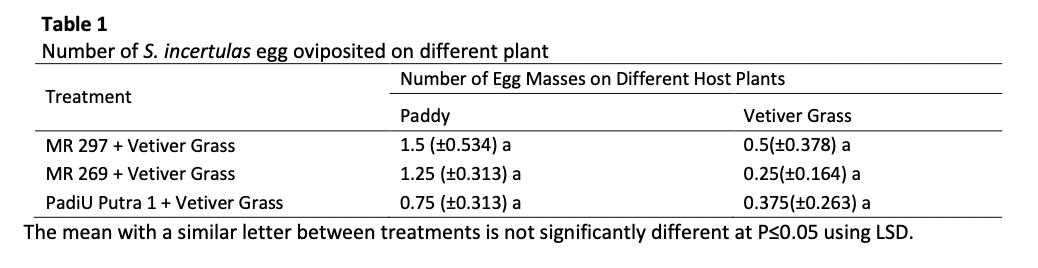
Stem borers pose a significant threat to paddy production, accounting for substantial yield losses. To mitigate this challenge, sustainable pest management strategies integrating ecological engineering principles have been proposed. This study investigates the efficacy of vetiver grass (Vetiveria zizanioides) as a trap crop for controlling stem borer populations. Unlike invasive weeds, vetiver grass offers a low-risk and effective solution. The oviposition preferences of yellow stem borers (Scirpophaga incertulas) between vetiver grass and three local paddy varieties (MR297, MR269, and PadiU Putra 1) were examined. Using a randomized complete block design (RCBD) with four replications, 240 female S. incertulas were released into net cages containing different treatment combinations. Evaluation of total egg masses laid on different host plants revealed no significant differences in attractiveness for oviposition, although S. incertulas displayed a preference for the adaxial surface of V. zizaniodes. Additionally, larvae fed on vetiver grass did not survive, while those on paddy plants exhibited similar growth rates and sizes. Overall, while no statistically significant oviposition preference was observed among host plants, vetiver grass demonstrated a pronounced lethal effect on S. incertulas larvae. This study contributes valuable insights into integrated pest management strategies in paddy cultivation systems, emphasizing the potential of vetiver grass as an environmentally sustainable solution.