The Role of Digital Leadership in Shaping Entrepreneurial Resilience and Business Success: A Qualitative Study of Micro-Entrepreneurs in Pahang
Keywords:
Digital leadership, entrepreneurial resilience, business success, micro-entrepreneurs, qualitative study, PahangAbstract
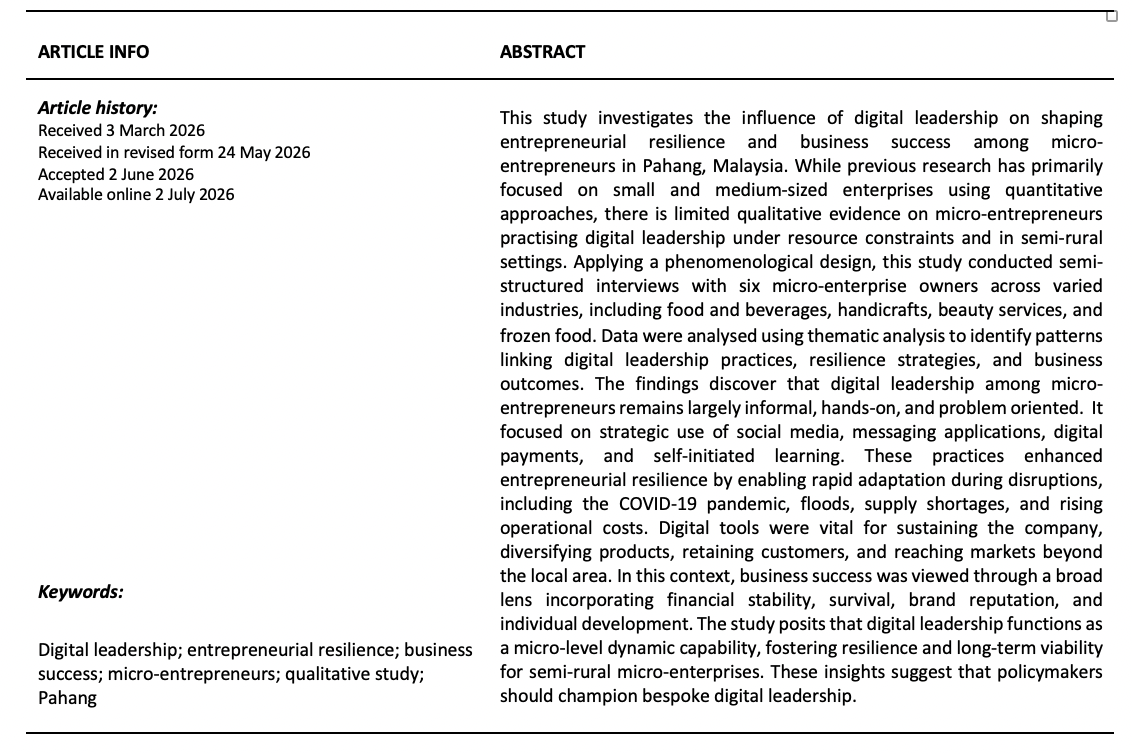
This study investigates the influence of digital leadership on shaping entrepreneurial resilience and business success among micro-entrepreneurs in Pahang, Malaysia. While previous research has primarily focused on small and medium-sized enterprises using quantitative approaches, there is limited qualitative evidence on micro-entrepreneurs practising digital leadership under resource constraints and in semi-rural settings. Applying a phenomenological design, this study conducted semi-structured interviews with six micro-enterprise owners across varied industries, including food and beverages, handicrafts, beauty services, and frozen food. Data were analysed using thematic analysis to identify patterns linking digital leadership practices, resilience strategies, and business outcomes. The findings discover that digital leadership among micro-entrepreneurs remains largely informal, hands-on, and problem oriented. It focused on strategic use of social media, messaging applications, digital payments, and self-initiated learning. These practices enhanced entrepreneurial resilience by enabling rapid adaptation during disruptions, including the COVID-19 pandemic, floods, supply shortages, and rising operational costs. Digital tools were vital for sustaining the company, diversifying products, retaining customers, and reaching markets beyond the local area. In this context, business success was viewed through a broad lens incorporating financial stability, survival, brand reputation, and individual development. The study posits that digital leadership functions as a micro-level dynamic capability, fostering resilience and long-term viability for semi-rural micro-enterprises. These insights suggest that policymakers should champion bespoke digital leadership.