Developing an Orange Economy Mapping Framework for Sustainable Homestays in Sabah, Malaysia: A Conceptual Paper

Authors

  • Kelvin Yong Centre for the Promotion of Knowledge and Language Learning, Universiti Malaysia Sabah, Sabah, Malaysia
  • Rudy Ansar Faculty of Business, Economics and Accountancy, Universiti Malaysia Sabah, Sabah, Malaysia
  • Suddin Lada Faculty of Business, Economics and Accountancy, Universiti Malaysia Sabah, Sabah, Malaysia
  • Brahim Chekima Faculty of Business, Economics and Accountancy, Universiti Malaysia Sabah, Sabah, Malaysia
  • Nizammuddin Ab Faculty of Economics and Business Universitas Borneo Tarakan, Indonesia
  • Poulyou Gapis Homestay Id Kalangadan, Sabah, Malaysia

Keywords:

Orange Economy, creative economy, sustainable homestay performance

Abstract

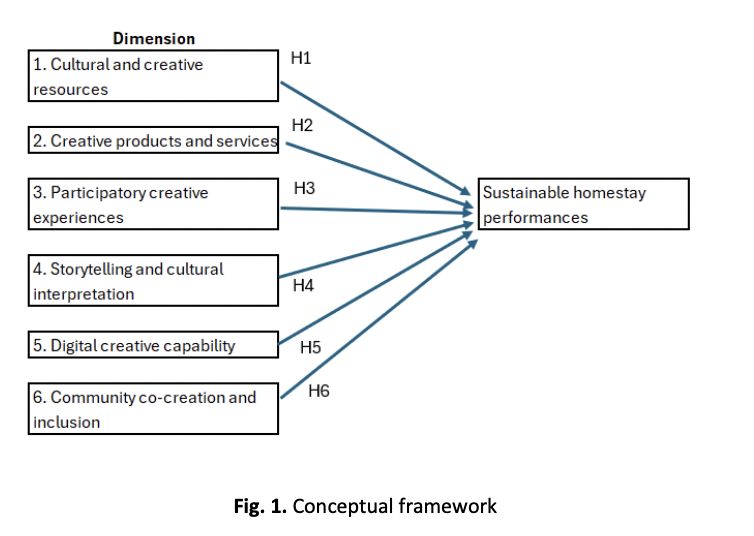
This study aims to develop and validate an Orange Economy Mapping Framework for sustainable homestay performance in Sabah, Malaysia. The Orange Economy is formally recognised in the 13th Malaysia Plan (13MP, 2026–2030) as a strategic thrust under the MADANI Economy framework, reflecting the federal government's intent to position the creative economy as a key driver of national growth. The framework conceptualises the Orange Economy as a development pathway through which homestay entrepreneurs transform cultural heritage, creativity, local knowledge, and intellectual property into products, services, and experiences that generate economic and social value. Although Malaysian homestay programmes possess substantial cultural and community resources, previous studies have predominantly examined tourist experiences, operational challenges, digitalisation, and sustainability, with limited attention given to the systematic identification and measurement of Orange Economy practices within community-based homestays. Theoretical frameworks are grounded based on resource-based view (RBV), this research also proposes a framework comprising six dimensions: cultural and creative resources; creative products and services; participatory creative experiences; storytelling and cultural interpretation; digital creative capability; and community co-creation and inclusion. A survey questionnaire development design will be employed, involving literature-based item generation, expert content validation, pre-testing, pilot testing, and a quantitative survey of entrepreneurs participating in Sabah's official homestay programme. Data will be collected using a structured questionnaire and analysed through partial least squares structural equation modelling (PLS-SEM) using SmartPLS 4. The analysis will assess the framework's measurement properties and examine the relationship between the Orange Economy framework and sustainable homestay performance. The proposed framework is expected to provide a theoretically grounded and practically applicable instrument for mapping creative-economy practices, identifying capability gaps, and guiding targeted interventions in Sabah's homestay sector. The study supports Sustainable Development Goal (SDG) 1 (No Poverty), SDG 4 (Quality Education), and SDG 17 (Partnerships for the Goals), and aligns with the Sabah Maju Jaya 2.0 (SMJ 2.0) agenda. The findings are expected to assist government agencies, Sabah homestay associations, and local universities in designing targeted financial assistance, training, and knowledge-transfer initiatives that strengthen collaboration, creative capabilities, and the sustainable development of homestay communities.

Author Biographies

Kelvin Yong, Centre for the Promotion of Knowledge and Language Learning, Universiti Malaysia Sabah, Sabah, Malaysia

kelvinyong@ums.edu.my

Rudy Ansar, Faculty of Business, Economics and Accountancy, Universiti Malaysia Sabah, Sabah, Malaysia

rudyansar@ums.edu.my

Suddin Lada, Faculty of Business, Economics and Accountancy, Universiti Malaysia Sabah, Sabah, Malaysia

suddin@ums.edu.my

Brahim Chekima, Faculty of Business, Economics and Accountancy, Universiti Malaysia Sabah, Sabah, Malaysia

bchekima@ums.edu.my

Nizammuddin Ab, Faculty of Economics and Business Universitas Borneo Tarakan, Indonesia

nizhamuddinab@gmail.com

Poulyou Gapis, Homestay Id Kalangadan, Sabah, Malaysia

poulyoudevon@gmail.com

Downloads

Published

2026-10-12

Issue

Section

Articles