Utilizing Orange Waste, Chicken Droppings, and Rice Husk for Bio-Fertilizer Production via Anaerobic Digestion
Keywords:
Orange Waste, Chicken Droppings, Rice Husk, Bio-Fertilizer, Anaerobic DigestionAbstract
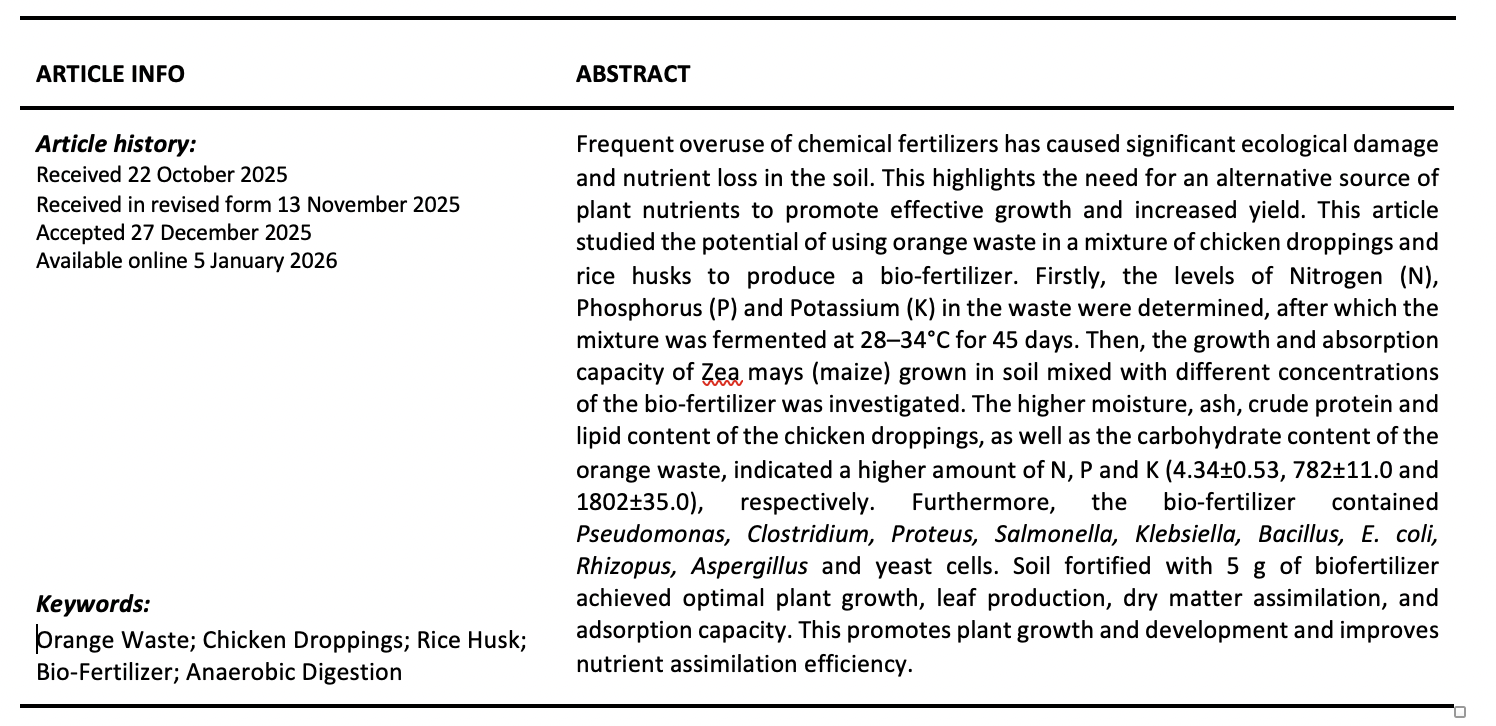
Several ecological damages because of overuse of chemical fertilizers is causing significant nutrient loss to the soil, hence the need for better options. This study aimed at studying the potential of orange waste in a mixture of chicken dropping and rice husk toward producing quality bio-fertilizer. Proximate composition and microbial load of the three raw materials were evaluated using standard procedure. Nitrogen (N), Phosphorus (P) and Potassium (K) content of the raw and produced bio-fertilizer were determined using DR/890 colorimeter and Atomic Absorption Spectroscopy (AAS). Subsequent to the dilution and loading in an anaerobic bio-digester, it was allowed to ferment for 45 days at mesophilic temperature (28 0C - 34 0C). Soil was mixed with 3g, 5g and 10g of the bio-fertilizer and controls respectively. Zea mays (Maize) growth response to the bio-fertilizer and adsorption capacity were investigated. Two-way ANOVA at 95 % (p<0.05) confidence level using GraphPad Prism software was employed to analyze the data. The proximate analysis showed chicken dropping has highest moisture (3.27%), ash (12.46%), crude protein (24.63%) and lipid content (5.28%), while rice husk and orange waste are the richest in crude fiber carbohydrate content (28.26%, 69.09%) respectively. Chicken dropping was found to have optimal P, K, while orange waste had the highest N. Bacterial genus identified are Pseudomonas, Clostridium, Proteus, Salmonella, Klebsiella, Bacillus and E. coli, while fungi are Rhizopus, Aspergillus and Yeast cells. The N, P, K content of the biofertilizer are 4.34±0.53, 782±11.0 and 1802±35.0 respectively. The bio-fertilizer 5g gave the best agronomic response in both growth rate, leaf area ratio, leaf area index, total dry matter production, and net assimilation rate, as well as adsorption capacity. This would promote plants’ growth and development, and nutrient assimilation efficiency.