

Why Students Click “Buy”: Trust, Social Influence, and Control in Online Purchase Intentions

Authors

  • Mohd Rosli Ismail Faculty of Business Management and Professional Studies, Management & Science University (MSU), 40100 Shah Alam, Selangor
  • Aimi Anuar Faculty of Business Management and Professional Studies, Management & Science University (MSU), 40100 Shah Alam, Selangor
  • Siti Maryam Md Nor Faculty of Business Management and Professional Studies, Management & Science University (MSU), 40100 Shah Alam, Selangor
  • Md Zaki Muhamad Hasan Faculty of Business Management and Professional Studies, Management & Science University (MSU), 40100 Shah Alam, Selangor
  • Nor Afiqah Md Noh Faculty of Business Management and Professional Studies, Management & Science University (MSU), 40100 Shah Alam, Selangor
  • Zarif Iman Mohd Azmir Faculty of Business Management and Professional Studies, Management & Science University (MSU), 40100 Shah Alam, Selangor

Keywords:

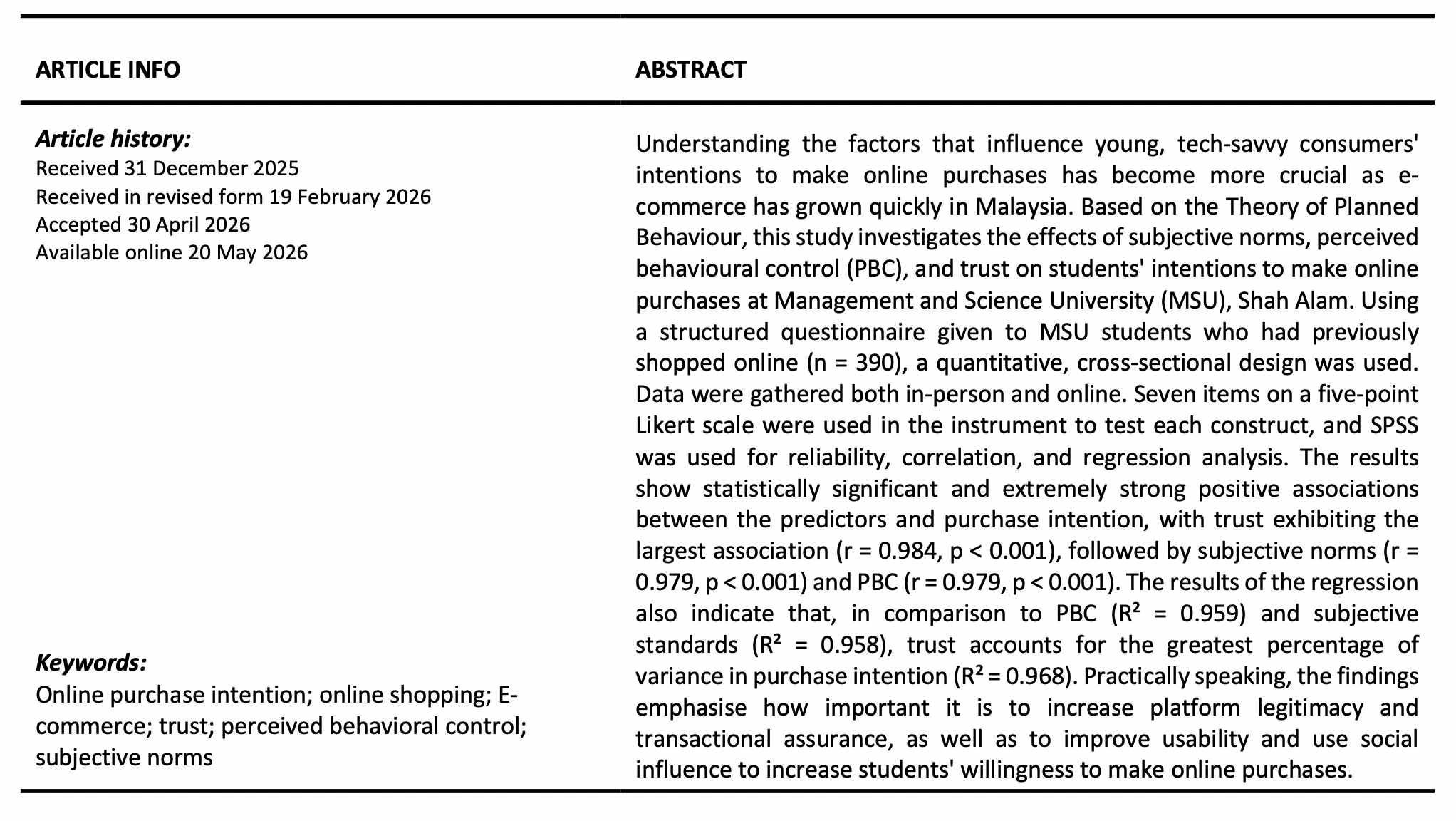
Online purchase intention, online shopping, E-commerce, trust, perceived behavioral control, subjective norms

Abstract

Understanding the factors that influence young, tech-savvy consumers' intentions to make online purchases has become more crucial as e-commerce has grown quickly in Malaysia. Based on the Theory of Planned Behaviour, this study investigates the effects of subjective norms, perceived behavioural control (PBC), and trust on students' intentions to make online purchases at Management and Science University (MSU), Shah Alam. Using a structured questionnaire given to MSU students who had previously shopped online (n = 390), a quantitative, cross-sectional design was used. Data were gathered both in-person and online. Seven items on a five-point Likert scale were used in the instrument to test each construct, and SPSS was used for reliability, correlation, and regression analysis. The results show statistically significant and extremely strong positive associations between the predictors and purchase intention, with trust exhibiting the largest association (r = 0.984, p < 0.001), followed by subjective norms (r = 0.979, p < 0.001) and PBC (r = 0.979, p < 0.001). The results of the regression also indicate that, in comparison to PBC (R² = 0.959) and subjective standards (R² = 0.958), trust accounts for the greatest percentage of variance in purchase intention (R² = 0.968). Practically speaking, the findings emphasise how important it is to increase platform legitimacy and transactional assurance, as well as to improve usability and use social influence to increase students' willingness to make online purchases.

Author Biographies

Mohd Rosli Ismail, Faculty of Business Management and Professional Studies, Management & Science University (MSU), 40100 Shah Alam, Selangor

mohdrosli_ismail@msu.edu.my

Aimi Anuar, Faculty of Business Management and Professional Studies, Management & Science University (MSU), 40100 Shah Alam, Selangor

aimi_anuar@msu.edu.my

Siti Maryam Md Nor, Faculty of Business Management and Professional Studies, Management & Science University (MSU), 40100 Shah Alam, Selangor

sitimaryam_mdnor@msu.edu.my

Md Zaki Muhamad Hasan, Faculty of Business Management and Professional Studies, Management & Science University (MSU), 40100 Shah Alam, Selangor

md_zaki@msu.edu.my

Nor Afiqah Md Noh, Faculty of Business Management and Professional Studies, Management & Science University (MSU), 40100 Shah Alam, Selangor

nor_afiqah@msu.edu.my

Downloads

Published

2026-05-20

Issue

Section

Articles