Urbanization, Agricultural GDP, and Food Availability in India: ARDL Evidence from 1961–2020

Authors

  • Jolin Norshyme Hashim Faculty of Business and Management, Universiti Teknologi MARA Cawangan Pahang, Kampus Raub,Malaysia
  • Azeni Abu Bakar Faculty of Business and Management, Universiti Teknologi MARA Cawangan Pahang, Kampus Raub,Malaysia
  • Nur Fakhzan Marwan Faculty of Business and Management, Universiti Teknologi MARA Cawangan Pahang, Kampus Raub,Malaysia
  • Syahida Md Zeni Faculty of Accountancy, Universiti Teknologi MARA Cawangan Pahang Kampus Jengka, Malaysia
  • Noraini Mohamed Faculty of Computer Science and Mathematics, Universiti Teknologi MARA Cawangan Pahang Kampus Jengka,Malaysia
  • Malik Cahyadin Faculty of Economics and Business, and PSP-KUMKM, Universitas Sebelas Maret, Indonesia

Keywords:

ARDL, Food Security, India, Granger Causality, Urban Population

Abstract

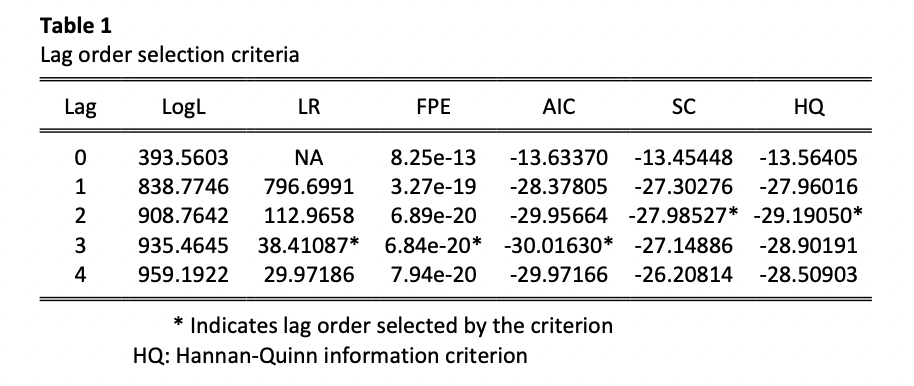
This study investigates the long-run and short-run determinants of food security availability in India using the Food Production Index as a proxy and annual data for 1961–2020. An Autoregressive Distributed Lag (ARDL) bounds-testing approach is employed to estimate cointegration relationships and short-run adjustment dynamics among fertilizer consumption, agricultural GDP, arable land, and urban population. The ARDL results indicate that fertilizer consumption and agricultural GDP are positively and significantly associated with food availability in both the long run and short run, highlighting the importance of input intensification and agricultural sector capacity for sustaining domestic food supply. In contrast, arable land and urban population exhibit significant negative relationships with the Food Production Index in both horizons, suggesting land-related constraints and urban transition pressures on food availability. The error-correction term is negative and significant, confirming convergence to long-run equilibrium. VAR Granger causality tests further show that arable land and urban population contain predictive information for food availability.
Author Biographies

Azeni Abu Bakar, Faculty of Business and Management, Universiti Teknologi MARA Cawangan Pahang, Kampus Raub,Malaysia

azeni@uitm.edu.my

Nur Fakhzan Marwan, Faculty of Business and Management, Universiti Teknologi MARA Cawangan Pahang, Kampus Raub,Malaysia

nurfakhzan@uitm.edu.my

Syahida Md Zeni, Faculty of Accountancy, Universiti Teknologi MARA Cawangan Pahang Kampus Jengka, Malaysia

syahidam@uitm.edu.my

Noraini Mohamed, Faculty of Computer Science and Mathematics, Universiti Teknologi MARA Cawangan Pahang Kampus Jengka,Malaysia

noraini_mohamed@uitm.edu.my

Malik Cahyadin, Faculty of Economics and Business, and PSP-KUMKM, Universitas Sebelas Maret, Indonesia

malikcahyadin_feb@staff.uns.ac.id

Downloads

Published

2026-07-01

Issue

Section

Articles