
Job Demands, Job Satisfaction and Women’s Job Performance among Malaysian Public Servants

Authors

  • Siti Aishah Hussin Faculty of Business and Management, Open University Malaysia, 47301, Petaling Jaya, Selangor, Malaysia
  • Nainatul Farzuha Nor Faculty of Business and Management, Open University Malaysia, 47301, Petaling Jaya, Selangor, Malaysia
  • Hamidah Md Yusop Arshad Ayub Graduate Business School, Universiti Teknologi MARA, 40450, Shah Alam, Selangor, Malaysia

Keywords:

Job demands, Job satisfaction, Emotional labor, Role conflict, Workload, Women’s job performance, Public service

Abstract

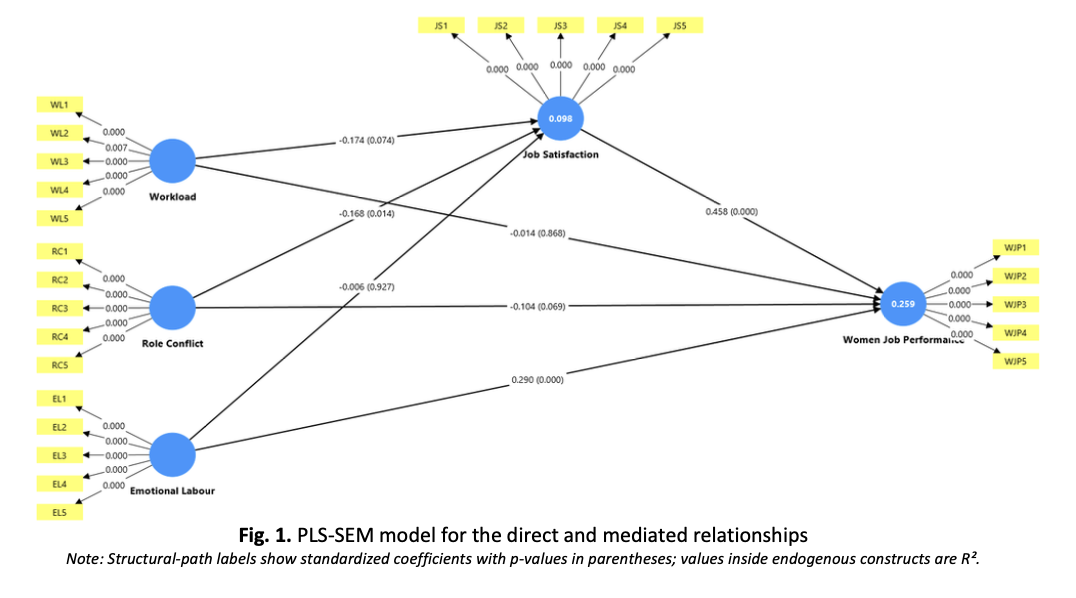
The study investigated the relationship between three job demands (workload, role conflict and emotional labor) and women's job performance and assessed the role of job satisfaction in this relationship for women working as public servants in Malaysia. Based on the Job Demands-Resources Theory and the Conservation of Resources Theory, the three job demands were described as three different work conditions rather than as one stress construct. A survey that utilized a quantitative cross-sectional design was completed by 714 participants, of which 572 valid responses were obtained after the survey data were cleaned. With the exception of workload, the direct effects of the job demands on job satisfaction and job performance were analyzed using the Partial Least Squares Structural Equation Modeling (PLS-SEM) with a bootstrap procedure. The results of the analysis revealed that emotional labor in the performance of women public servants was positively significant (β = 0.290, p < .001), while role conflict in job satisfaction was negatively significant (β = -0.168, p = .014). Job satisfaction of public servants had a positive and significant effect on the job performance of women public servants (β = 0.458, p < .001). Role conflict did not have a positive effect on performance and workload did not have either a positive or negative effect on job satisfaction or job performance. Additionally, the mediation analysis showed that role conflict was negatively significant to the job performance of women public servants with job satisfaction as a mediating factor (β = -0.077, 95% CI [-0.137, -0.012]), while the emotional labor and workload indirect effects were not significant. Overall, the findings demonstrate that the effects of job demands are demand-specific. Emotional labor was positively associated with women’s job performance but was not significantly related to job satisfaction, whereas role conflict negatively affected job satisfaction and indirectly affected job performance through job satisfaction. Workload showed no significant direct or indirect relationships. The study discusses role clarity and job satisfaction as significant human resource concerns in women’s performance and outlines a demand-specific explanation of the public sector.

Author Biographies

Siti Aishah Hussin, Faculty of Business and Management, Open University Malaysia, 47301, Petaling Jaya, Selangor, Malaysia

sitiaishah_husin@oum.edu.my

Nainatul Farzuha Nor, Faculty of Business and Management, Open University Malaysia, 47301, Petaling Jaya, Selangor, Malaysia

nainatul_farzuha@oum.edu.my

Hamidah Md Yusop, Arshad Ayub Graduate Business School, Universiti Teknologi MARA, 40450, Shah Alam, Selangor, Malaysia

hamidahyusop@uitm.edu.my

Downloads

Published

2026-10-26

Issue

Section

Articles