A Quantitative Assessment of Growth, Penetration, and Social Impact in Malaysia’s Takaful Industry
Keywords:
Takaful Malaysia, Quantitative Analysis, ESG, Industry Performance, Social ImpactAbstract
This study presents a quantitative assessment of Malaysia’s Takaful industry using secondary data from the
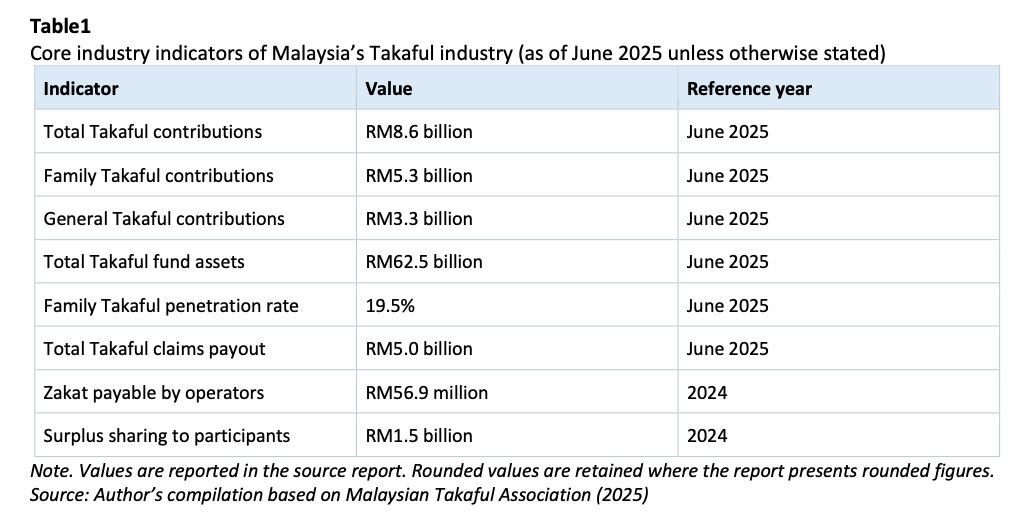
2025 Financial Sector Blueprint and Sustainability Report for Takaful. Adopting a descriptive quantitative research design, the study examines key industry indicators, including total contributions, the market composition of family and general Takaful, penetration rates, claims, social impact, and sustainability-related performance. The findings reveal that total Takaful contributions increased from RM5.93 billion in 2015 to RM15.64 billion in 2024, representing more than a 2.5-fold increase and an approximate compound annual growth rate (CAGR) of 11.4%. Although family Takaful continued to dominate the industry, general Takaful recorded faster growth in recent years, accounting for 37.8% of the total market in 2024. As of June 2025, the industry recorded total contributions of RM8.56 billion, fund assets amounting to RM62.54 billion, and a family Takaful penetration rate of 19.48%. In terms of social contributions, the industry distributed RM56.9 million in zakat and RM1.469 billion through surplus-sharing arrangements in 2024. Furthermore, microtakaful initiatives provided coverage to more than 13 million participants between 2014 and 2024. Sustainability-related performance also demonstrated significant progress, with Value-Based Intermediation (VBI) investments and environmental, social, and governance (ESG)-related assets under management exceeding RM22.5 billion as of June 2025. Overall, the findings demonstrate that Malaysia’s Takaful industry has experienced substantial growth while strengthening its contributions to financial inclusion, social welfare, and sustainable financial development. These results highlight the industry's expanding role within Malaysia’s financial system and provide quantitative evidence of its evolving market structure, socioeconomic contributions, and commitment to sustainability.