AI Becomes Institutional through Practice: Human-Centered and Ethical AI in Supporting Institutional Information Capability in Academic Libraries

Authors

  • Norhashimah Hashim Faculty of Information Science, Universiti Teknologi MARA, Cawangan Negeri Sembilan, Kampus Rembau, Malaysia
  • Haziah Sa'ari Faculty of Information Science, Universiti Teknologi MARA, Cawangan Negeri Sembilan, Kampus Rembau, Malaysia
  • Al-Bakri Mohammad@Ahmad Faculty of Information Science, Universiti Teknologi MARA, Cawangan Negeri Sembilan, Kampus Rembau, Malaysia

Keywords:

Institutional Information Capability, human-centered AI, ethical AI, academic libraries, AI-enabled information practices

Abstract

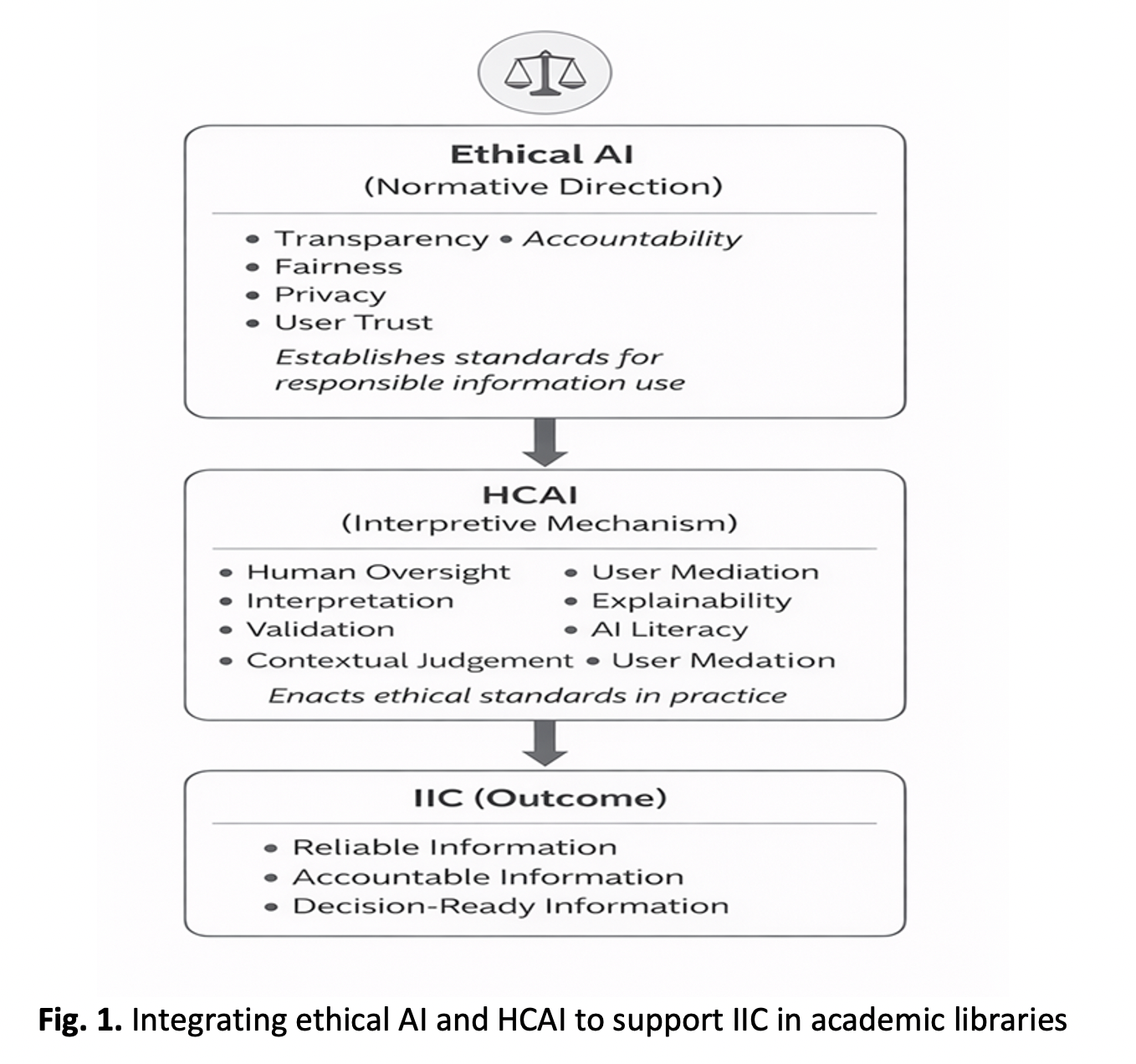
Artificial intelligence (AI) is increasingly embedded in academic library work, influencing how information is organised, interpreted, validated, and used in higher education. Current discussions on Ethical AI and Human-Centered AI (HCAI) have established important principles for responsible AI use, but the connection between ethical direction, librarian judgement, and Institutional Information Capability (IIC) remains insufficiently integrated. This paper aims to develop a practice-based conceptual explanation of how Ethical AI and HCAI support IIC in academic libraries. A literature-based conceptual synthesis was used to integrate key arguments on responsible AI, human oversight, professional judgement, information reliability, and institutional decision support. The synthesis positions Ethical AI as the normative basis for responsible information conduct, HCAI as the operational logic through which librarians exercise oversight, interpretation, and contextual judgement, and IIC as the institutional outcome produced when AI-supported information becomes reliable, accountable, and decision-ready. The paper argues that AI becomes institutionally meaningful through library practice, rather than through system adoption or technical capability by itself. Librarians are positioned as interpretive actors who scrutinise AI-generated outputs, protect user interests, refine information processes, and align machine-supported information with academic standards and institutional expectations. The paper contributes an integrated conceptual framework that links Ethical AI, HCAI, and IIC as a connected practice-based mechanism. This framework strengthens understanding of how Malaysian public university libraries can sustain informational integrity, trust, and decision-relevant knowledge as AI adoption expands.

Downloads

Published

2026-06-22

Issue

Section

Articles