Unsustainable Sediment Harvesting: A Review of AIoT-Enabled Monitoring Approaches, Detection Strategies, and Environmental Implication
Keywords:
Sediment disturbance, and mining, smart sensing, anomaly detection, mangrove ecosystems, sustainabilityAbstract
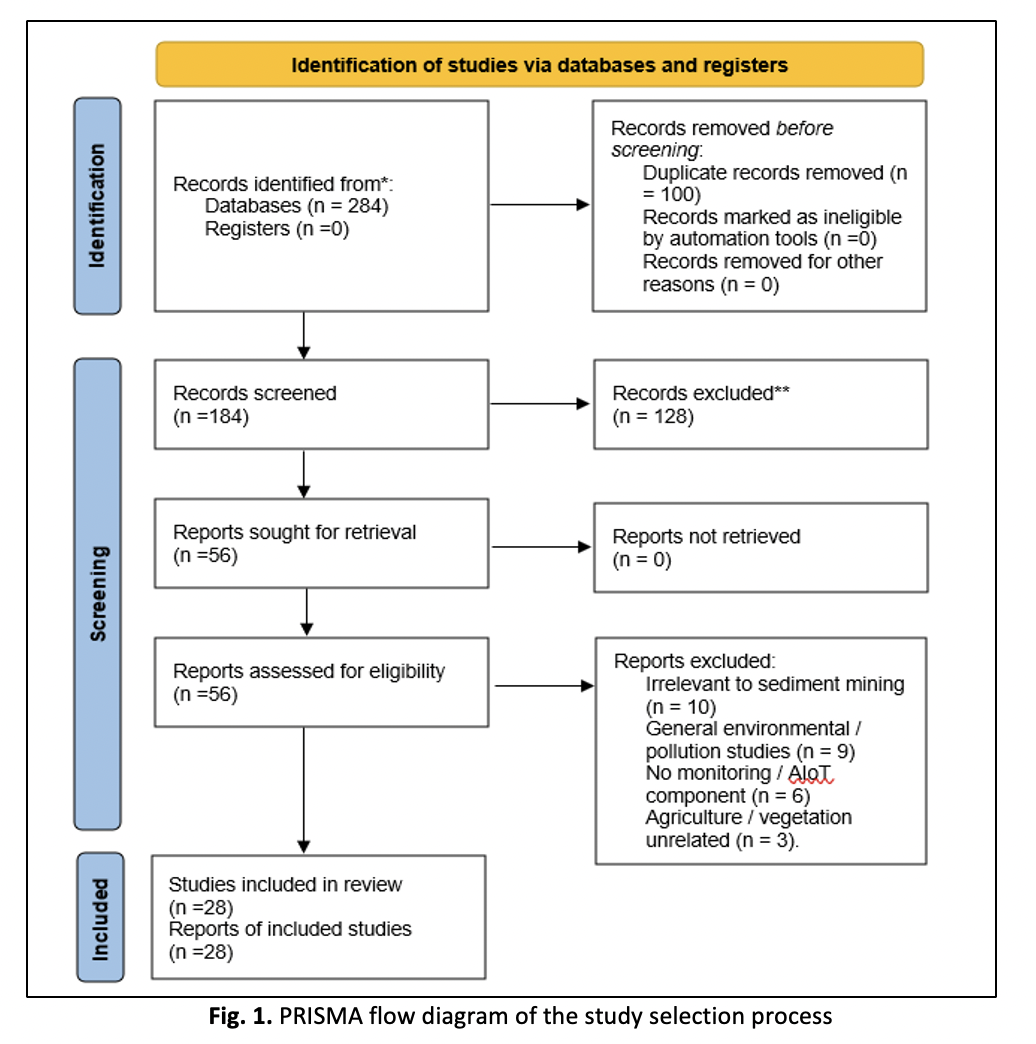
Unsustainable sediment harvesting in coastal environments has emerged as a critical environmental concern, contributing to shoreline erosion, habitat degradation, and increased vulnerability of ecosystems such as mangroves and nearshore zones. The growing demand for sand resources, coupled with inadequate monitoring and enforcement mechanisms, has intensified anthropogenic pressure on coastal systems. Although research on environmental monitoring and smart sensing technologies has expanded over the past decade, existing studies remain fragmented across technological, environmental, and governance domains, with limited integration of Artificial Intelligence of Things (AIoT) approaches for real-time detection and management. To address this gap, this study conducts a systematic review of AIoT-enabled environmental monitoring approaches for detecting coastal sediment disturbance. Publications indexed in the Scopus database between 2011 and 2026 were analysed following the PRISMA 2020 protocol. A total of 284 records were initially identified. After applying preliminary inclusion and exclusion criteria, 156 records were retained. Subsequently, duplicate entries and records with missing essential information were removed, resulting in 56 records for screening. Following title and abstract evaluation, 28 records were excluded due to irrelevance to sediment harvesting, lack of monitoring or AIoT components, and focus on unrelated environmental domains. Finally, 28 studies were included for qualitative and thematic analysis. Bibliometric mapping was further conducted to identify key research trends and thematic relationships. The analysis reveals four major thematic clusters: (i) sensor-based environmental monitoring systems, (ii) AI-driven detection and anomaly recognition techniques, (iii) coastal and marine ecosystem monitoring applications, and (iv) sustainability and governance challenges in resource management. The findings indicate a progressive shift from conventional monitoring approaches to real-time, multi-sensor AIoT systems capable of detecting sediment disturbances through parameters such as turbidity, vibration, and spatial activity patterns. However, several challenges persist, including limited system scalability, data reliability issues, energy constraints, and insufficient integration with policy enforcement mechanisms. By synthesizing current research trends and technological advancements, this study provides a structured knowledge map of AIoT-enabled coastal monitoring systems and identifies critical research gaps for future development. The findings contribute to advancing sustainable environmental monitoring strategies and support global sustainability goals related to climate action and coastal ecosystem protection.