

Understanding Barriers and Enablers of Offline Digital Adoption and Pedagogy Practices in Sabah Schools: A Systematic Literature Review

Authors

  • Faerozh Madli Faculty of Business, Economics and Accountancy, Universiti Malaysia Sabah, Malaysia
  • Lai Che Ching UMS-Unicef C4D Research Unit head, Faculty of Social Sciences and Humanities, Universiti Malaysia Sabah, Malaysia
  • Syahruddin Ag Ahmad UMS-Unicef C4D Research Unit head, Faculty of Social Sciences and Humanities, Universiti Malaysia Sabah, Malaysia
  • Jamsari Hashim UMS-Unicef C4D Research Unit head, Faculty of Social Sciences and Humanities, Universiti Malaysia Sabah, Malaysia
  • Kennedy Aaron Aguol UMS-Unicef C4D Research Unit head, Faculty of Social Sciences and Humanities, Universiti Malaysia Sabah, Malaysia
  • Dean Nelson Mojolou UMS-Unicef C4D Research Unit head, Faculty of Social Sciences and Humanities, Universiti Malaysia Sabah, Malaysia
  • Diana Nabila Chau Abdullah UMS-Unicef C4D Research Unit head, Faculty of Social Sciences and Humanities, Universiti Malaysia Sabah, Malaysia
  • Ayesah Uy Abubakar UMS-Unicef C4D Research Unit head, Faculty of Social Sciences and Humanities, Universiti Malaysia Sabah, Malaysia
  • Adi Jafar UMS-Unicef C4D Research Unit head, Faculty of Social Sciences and Humanities, Universiti Malaysia Sabah, Malaysia
  • Yuzainy Janin UMS-Unicef C4D Research Unit head, Faculty of Social Sciences and Humanities, Universiti Malaysia Sabah, Malaysia

Keywords:

Offline digital adoption, digital pedagogy, rural education

Abstract

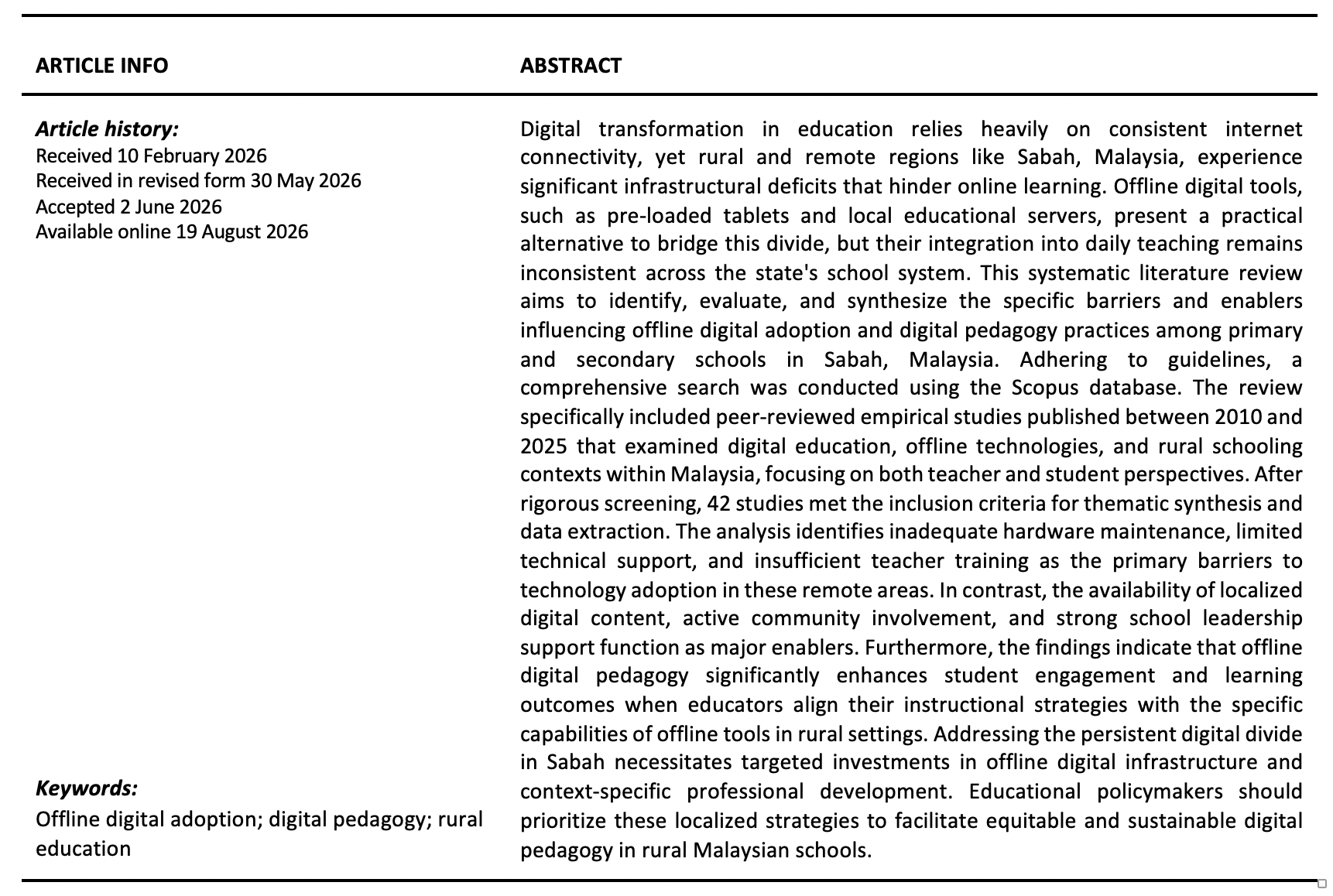
Digital transformation in education relies heavily on consistent internet connectivity, yet rural and remote regions like Sabah, Malaysia, experience significant infrastructural deficits that hinder online learning. Offline digital tools, such as pre-loaded tablets and local educational servers, present a practical alternative to bridge this divide, but their integration into daily teaching remains inconsistent across the state's school system. This systematic literature review aims to identify, evaluate, and synthesize the specific barriers and enablers influencing offline digital adoption and digital pedagogy practices among primary and secondary schools in Sabah, Malaysia. Adhering to guidelines, a comprehensive search was conducted using the Scopus database. The review specifically included peer-reviewed empirical studies published between 2010 and 2025 that examined digital education, offline technologies, and rural schooling contexts within Malaysia, focusing on both teacher and student perspectives. After rigorous screening, 42 studies met the inclusion criteria for thematic synthesis and data extraction. The analysis identifies inadequate hardware maintenance, limited technical support, and insufficient teacher training as the primary barriers to technology adoption in these remote areas. In contrast, the availability of localized digital content, active community involvement, and strong school leadership support function as major enablers. Furthermore, the findings indicate that offline digital pedagogy significantly enhances student engagement and learning outcomes when educators align their instructional strategies with the specific capabilities of offline tools in rural settings. Addressing the persistent digital divide in Sabah necessitates targeted investments in offline digital infrastructure and context-specific professional development. Educational policymakers should prioritize these localized strategies to facilitate equitable and sustainable digital pedagogy in rural Malaysian schools.

Author Biography

Faerozh Madli, Faculty of Business, Economics and Accountancy, Universiti Malaysia Sabah, Malaysia

faerozhmadli@ums.edu.my

Downloads

Published

2026-08-19

Issue

Section

Articles