
Reimagining Digital Learning Without Internet Access: A Survey of Offline Technology Practices in Sabah Schools

Authors

  • Faerozh Madli Faculty of Business, Economics and Accountancy, Universiti Malaysia Sabah, Malaysia
  • Lai Che Ching UMS-Unicef C4D Research Unit head, Faculty of Social Sciences and Humanities, Universiti Malaysia Sabah, Malaysia
  • Syahruddin Ag Ahmad UMS-Unicef C4D Research Unit head, Faculty of Social Sciences and Humanities, Universiti Malaysia Sabah, Malaysia
  • Jamsari Hashim UMS-Unicef C4D Research Unit head, Faculty of Social Sciences and Humanities, Universiti Malaysia Sabah, Malaysia
  • Kennedy Aaron Aguol UMS-Unicef C4D Research Unit head, Faculty of Social Sciences and Humanities, Universiti Malaysia Sabah, Malaysia
  • Dean Nelson Mojolou UMS-Unicef C4D Research Unit head, Faculty of Social Sciences and Humanities, Universiti Malaysia Sabah, Malaysia
  • Diana Nabila Chau Abdullah UMS-Unicef C4D Research Unit head, Faculty of Social Sciences and Humanities, Universiti Malaysia Sabah, Malaysia
  • Khairunisah Kamsin Faculty of Business, Economics and Accountancy, Universiti Malaysia Sabah, Malaysia
  • Helmina Thomas Faculty of Business, Economics and Accountancy, Universiti Malaysia Sabah, Malaysia
  • Lindah Roziani Jamru Faculty of Social Sciences and Humanities, Universiti Malaysia Sabah, Malaysia

Keywords:

Offline digital learning, rural education, Sabah

Abstract

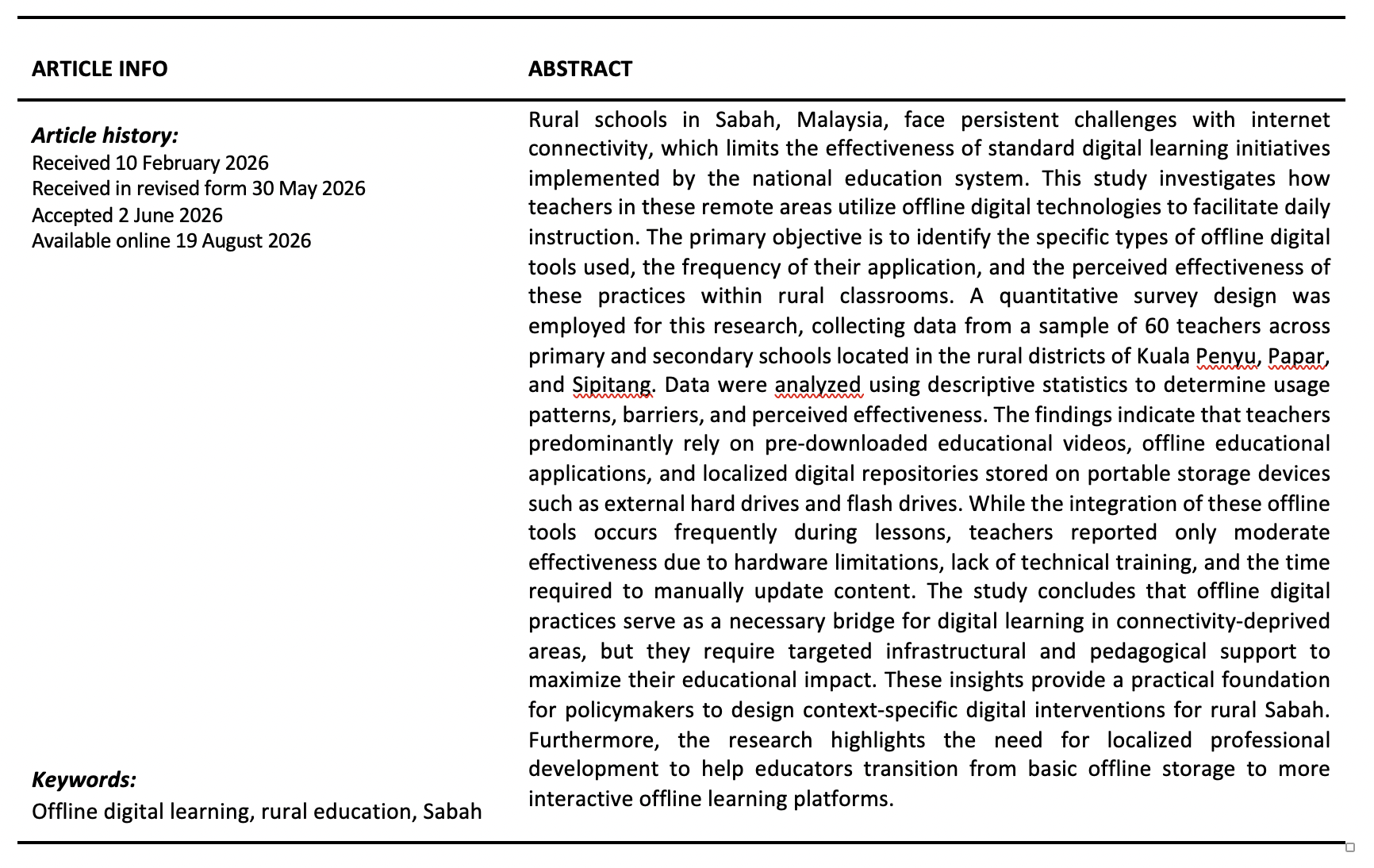
Rural schools in Sabah, Malaysia, face persistent challenges with internet connectivity, which limits the effectiveness of standard digital learning initiatives implemented by the national education system. This study investigates how teachers in these remote areas utilize offline digital technologies to facilitate daily instruction. The primary objective is to identify the specific types of offline digital tools used, the frequency of their application, and the perceived effectiveness of these practices within rural classrooms. A quantitative survey design was employed for this research, collecting data from a sample of 60 teachers across primary and secondary schools located in the rural districts of Kuala Penyu, Papar, and Sipitang. Data were analyzed using descriptive statistics to determine usage patterns, barriers, and perceived effectiveness. The findings indicate that teachers predominantly rely on pre-downloaded educational videos, offline educational applications, and localized digital repositories stored on portable storage devices such as external hard drives and flash drives. While the integration of these offline tools occurs frequently during lessons, teachers reported only moderate effectiveness due to hardware limitations, lack of technical training, and the time required to manually update content. The study concludes that offline digital practices serve as a necessary bridge for digital learning in connectivity-deprived areas, but they require targeted infrastructural and pedagogical support to maximize their educational impact. These insights provide a practical foundation for policymakers to design context-specific digital interventions for rural Sabah. Furthermore, the research highlights the need for localized professional development to help educators transition from basic offline storage to more interactive offline learning platforms.

Author Biography

Faerozh Madli, Faculty of Business, Economics and Accountancy, Universiti Malaysia Sabah, Malaysia

faerozhmadli@ums.edu.my

Downloads

Published

2026-08-19

Issue

Section

Articles