From Reactive to Cognitive: A Framework for Optimizing System Reliability through Smart Maintenance and Human-AI Collaboration
Keywords:
Maintenance, troubleshooting, safetyAbstract
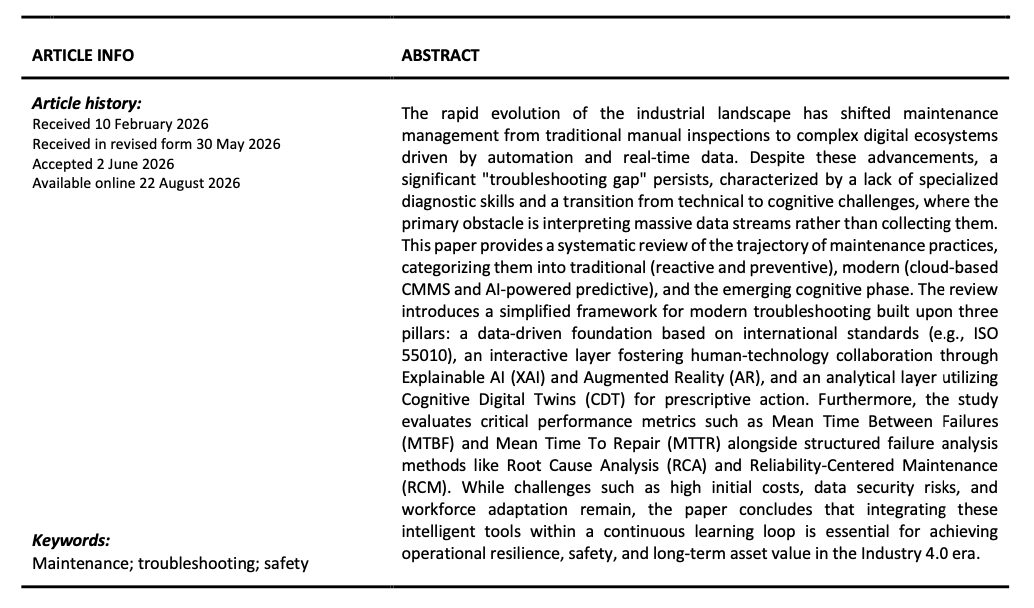
The rapid evolution of the industrial landscape has shifted maintenance management from traditional manual inspections to complex digital ecosystems driven by automation and real-time data. Despite these advancements, a significant "troubleshooting gap" persists, characterized by a lack of specialized diagnostic skills and a transition from technical to cognitive challenges, where the primary obstacle is interpreting massive data streams rather than collecting them. This paper provides a systematic review of the trajectory of maintenance practices, categorizing them into traditional (reactive and preventive), modern (cloud-based CMMS and AI-powered predictive), and the emerging cognitive phase. The review introduces a simplified framework for modern troubleshooting built upon three pillars: a data-driven foundation based on international standards (e.g., ISO 55010), an interactive layer fostering human-technology collaboration through Explainable AI (XAI) and Augmented Reality (AR), and an analytical layer utilizing Cognitive Digital Twins (CDT) for prescriptive action. Furthermore, the study evaluates critical performance metrics such as Mean Time Between Failures (MTBF) and Mean Time To Repair (MTTR) alongside structured failure analysis methods like Root Cause Analysis (RCA) and Reliability-Centered Maintenance (RCM). While challenges such as high initial costs, data security risks, and workforce adaptation remain, the paper concludes that integrating these intelligent tools within a continuous learning loop is essential for achieving operational resilience, safety, and long-term asset value in the Industry 4.0 era.