Strengthening Radiation Protection Culture: A Review of Global Guidelines and Malaysian Regulatory Oversight
Abstract
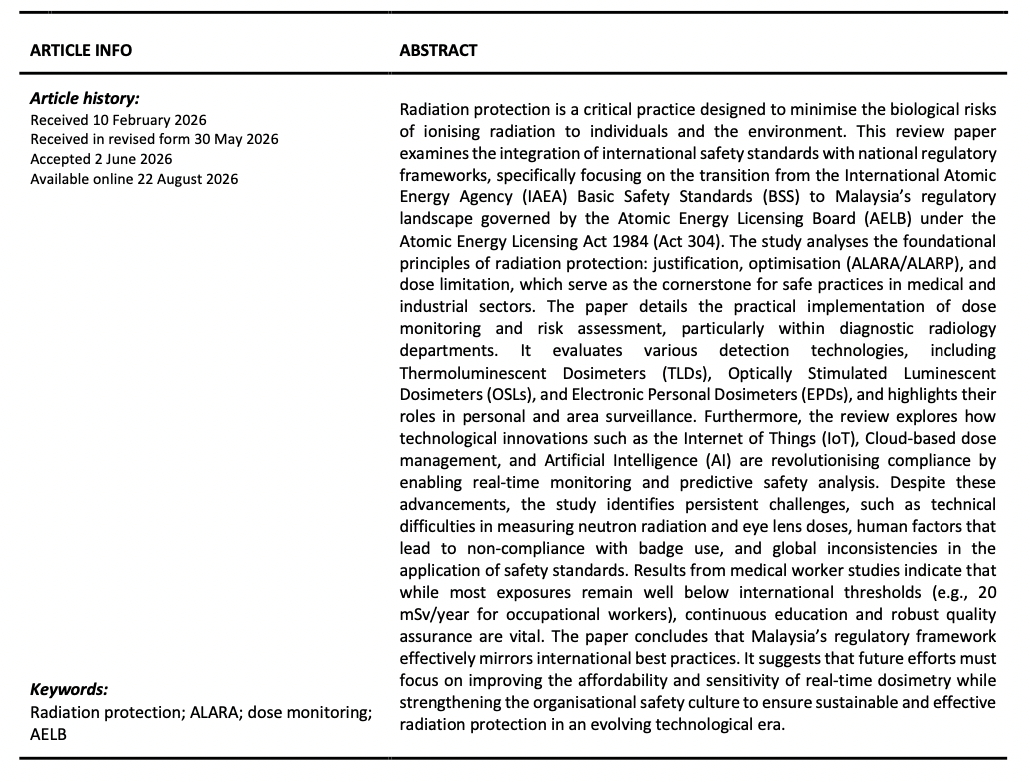
Radiation protection is a critical practice designed to minimise the biological risks of ionising radiation to individuals and the environment. This review paper examines the integration of international safety standards with national regulatory frameworks, specifically focusing on the transition from the International Atomic Energy Agency (IAEA) Basic Safety Standards (BSS) to Malaysia’s regulatory landscape governed by the Atomic Energy Licensing Board (AELB) under the Atomic Energy Licensing Act 1984 (Act 304). The study analyses the foundational principles of radiation protection: justification, optimisation(ALARA/ALARP), and dose limitation, which serve as the cornerstone for safe practices in medical and industrial sectors. The paper details the practical implementation of dose monitoring and risk assessment, particularly within diagnostic radiology departments. It evaluates various detection technologies, including Thermoluminescent Dosimeters (TLDs), Optically Stimulated Luminescent Dosimeters (OSLs), and Electronic Personal Dosimeters (EPDs), and highlights their roles in personal and area surveillance. Furthermore, the review explores how technological innovations such as the Internet of Things (IoT), Cloud-based dose management, and Artificial Intelligence (AI) are revolutionisingcompliance by enabling real-time monitoring and predictive safety analysis. Despite these advancements, the study identifies persistent challenges, such as technical difficulties in measuring neutron radiation and eye lens doses, human factors that lead to non-compliance with badge use, and global inconsistencies in the application of safety standards. Results from medical worker studies indicate that while most exposures remain well below international thresholds (e.g., 20 mSv/year for occupational workers), continuous education and robust quality assurance are vital. The paper concludes that Malaysia’s regulatory framework effectively mirrors international best practices. It suggests that future efforts must focus on improving the affordability and sensitivity of real-time dosimetry while strengthening the organisational safety culture to ensure sustainable and effective radiation protection in an evolving technological era.