Quantum Deep Learning Strategies for Facial Feature Extraction Based on Quantum Image Representation
Keywords:
Facial recognition, image representation, quantum machine learning, feature extraction, feature fusion, principal component analysis, hybrid learningAbstract
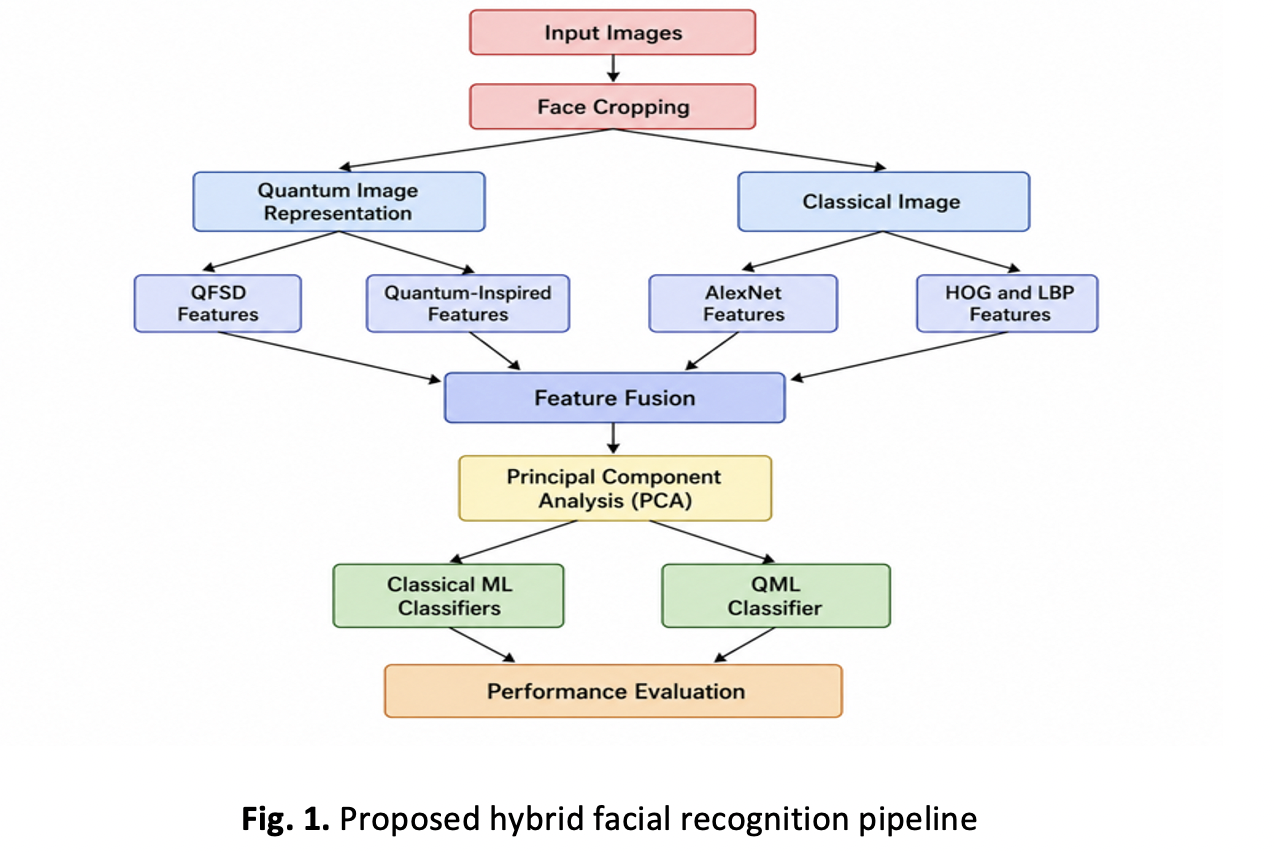
Facial recognition has become one of the most widely implemented biometric technologies, with applications ranging from identity authentication to human-computer interaction. Despite the remarkable performance under controlled conditions, recognition accuracy degrades significantly in unconstrained environments because of variations in illumination, pose, facial expression, and background complexity. However, current facial recognition research remains subject to several limitations. First, most studies are evaluated primarily on controlled or semi-constrained benchmarks, resulting in limited evidence of robustness under fully unconstrained real-world conditions. Second, the integration of quantum image processing techniques into facial recognition pipelines remains scarce, despite the considerable advances in quantum image processing. Finally, existing studies primarily investigate image representation and feature extraction independently, leaving their interaction within facial recognition pipelines largely unexplored. A dual-branch hybrid framework is proposed that integrates quantum image representation with classical and quantum-based feature extraction. The framework employs two quantum encoding methods, followed by feature fusion and Principal Component Analysis (PCA)-based dimensionality reduction. The resulting feature representations are evaluated using both classical and quantum machine learning classifiers. The proposed hybrid feature combinations achieved up to 81.96% recognition accuracy on the in-the-wild dataset while maintaining competitive performance on the controlled dataset. These results demonstrate the practical value of hybrid classical–quantum facial recognition frameworks and provide a foundation for future quantum machine learning research in computer vision.