Bridging Maintenance and Troubleshooting for Enhanced System Reliability: A Review of Smart and Data-Driven Approaches
Keywords:
Maintenance, systems, troubleshooting, preventiveAbstract
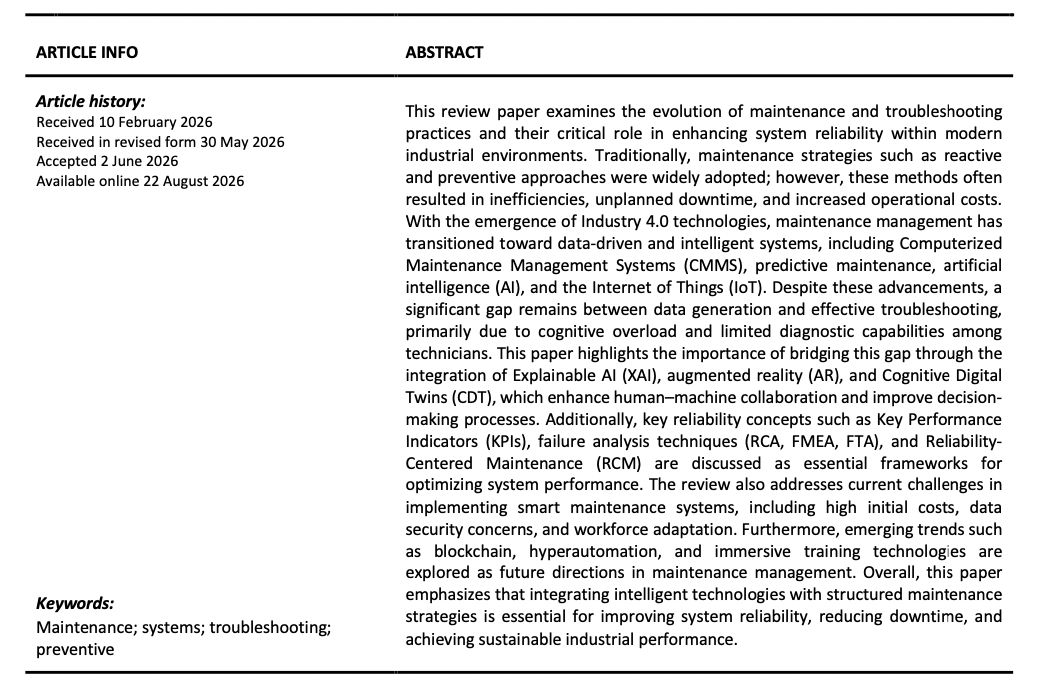
This review paper examines the evolution of maintenance and troubleshooting practices and their critical role in enhancing system reliability within modern industrial environments. Traditionally, maintenance strategies such as reactive and preventive approaches were widely adopted; however, these methods often resulted in inefficiencies, unplanned downtime, and increased operational costs. With the emergence of Industry 4.0 technologies, maintenance management has transitioned toward data-driven and intelligent systems, including Computerized Maintenance Management Systems (CMMS), predictive maintenance, artificial intelligence (AI), and the Internet of Things (IoT). Despite these advancements, a significant gap remains between data generation and effective troubleshooting, primarily due to cognitive overload and limited diagnostic capabilities among technicians. This paper highlights the importance of bridging this gap through the integration of Explainable AI (XAI), augmented reality (AR), and Cognitive Digital Twins (CDT), which enhance human–machine collaboration and improve decision-making processes. Additionally, key reliability concepts such as Key Performance Indicators (KPIs), failure analysis techniques (RCA, FMEA, FTA), and Reliability-Centered Maintenance (RCM) are discussed as essential frameworks for optimizing system performance. The review also addresses current challenges in implementing smart maintenance systems, including high initial costs, data security concerns, and workforce adaptation. Furthermore, emerging trends such as blockchain, hyperautomation, and immersive training technologies are explored as future directions in maintenance management. Overall, this paper emphasizes that integrating intelligent technologies with structured maintenance strategies is essential for improving system reliability, reducing downtime, and achieving sustainable industrial performance.