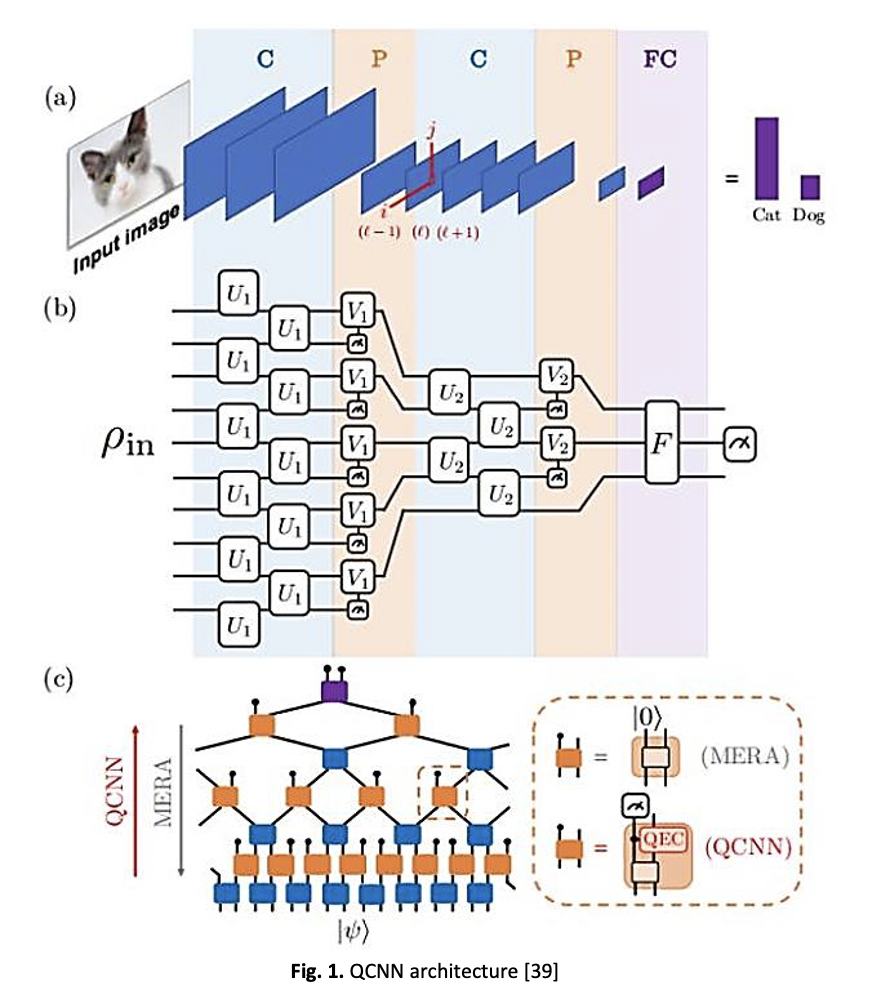


Hybrid Quantum Convolutional Neural Network for Photovoltaic Defect Classification Using Electroluminescence Images

Authors

  • Yuan Jing Department of Electrical, Electronics and Systems Engineering, Faculty of Engineering and Built Environment, Universiti Kebangsaan Malaysia, 43600 UKM Bangi, Selangor, Malaysia
  • Siti Salasiah Mokri Department of Electrical, Electronics and Systems Engineering, Faculty of Engineering and Built Environment, Universiti Kebangsaan Malaysia, 43600 UKM Bangi, Selangor, Malaysia
  • Kalaivani Chellapan Department of Electrical, Electronics and Systems Engineering, Faculty of Engineering and Built Environment, Universiti Kebangsaan Malaysia, 43600 UKM Bangi, Selangor, Malaysia
  • Aziz Fajar Faculty of Advanced Technology and Multidiscipline, Universitas Airlangga, Gedung Kuliah Bersama, Kampus C, Jl. Dr. Ir. H. Soekarno, Mulyorejo, Surabaya, East Java 60115, Indonesia

Keywords:

Photovoltaic modules, fault detection, electroluminescence imaging, deep learning, quantum computing

Abstract

As photovoltaic (PV) systems become more widespread, they need inspection methods that are both reliable and automated. Near-infrared electroluminescence imaging can reveal internal cell defects that visual inspection may miss. Many conventional CNN-based classifiers, however, use deep backbones with large numbers of trainable parameters and often require substantial labelled datasets. This has encouraged interest in more compact hybrid architectures. Here, we evaluate a Hybrid Quantum Convolutional Neural Network for classifying PV defects in electroluminescence images. The model replaces the first convolutional stage of a classical CNN with a quantum convolutional layer based on angle encoding, cyclic entanglement, parameterized rotations and Pauli-Z measurement. We tested it on a five-class subset of 409 images from the PVEL-AD dataset and compared it with CNN-based models including ResNet, DenseNet, GoogLeNet, AlexNet and CNN-LSTM. The subset was chosen to keep quantum-circuit simulation computationally manageable. With approximately 35K trainable parameters, the Hybrid QCNN reached 75.8% accuracy in this feasibility experiment. It used far fewer parameters than several classical models, but its deployment is constrained by the latency introduced by quantum-circuit simulation. The results support the feasibility of the approach, while further work is needed before it can support real-time monitoring.

Author Biographies

Yuan Jing, Department of Electrical, Electronics and Systems Engineering, Faculty of Engineering and Built Environment, Universiti Kebangsaan Malaysia, 43600 UKM Bangi, Selangor, Malaysia

p150833@siswa.ukm.edu.my

Siti Salasiah Mokri, Department of Electrical, Electronics and Systems Engineering, Faculty of Engineering and Built Environment, Universiti Kebangsaan Malaysia, 43600 UKM Bangi, Selangor, Malaysia

siti1950@ukm.edu.my

Kalaivani Chellapan, Department of Electrical, Electronics and Systems Engineering, Faculty of Engineering and Built Environment, Universiti Kebangsaan Malaysia, 43600 UKM Bangi, Selangor, Malaysia

kckalai@ukm.edu.my

Aziz Fajar, Faculty of Advanced Technology and Multidiscipline, Universitas Airlangga, Gedung Kuliah Bersama, Kampus C, Jl. Dr. Ir. H. Soekarno, Mulyorejo, Surabaya, East Java 60115, Indonesia

azizfajar@ftmm.unair.ac.id

Downloads

Published

2026-10-05

Issue

Section

Articles