
Implementation of an Identity-Based Blockchain Signature Protocol on Smart Phones

Authors

  • Yi Liu Faculty of Computer Science and Information Technology, Universiti Putra Malaysia, Jalan Universiti 1, 43400 Serdang, Selangor, Malaysia
  • Sharifah Md Yasin Faculty of Computer Science and Information Technology, Universiti Putra Malaysia, Jalan Universiti 1, 43400 Serdang, Selangor, Malaysia
  • Mohd Izuan Hafez Ninggal Faculty of Computer Science and Information Technology, Universiti Putra Malaysia, Jalan Universiti 1, 43400 Serdang, Selangor, Malaysia
  • Aziah Asmawi Faculty of Computer Science and Information Technology, Universiti Putra Malaysia, Jalan Universiti 1, 43400 Serdang, Selangor, Malaysia

Keywords:

identity-based signature, blockchain, smartphone, trusted execution environment, hardware-backed keystore, pairing-free elliptic-curve cryptography

Abstract

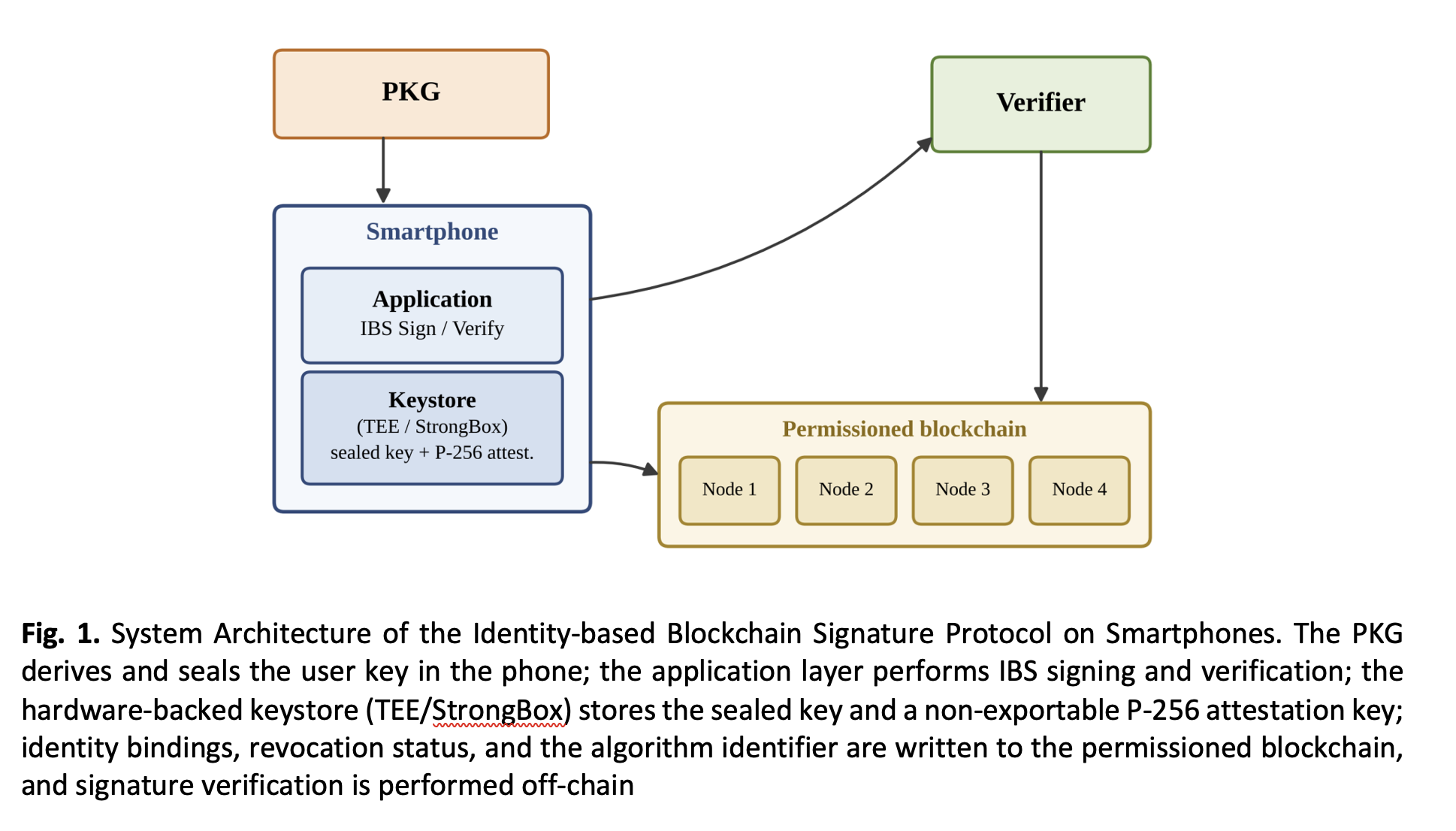
As of now, people's primary devices for carrying their personal digital identity are smartphones, and thus a genuine need has arisen for trustworthy signatures and private keys that cannot be stolen from a phone. Identity-Based Signatures (IBS) are used to provide an identity string as the public key without requiring certificate management, and can be applied to a blockchain as the root of trust. Most pairing-free IBS schemes that have been combined with blockchain have only been tested on IoT boards or servers, and how a phone's hardware-backed keystore protects an IBS private key has rarely been validated in practice. This paper implements a pairing-free elliptic-curve IBS protocol on commodity Android smartphones, seals the user's private key in the device keystore (TEE by default, StrongBox when available), and anchors identity bindings and revocation status on a permissioned blockchain. We test the protocol on three real devices and a four-node permissioned network. On-device signing is around 3.1ms for operation and about 5.1ms for verification on a high-end mobile phone; it is about 12.5 times faster than the pairing-based baseline for signing, and although richer in functions, it is measured to be about 1.6 times slower than plain ECDSA. The cost of the highest-security level is concentrated in the per-signature key unsealing of StrongBox (about 29ms), not in the signature generation process. The primary cause of the extended end-to-end latency is chain confirmation; the proportion of phone-side cryptography in the total at high-end TEE devices is about 1.4%. Based on the above results, a pairing-free IBS for smartphones is feasible, and TEE has a good balance of security and performance.

Author Biographies

Yi Liu, Faculty of Computer Science and Information Technology, Universiti Putra Malaysia, Jalan Universiti 1, 43400 Serdang, Selangor, Malaysia

987014608@qq.com

Sharifah Md Yasin, Faculty of Computer Science and Information Technology, Universiti Putra Malaysia, Jalan Universiti 1, 43400 Serdang, Selangor, Malaysia

Mohd Izuan Hafez Ninggal, Faculty of Computer Science and Information Technology, Universiti Putra Malaysia, Jalan Universiti 1, 43400 Serdang, Selangor, Malaysia

Aziah Asmawi, Faculty of Computer Science and Information Technology, Universiti Putra Malaysia, Jalan Universiti 1, 43400 Serdang, Selangor, Malaysia

Downloads

Published

2026-11-10

Issue

Section

Articles