
Remote Patient Monitoring System Adoption Framework: Case Study from Malaysia and Pakistan

Authors

  • Fatima Alam Department of Computing, Universiti Teknologi Petnonas, Perak, Malaysia
  • Mazeyanti M Ariffin Department of Computing, Universiti Teknologi Petnonas, Perak, Malaysia
  • Khairul Shafee Kalid Department of Computing, Universiti Teknologi Petnonas, Perak, Malaysia
  • Shariq Hussain Department of Software Engineering, Foundation University of Islamabad, Islamabad, Pakistan
  • Ateeq Ur Rehman Department of Software Engineering, Foundation University of Islamabad, Islamabad, Pakistan
  • Umar Mahmud Department of Software Engineering, Foundation University of Islamabad, Islamabad, Pakistan

Keywords:

Remote Patient Monitoring (RPM), MIoT in Healthcare, Adoption Framework, Malaysia, Pakistan

Abstract

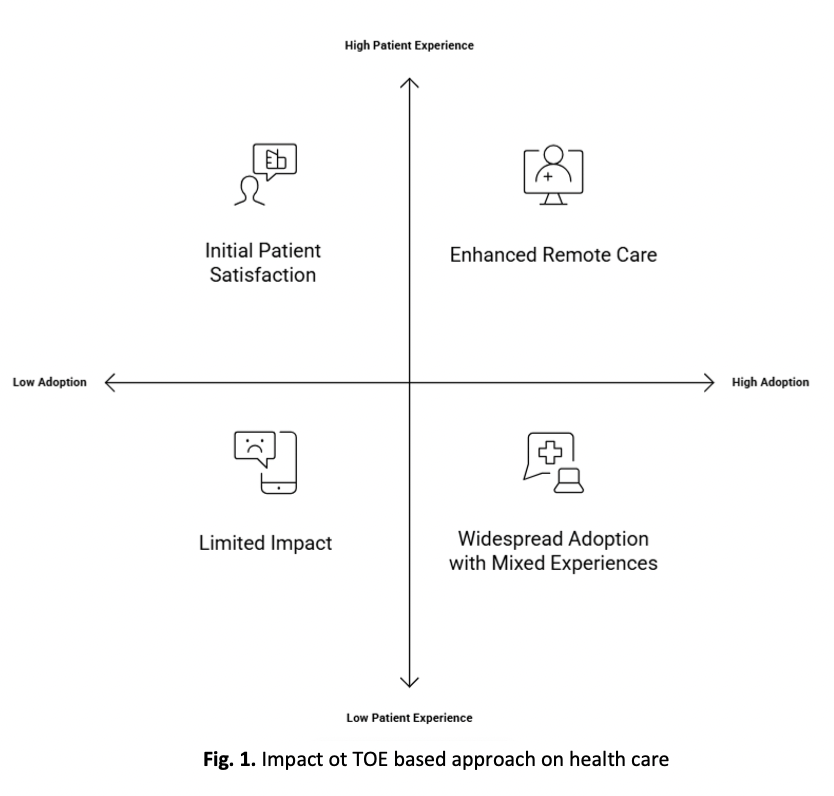
The COVID-19 pandemic has accelerated the digital transformation of healthcare monitoring systems, particularly the adoption of remote patient monitoring (RPM). RPM systems provide patients with a sense of security and fast access to competent care, reducing unnecessary hospital visits and infection risks. Remote Patient Monitoring (RPM) systems have only gained rapid adoption in the wake of the COVID-19 pandemic, but various contextual factors still hinder their use in Malaysia and Pakistan. RPM has become a crucial element of the contemporary healthcare delivery model, as it provides better accessibility, persistent monitoring of the patient, and decision-making about the patient. Nevertheless, its use in developing nations like Malaysia and Pakistan is still far-fetched as a result of technological, organizational, environmental, and human factors. The proposed study uses a qualitative research design to investigate the perceptions of the stakeholders via semi-structured interviews with the clinicians, IT staff and the management personnel. Key patterns that define the adoption of RPM were identified through thematic analysis, which resulted in the creation of an empirically based conceptual framework. The framework combines the model of Technology-Organization-Environment (TOE) and human-focused factors to get a holistic overview of adoption preparedness. The soundness and contextual appropriateness of the framework were proven by validation by experts. The research offers practical implications to health institutions and policymakers interested in enhancing the RPM implementation plans in different clinical settings.

Author Biographies

Fatima Alam, Department of Computing, Universiti Teknologi Petnonas, Perak, Malaysia

fatima_24003757@utp.edu.my

Mazeyanti M Ariffin, Department of Computing, Universiti Teknologi Petnonas, Perak, Malaysia

mazeyanti@utp.edu.my

Khairul Shafee Kalid, Department of Computing, Universiti Teknologi Petnonas, Perak, Malaysia

Khairulshafee_Kalid@utp.edu.my

Shariq Hussain, Department of Software Engineering, Foundation University of Islamabad, Islamabad, Pakistan

shariq@fui.edu.pk

Ateeq Ur Rehman, Department of Software Engineering, Foundation University of Islamabad, Islamabad, Pakistan

ateequr.rehman@fui.edu.pk

Umar Mahmud, Department of Software Engineering, Foundation University of Islamabad, Islamabad, Pakistan

umar.mahmud@fui.edu.pk

Downloads

Published

2025-12-14

Issue

Section

Articles