Heat Distribution Analysis in Seawater Desalination Prototype using ANSYS Simulation: Comparison of Natural and Plate Heating Systems
Keywords:
Solar still, heat distribution, ANSYS Fluent, desalination system, heating plate, heat fluxAbstract
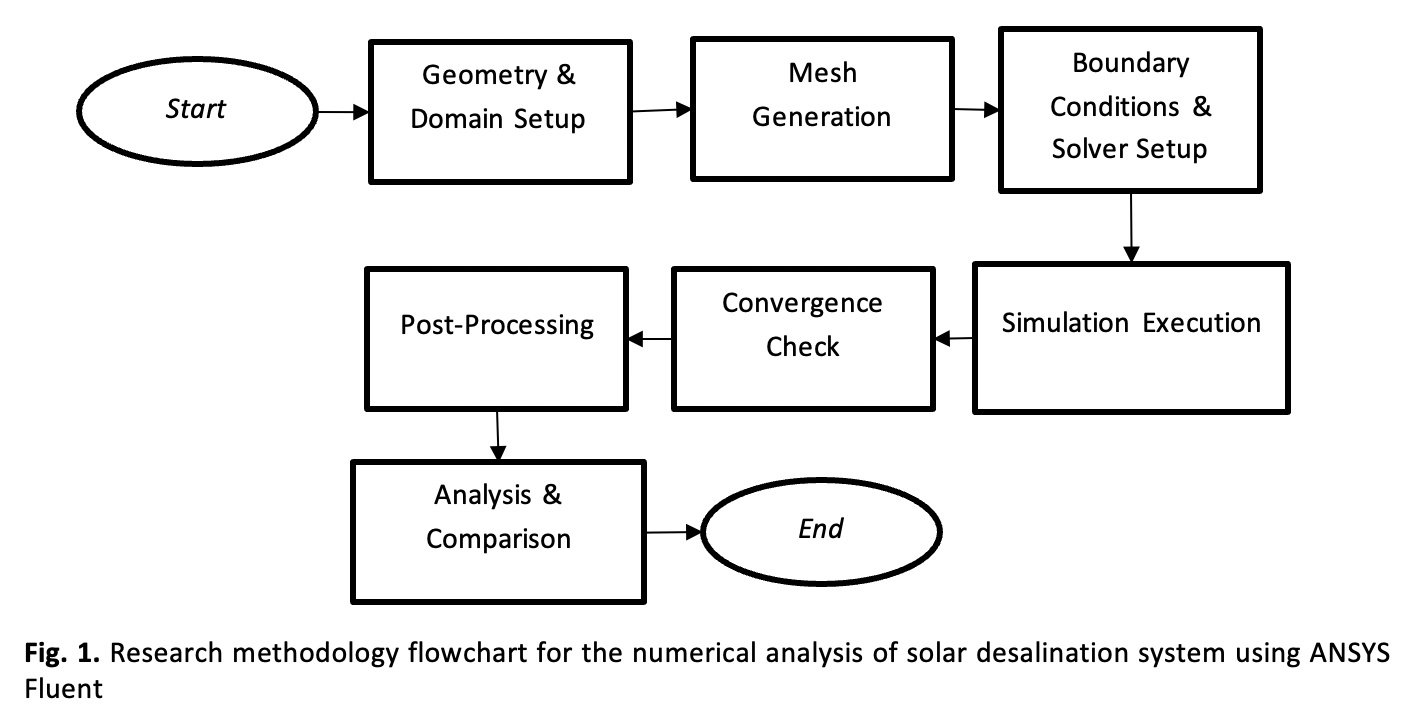
The increasing demand for clean water due to population growth and environmental degradation has intensified the need for efficient desalination technologies. Solar still systems offer a simple and low-cost solution; however, their performance is limited by low thermal efficiency and uneven heat distribution. Therefore, this study aims to analyze the heat distribution characteristics of a seawater desalination prototype by comparing natural solar heating and a system assisted by a heating plate. The methodology employed in this study involves numerical simulation using ANSYS Fluent to model heat transfer phenomena within the desalination system. A three-dimensional model of a box-type solar still was developed, consisting of fluid and solid domains, including seawater, air, glass cover, structural frame, and heating plate. Two simulation conditions were applied, namely natural heating (solar-based) and assisted heating using a heating plate, under steady-state conditions. The analysis focuses on temperature distribution and heat flux behavior within the system. The results indicate that the addition of a heating plate significantly enhances the thermal performance of the system. The temperature distribution becomes more uniform and reaches higher values compared to the natural heating condition. Moreover, the heat flux distribution shows increased intensity and improved heat transfer from the heat source to the fluid domain, which contributes to a higher evaporation potential. In conclusion, the integration of a heating plate into the solar desalination system improves heat distribution and thermal efficiency, thereby enhancing the overall performance of the desalination process. This approach provides a promising solution for improving solar still productivity, especially in conditions with limited solar radiation.