Thermal Performance Assessment of a Greenhouse-Assisted Solar Water Heater with Sand Thermal Storage
Keywords:
Hydropower performance, power plant efficiency, water discharge analysis, operational hours, energy conversionAbstract
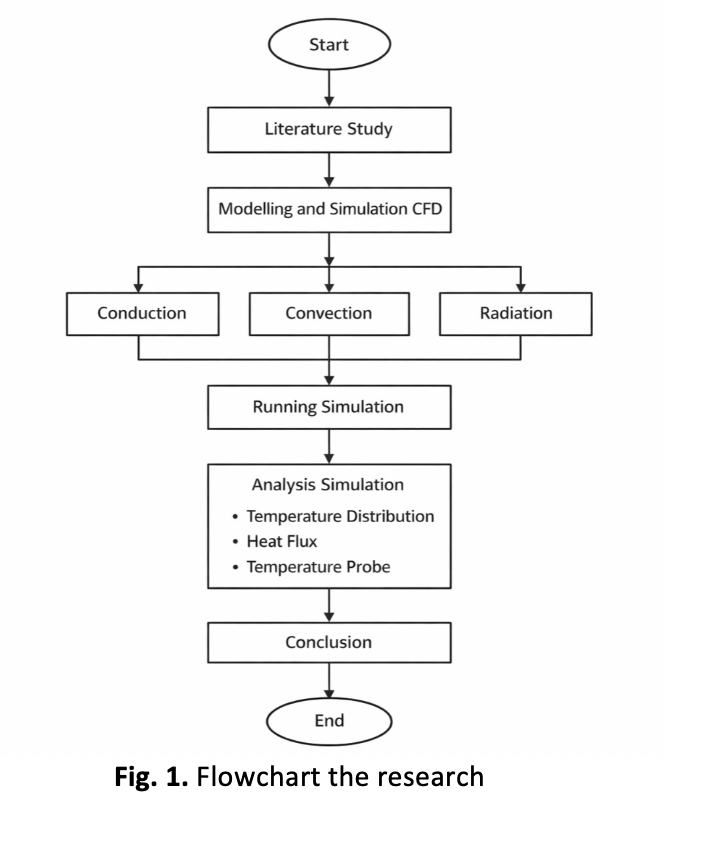
The increasing demand for domestic water heating, coupled with the environmental impact of fossil fuel-based systems, has driven the need for sustainable and low-carbon thermal technologies. This study presents a thermal performance assessment of a greenhouse-assisted solar water heater integrated with sand-based thermal energy storage. A three-dimensional steady-state numerical model was developed using ANSYS Fluent to analyze the coupled heat transfer mechanisms, including conduction, convection, and radiation within the system. The system consists of a transparent cover to induce the greenhouse effect, a black absorber surface, a sand thermal storage medium, and a spiral coil heat exchanger for water heating. The results show that the absorber region reaches a maximum temperature of approximately 127°C, while the inlet water temperature of around 72°C increases to about 93°C at the outlet, indicating a temperature rise of over 20°C. The sand storage medium demonstrates effective heat retention, contributing to a more uniform temperature distribution and prolonged thermal energy release. Heat flux analysis reveals that the highest heat transfer occurs at the absorber surface, while heat losses are primarily observed at the outer wall. The integration of sand-based thermal storage and greenhouse effect significantly enhances the thermal performance of the system, improving energy utilization and stability. The system operates passively without additional energy input, making it an environmentally friendly and low-carbon solution for residential water heating. However, its performance remains dependent on solar radiation intensity, suggesting the need for further optimization under varying environmental conditions.