Epoxy K-153A/ Poly(propylene glycol) Diglycidyl Ether Polymer Composites Enhanced Nanosilica and Graphene Oxide
Keywords:
Polymer, K-153A epoxy resin, Poly(propylene glycol) diglycidyl ether, polymer composite, thermal resistanceAbstract
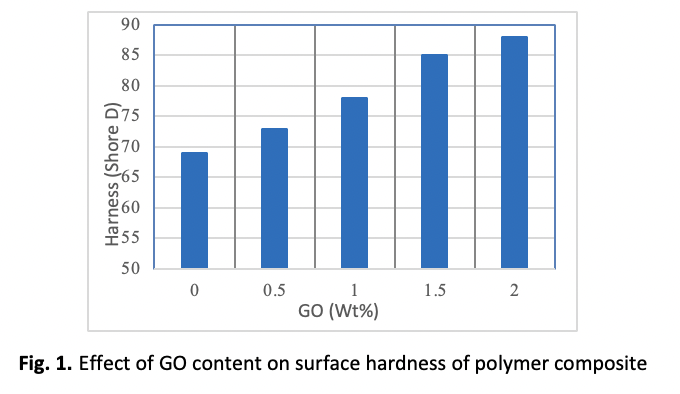
This article introduced effects of graphene oxide (GO) and nanosilica contents on properties of polymer composites based on K-153A epoxy resin and Poly(propylene glycol) diglycidyl ether with hardener of polyethylene polyamine (PEPA). Viscosity was determined by Brookfield Model RVT- Series 93412. Hardness of material was determined as by TECLOCK- Jisk 6301A and Thermogravimetric analysis (TGA), Energy Dispersive X-ray Spectrometry (EDX) were used to characterize the metarials. Results showed that GO content of 2 weight percent (wt%) and nanosilica content of 1.5 wt% were the most suitable for 100 wt% of K-153A epoxy resin/ 10 wt% of Poly(propylene glycol) diglycidyl ether (PPGDE) mixture in manufacturing polymer composites. Surface hardness of polymer composites with 2 wt% of GO was 88 Shore D and was 84 Shore D for polymer composite with 1.5 wt of nanosilica these values were much higher than that of K-153A/ Poly(propylene glycol) diglycidyl ether mixture of 69 Shore D, respectively. Besides that thermal resistance and ash remaining of polymer composites also increase in comparison to those of K-153A epoxy resin/ Poly(propylene glycol) diglycidyl ether mixture.