Mechanical Performance of Textile Waste Blended Recycled Polyester using Needle-Punched Method for Nonwoven TW/RP Composite
Keywords:
Nonwoven, Needle Punching, Recycled Polyester, Textile Waste, Tensile StrengthAbstract
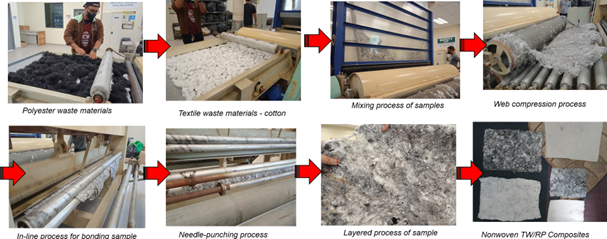
This study examines the mechanical performance of nonwoven composites produced by blending textile waste (TW) with recycled polyester (RP) via needle punching. Composites were fabricated with varying TW:RP ratios (1:40, 2:40, 3:40, 4:40, and 5:40) and evaluated for maximum load, tensile strength, strain, stiffness, tear strength, and Young’s modulus. Tensile tests were conducted with a Universal Tensile Machine (UTM) in accordance with ASTM D2261. Results showed that the 4:40 TW:RP composition (Sample D) achieved the highest tensile strength (52.69 kPa), maximum load (158.07 N), strain (114.92%), and stiffness (6.73 N/mm). Tear strength testing also confirmed superior performance for Sample D, with a maximum load of 20.65 kPa, while Young’s modulus reached 44.67 kPa. These findings indicate that the 4:40 composition provides an optimal balance of flexibility and strength, enabling the composite to absorb more energy before failure. Mechanical performance improved with increasing TW content up to this ratio, where effective fiber reinforcement and matrix interaction enhanced structural properties. Beyond this point, excessive TW content reduced tear strength due to poor dispersion and weak fiber bonding. Overall, Sample D (4:40 TW:RP) demonstrated the best mechanical performance, underscoring its potential for sustainable, high‑performance nonwoven textile applications.