
Characterization of the Effect of Reaction Residence Time on CO2 Gasification of Empty Fruit Bunch (EFB)

Authors

  • Ibrahim Idris Enagi Department of Renewable Energy Engineering, School of Engineering Technology, Federal Polytechnic, P.M.B 55, Bida, Niger State -Nigeria
  • Khaled Ali Al-attab School of Mechanical Engineering, Universiti Sains Malaysia, Engineering Campus, 14300 Nibong Tebal, Penang, Malaysia
  • Pooya Lahijani School of Chemical Engineering, Universiti Sains Malaysia, Engineering Campus, 14300 Nibong Tebal, Penang, Malaysia
  • Abdul Rahman Mohamed School of Aerospace Engineering, Universiti Sains Malaysia Engineering Campus, 14300 Nibong Tebal, Penang, Malaysia

Keywords:

Empty fruit bunch (EFB), reaction residence time, CO2 gasification, Low heating value (LHV), rate of reaction, furnace oven

Abstract

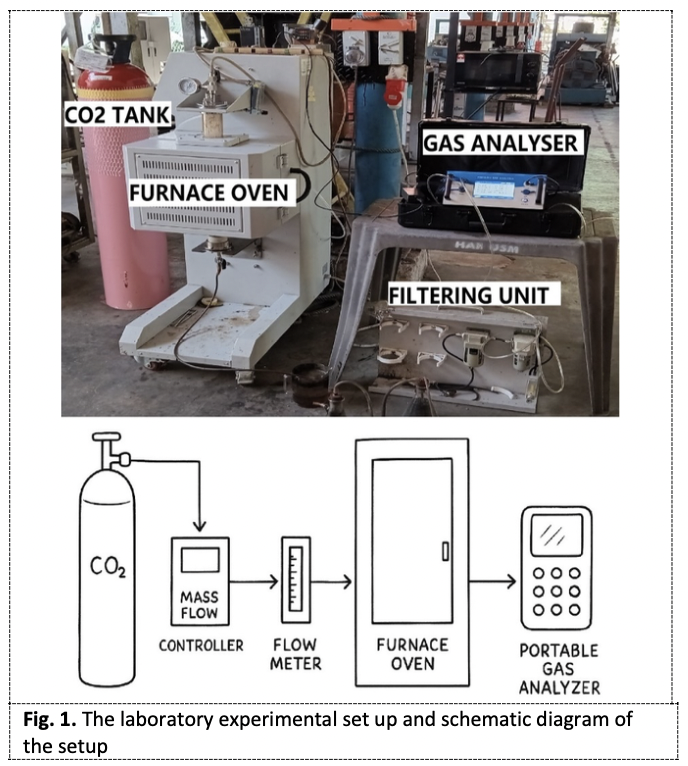
Empty Fruit Bunch (EFB) is a lignocellulosic biomass residue from extraction and processing of palm oil, which is rich in lignin, cellulose and hemicellulose that makes it suitable to be used to produce syngas through CO2 gasification process. The reaction residence time of EFB biomass species in gasification reactions critically influences the CO2 conversion, quality of syngas composition, the carbon efficiency of overall cold gas and tar formation. This paper investigates the effect of reaction residence time on CO₂ gasification of EFB biomass using a 2-inch quartz tube furnace reactor. Three different weights: 20g, 30g and 40g of EFB biomass samples equivalent to reactor bed heights of 9, 14 and 19cm were gasified at temperatures of 700, 800 and 900°C. A constant flowrate of CO2 of 50ml/min was passed through the three different bed heights, resulting in an increase in residence time from 229s to 459s. This study demonstrated the influence of residence times over CO2 conversion using variation of bed temperatures and feedstock reactor bed heights on the quality of the syngas obtained. The results showed that higher resident times and temperatures enhanced the reverse Boudouard gasification reaction and the formation of CO from 20 to 93% and H2 from 50 to 64% in syngas, whereby the material reactivity increased from 0.0968g/min to 0.369g/min. Therefore, the increase in the reaction residence time and temperature enhanced CO2 gasification considerably and promoted syngas production quality with LHV increase from 3.607MJ/m3 to 14.106MJ/m3.

Author Biographies

Ibrahim Idris Enagi, Department of Renewable Energy Engineering, School of Engineering Technology, Federal Polytechnic, P.M.B 55, Bida, Niger State -Nigeria

ibrahimidr@gmail.com

Khaled Ali Al-attab, School of Mechanical Engineering, Universiti Sains Malaysia, Engineering Campus, 14300 Nibong Tebal, Penang, Malaysia

khaled@usm.my

Pooya Lahijani, School of Chemical Engineering, Universiti Sains Malaysia, Engineering Campus, 14300 Nibong Tebal, Penang, Malaysia

Pooya.lahijani@usm.my

Abdul Rahman Mohamed , School of Aerospace Engineering, Universiti Sains Malaysia Engineering Campus, 14300 Nibong Tebal, Penang, Malaysia

chrahman@usm.my

Downloads

Published

2026-04-02

Issue

Section

Articles