

Evaluation of Phosphate Removal by Activated Carbon from Palm Oil Mill Effluent (Pome) Sludge and Empty Fruit Bunch (EFB) Blend

Authors

  • Danish Akmal Jihat Ahmad Chemical Reaction Engineering Group (CREG), Faculty of Chemical and Energy Engineering, Universiti Teknologi Malaysia, 81310 Skudai, Johor, Malaysia
  • Nur Vida Aimar Faizai Chemical Reaction Engineering Group (CREG), Faculty of Chemical and Energy Engineering, Universiti Teknologi Malaysia, 81310 Skudai, Johor, Malaysia
  • Mohd Asmadi Chemical Reaction Engineering Group (CREG), Faculty of Chemical and Energy Engineering, Universiti Teknologi Malaysia, 81310 Skudai, Johor, Malaysia
  • Nur Hafizah Ab Hamid Chemical Reaction Engineering Group (CREG), Faculty of Chemical and Energy Engineering, Universiti Teknologi Malaysia, 81310 Skudai, Johor, Malaysia

Keywords:

Palm Oil Mill Effluent (POME) sludge, Empty Fruit Bunch (EFB), phosphate adsorption, activated carbon

Abstract

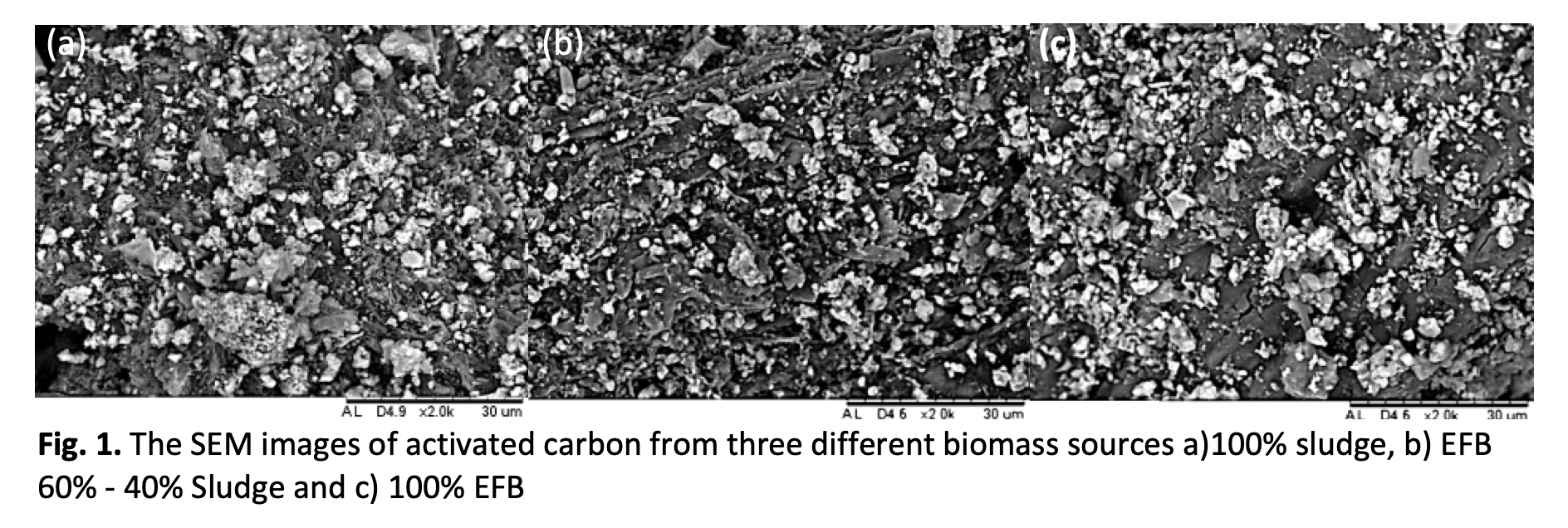
Adsorption using activated carbon has attracted considerable attention for phosphate removal from wastewater. In this study, Palm Oil Mill Effluent (POME) sludge and Empty Fruit Bunch (EFB) were blended and evaluated as precursor materials for activated carbon production. The efficiency of phosphate removal from aqueous solutions was assessed, and the physicochemical properties of the activated carbons prepared from different EFB-POME sludge compositions were characterised using Scanning Electron Microscopy coupled with Energy-Dispersive X-ray Spectroscopy (SEM–EDX) and Brunauer–Emmett–Teller (BET) surface area analysis. The biomasses were subjected to slow pyrolysis followed by chemical activation using calcium hydroxide (Ca(OH)₂). Batch adsorption experiments were conducted to evaluate adsorption performance under varying biomass compositions, contact times, and initial phosphate concentrations. Adsorption behaviour was further analysed using the Langmuir and the Freundlich isotherm models. BET analysis revealed specific surface areas of 9.404 m²/g, 11.200 m²/g, and 10.393 m²/g for activated carbons derived from 100% EFB, the 60%EFB – 40%POME sludge and 100% sludge, respectively. SEM–EDX analysis indicated the presence of Ca²⁺ on the activated carbon surfaces, evidenced by 22 – 38 % Ca2+ detected. All activated carbons exhibited high phosphate adsorption performance, achieving a maximum adsorption capacity of 347.55 mg/g at an initial phosphate concentration of 350 mg/L. Isotherm analysis showed comparable adsorption performance among all samples with the highest Langmuir maximum adsorption capacity observed for 100% EFB (qₘₐₓ = 332.652 mg/g), while the EFB–sludge composite exhibited the highest Freundlich constant (Kf = 393.236), indicating greater surface heterogeneity. Favourable adsorption behaviour was confirmed for all adsorbents, with n > 1 and strong model fitting (R² > 0.98 for the Langmuir model). Overall, this study demonstrates the successful valorisation of Palm Oil Mill Effluent (POME) sludge and Empty Fruit Bunch (EFB) as effective precursors for calcium-activated carbon in phosphate removal from wastewater, supporting waste-to-resource strategies and circular economy approaches in wastewater treatment.

Author Biographies

Danish Akmal Jihat Ahmad, Chemical Reaction Engineering Group (CREG), Faculty of Chemical and Energy Engineering, Universiti Teknologi Malaysia, 81310 Skudai, Johor, Malaysia

danishakmal@graduate.utm.my

Nur Vida Aimar Faizai, Chemical Reaction Engineering Group (CREG), Faculty of Chemical and Energy Engineering, Universiti Teknologi Malaysia, 81310 Skudai, Johor, Malaysia

nurvidaaimar@utm.my

Mohd Asmadi, Chemical Reaction Engineering Group (CREG), Faculty of Chemical and Energy Engineering, Universiti Teknologi Malaysia, 81310 Skudai, Johor, Malaysia

mohdasmadi@utm.my

Nur Hafizah Ab Hamid, Chemical Reaction Engineering Group (CREG), Faculty of Chemical and Energy Engineering, Universiti Teknologi Malaysia, 81310 Skudai, Johor, Malaysia

nurhafizah.abhamid@utm.my

Downloads

Published

2026-04-02

Issue

Section

Articles