Bridging Assessment and Cognition: A Review of Dynamic Assessment and Metacognitive Strategy Research in EFL Listening
Keywords:
Dynamic assessment, cognition, metacognitive strategies, EFL listening, literature reviewAbstract
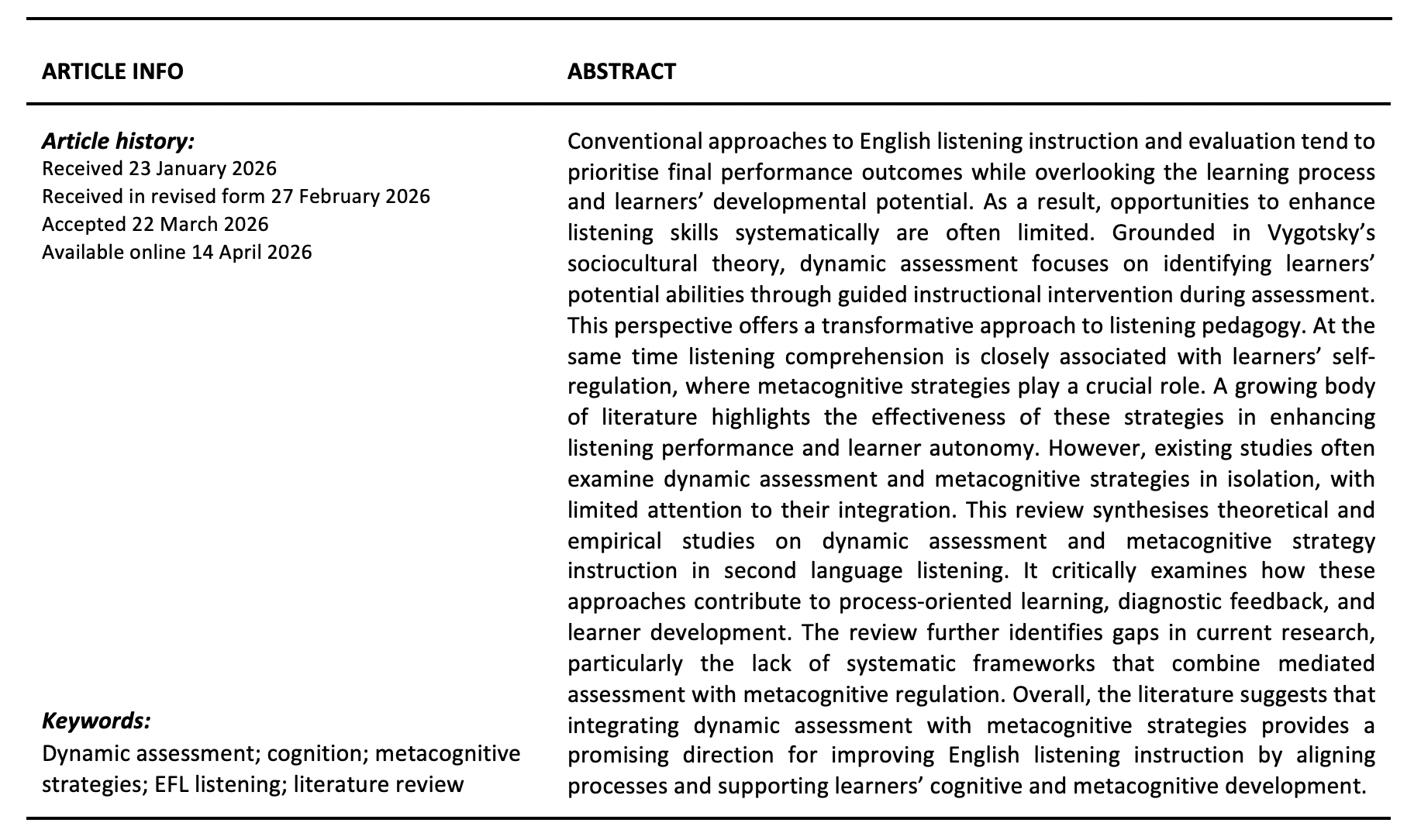
Conventional approaches to English listening instruction and evaluation tend to prioritise final performance outcomes while overlooking the learning process and learners’ developmental potential. As a result, opportunities to enhance listening skills systematically are often limited. Grounded in Vygotsky’s sociocultural theory, dynamic assessment focuses on identifying learners’ potential abilities through guided instructional intervention during assessment. This perspective offers a transformative approach to listening pedagogy. At the same time listening comprehension is closely associated with learners’ self-regulation, where metacognitive strategies play a crucial role. A growing body of literature highlights the effectiveness of these strategies in enhancing listening performance and learner autonomy. However, existing studies often examine dynamic assessment and metacognitive strategies in isolation, with limited attention to their integration. This review synthesises theoretical and empirical studies on dynamic assessment and metacognitive strategy instruction in second language listening. It critically examines how these approaches contribute to process-oriented learning, diagnostic feedback, and learner development. The review further identifies gaps in current research, particularly the lack of systematic frameworks that combine mediated assessment with metacognitive regulation. Overall, the literature suggests that integrating dynamic assessment with metacognitive strategies provides a promising direction for improving English listening instruction by aligning processes and supporting learners’ cognitive and metacognitive development.