Students’ Perceptions of AI-Mediated Formative Feedback in Academic Writing: Evidence from Malaysian Higher Education

Authors

  • Maizatul Akmal Mohd Mohzan Akademi Pengajian Bahasa, UiTM Cawangan Pulau Pinang, Malaysia
  • Norhafizah Abdul Halil Akademi Pengajian Bahasa, UiTM Cawangan Pulau Pinang, Malaysia
  • Norhaslinda Hassan Akademi Pengajian Bahasa, UiTM Cawangan Pulau Pinang, Malaysia
  • Hanani Ahmad Zubir Akademi Pengajian Bahasa, UiTM Cawangan Pulau Pinang, Malaysia
  • Fenny Thresia Universitas Muhammadiyah Metro, Indonesia
  • Dedy Subandowo Universitas Muhammadiyah Metro, Indonesia

Keywords:

Artificial intelligence, formative feedback, academic writing, learner autonomy, higher education

Abstract

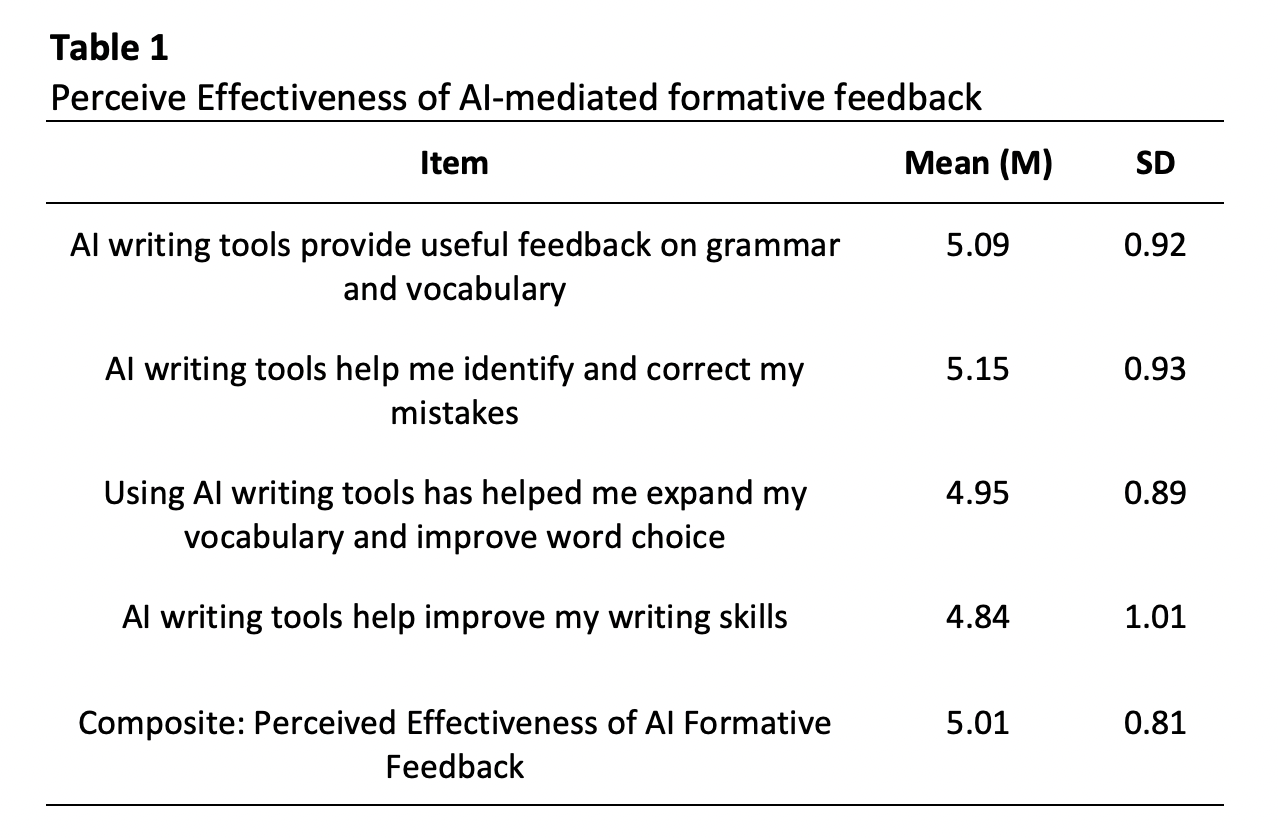
The increasing use of artificial intelligence (AI) writing tools in higher education has raised important questions about their role in supporting formative assessment in academic writing. While AI-generated feedback is widely available, empirical evidence on how students perceive such feedback as part of their learning process remains limited in the Malaysian higher education context. This study addresses this gap by examining tertiary-level ESL students’ perceptions of AI-mediated formative feedback in academic writing courses. The purpose of this study is to investigate students’ perceptions of (i) the effectiveness of AI writing tools as formative feedback, (ii) the extent to which AI feedback supports learner autonomy and affective aspects of learning, and (iii) students’ confidence in evaluating and exercising judgment over AI-generated feedback. A quantitative survey design was employed, involving 210 undergraduate students enrolled in English academic writing courses at a Malaysian public university. Data were analysed using SPSS, applying descriptive statistics, reliability analysis, and Pearson correlation analysis. The findings indicate generally positive student perceptions of AI-mediated formative feedback, particularly in relation to identifying language issues, supporting revision, and promoting independent learning. Pearson correlation analysis revealed moderate positive associations between perceived effectiveness of AI feedback and learner autonomy, as well as between perceived effectiveness and AI feedback literacy. Learner autonomy was also positively associated with students’ confidence in evaluating AI-generated suggestions, suggesting that students who perceived greater learning support were more likely to engage critically with AI feedback. Overall, the study demonstrates that AI writing tools can function as supportive formative feedback resources when integrated responsibly into academic writing instruction. The findings highlight the importance of guided implementation that encourages students to develop feedback literacy rather than rely uncritically on AI-generated suggestions. Implications are discussed for learning-oriented assessment practices and ethical AI integration in Malaysian higher education.

Author Biographies

Maizatul Akmal Mohd Mohzan, Akademi Pengajian Bahasa, UiTM Cawangan Pulau Pinang, Malaysia

maizatul.akmal@uitm.edu.my

Norhafizah Abdul Halil, Akademi Pengajian Bahasa, UiTM Cawangan Pulau Pinang, Malaysia

hafizahalil@uitm.edu.my

Norhaslinda Hassan, Akademi Pengajian Bahasa, UiTM Cawangan Pulau Pinang, Malaysia

haslinda.hassan@uitm.edu.my

Hanani Ahmad Zubir, Akademi Pengajian Bahasa, UiTM Cawangan Pulau Pinang, Malaysia

hanani.az@uitm.edu.my

Fenny Thresia, Universitas Muhammadiyah Metro, Indonesia

fthresia@gmail.com

Dedy Subandowo, Universitas Muhammadiyah Metro, Indonesia

Dedy.Subandowo@gmail.com

Downloads

Published

2026-04-22

Issue

Section

Articles