Employment Outcomes among Deaf and Hearing-Impaired Graduates in Malaysian Polytechnics: Key Issues and Challenges
Keywords:
Graduate Employability, Graduate Marketability, TVET, Employment Outcomes, Workplace Barriers, Inclusive EmploymentAbstract
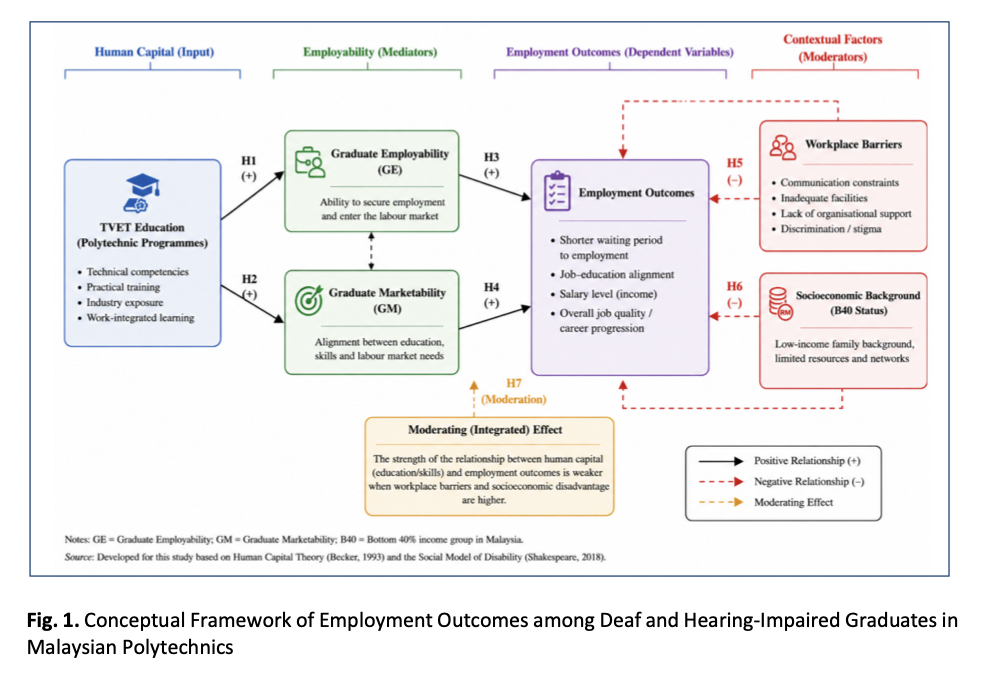
This study examines the employment outcomes of deaf and hearing-impaired graduates from Malaysian polytechnics, focusing on the relationship between employability and employment quality. Using secondary data from the Graduate Tracer Study by the Ministry of Higher Education Malaysia, the study analyses Graduate Employability (GE), Graduate Marketability (GM), salary, job–education alignment, waiting period to employment, workplace barriers, and socioeconomic background. The findings show that employability has improved significantly, with GE increasing from 93.3% in 2022 to 100% in 2024, and GM rising from 90.8% to 97.9%. However, high employability does not necessarily lead to quality employment. A large proportion of graduates earn low wages, with 89.5% earning RM2,000 or below, alongside persistent job mismatch and workplace challenges. The results further indicate that employment outcomes are influenced by structural barriers and socioeconomic disadvantage. By integrating Human Capital Theory and the Social Model of Disability, the study highlights that employability is context-dependent. It concludes that improving employment outcomes requires not only skills development but also more inclusive labour market practices.. Implications are discussed for learning-oriented assessment practices and ethical AI integration in Malaysian higher education.