Advancing Inclusive Early Childhood Pedagogy Through Human-Centered Artificial Intelligence: A Conceptual Framework For Supporting Children With Special Education Needs

Authors

  • Nurmuma Kamarina Jamil Faculty of Education and Liberal Studies, City University of Malaysia, No. 8, Jalan 51A/223, Seksyen 51A, 46100 Petaling Jaya, Selangor, Malaysia
  • Zaheril Zainudin Faculty of Education and Liberal Studies, INTI International University, Persiaran Perdana BBN, Putra Nilai, Bandar Baru Nilai, 71800 Nilai, Negeri Sembilan, Malaysia
  • Hasnah Embi Tadika Sri Comel Manja, No 1, Jalan Ara SD 7/4, Bandar Sri Damansara, 52200 Kuala Lumpur, Malaysia

Keywords:

Artificial intelligence (AI), inclusive pedagogy, early childhood education (ECE), special educational needs (SEN), human-centered AI

Abstract

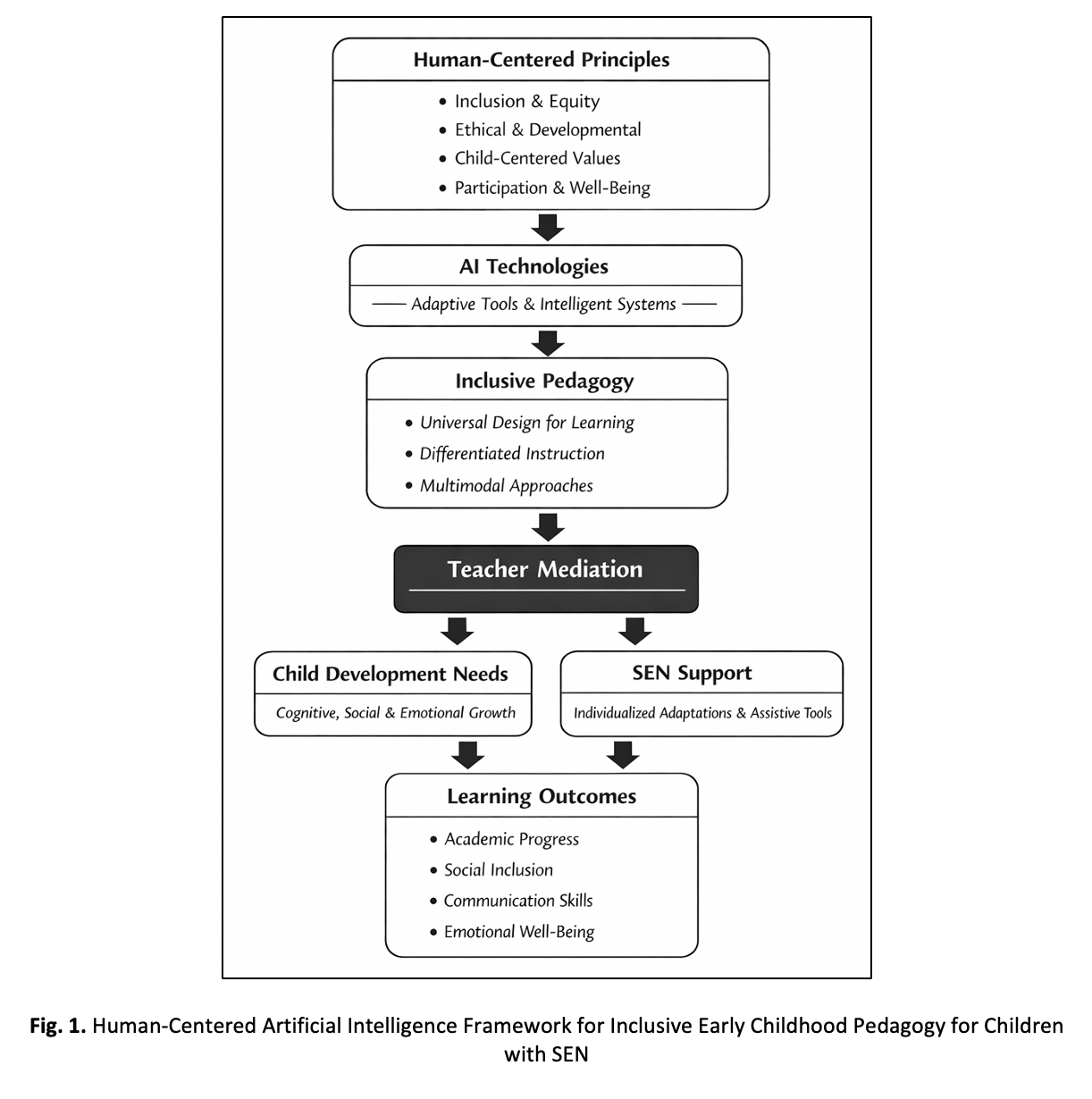
The integration of artificial intelligence (AI) in early childhood education (ECE) presents new opportunities for enhancing inclusive pedagogy, particularly for children with special educational needs (SEN). However, existing approaches often prioritize technological efficiency over developmental, pedagogical and ethical considerations. This study proposes a human-centered AI framework for inclusive ECE pedagogy that positions AI as a supportive, teacher-mediated tool rather than a replacement for human interaction. Drawing on Inclusive Education Theory, Universal Design for Learning, Human-Centered AI, Child Development Theory, Sociocultural Theory and Assistive Technology Theory, the study develops a conceptual model linking human-centered principles, AI technologies, inclusive pedagogy, teacher mediation, developmental needs, SEN support and learning outcomes. The framework highlights that effective AI integration depends on alignment with human values, teacher expertise, and developmental appropriateness. This study contributes theoretically by offering a comprehensive model to guide research, policy and practice in responsible AI implementation in inclusive ECE.

Author Biographies

Nurmuma Kamarina Jamil, Faculty of Education and Liberal Studies, City University of Malaysia, No. 8, Jalan 51A/223, Seksyen 51A, 46100 Petaling Jaya, Selangor, Malaysia

nurmumakamarina@gmail.com

Zaheril Zainudin, Faculty of Education and Liberal Studies, INTI International University, Persiaran Perdana BBN, Putra Nilai, Bandar Baru Nilai, 71800 Nilai, Negeri Sembilan, Malaysia

zaheril.zainudin@newinti.edu.my

Hasnah Embi, Tadika Sri Comel Manja, No 1, Jalan Ara SD 7/4, Bandar Sri Damansara, 52200 Kuala Lumpur, Malaysia

sricomel25@gmail.com

Downloads

Published

2026-06-20

Issue

Section

Articles