Elucidating New Model Of Artificial Intelligence As Teaching Aids In Special Education Needs: A Pedagogical Perspective

Authors

  • Zaheril Zainudin Faculty of Education and Liberal Studies, INTI International University, Persiaran Perdana BBN, Putra Nilai, Bandar Baru Nilai, 71800 Nilai, Negeri Sembilan, Malaysia
  • Nurmuma Kamarina Jami Faculty of Education and Liberal Studies, City University of Malaysia, No. 8, Jalan 51A/223, Seksyen 51A, 46100 Petaling Jaya, Selangor, Malaysia
  • Hasnah Embi Tadika Sri Comel Manja, No 1, Jalan Ara SD 7/4, Bandar Sri Damansara, 52200 Kuala Lumpur, Malaysia

Keywords:

Artificial intelligence (AI), special education needs (SEN), inclusive pedagogy, assistive technology, educational technology

Abstract

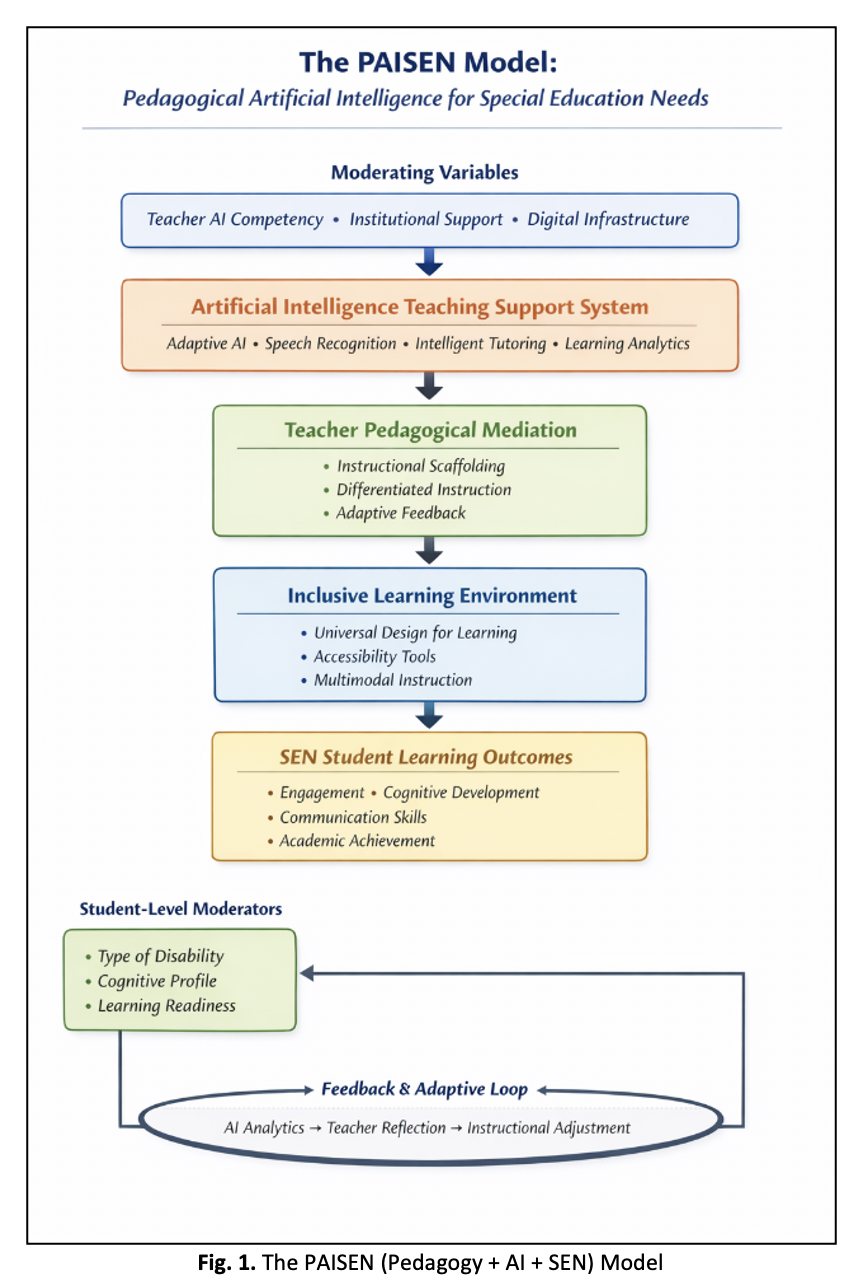
The growing integration of artificial intelligence (AI) in education has created new possibilities for enhancing inclusive teaching and learning, particularly for students with special education needs (SEN). Despite the increasing development of AI-driven educational technologies, many existing systems remain predominantly technocentric and insufficiently aligned with pedagogical principles required for inclusive education. This conceptual paper proposes the PAISEN Model (Pedagogical Artificial Intelligence for Special Education Needs) as a theoretical framework that explains how AI can function as a pedagogically mediated teaching aid in special education contexts. Drawing on interdisciplinary literature from artificial intelligence in education, inclusive pedagogy, Universal Design for Learning (UDL), and assistive technology, the study conceptualizes a multilevel framework in which AI teaching support systems operate through teacher pedagogical mediation and inclusive learning environments to improve learning outcomes for SEN students. The model highlights the importance of teacher interpretation of AI-generated insights and the creation of accessible learning environments that accommodate diverse cognitive and communication needs. In addition, the framework recognizes the role of contextual moderating factors such as teacher AI competency, institutional support, and digital infrastructure in influencing the effectiveness of AI integration. By integrating technological innovation with pedagogical expertise, the PAISEN Model contributes to theoretical discussions on AI-supported inclusive education and provides guidance for future empirical research, educational practice, and policy development aimed at promoting equitable learning opportunities for students with special education needs.

Author Biographies

Zaheril Zainudin, Faculty of Education and Liberal Studies, INTI International University, Persiaran Perdana BBN, Putra Nilai, Bandar Baru Nilai, 71800 Nilai, Negeri Sembilan, Malaysia

zaheril.zainudin@newinti.edu.my

Nurmuma Kamarina Jami, Faculty of Education and Liberal Studies, City University of Malaysia, No. 8, Jalan 51A/223, Seksyen 51A, 46100 Petaling Jaya, Selangor, Malaysia

nurmumakamarina@gmail.com

Hasnah Embi, Tadika Sri Comel Manja, No 1, Jalan Ara SD 7/4, Bandar Sri Damansara, 52200 Kuala Lumpur, Malaysia

sricomel25@gmail.com

Downloads

Published

2026-06-20

Issue

Section

Articles