Prophetic Guidance on Lunar Observation: A Contemporary Technological Analysis
Keywords:
Lunar observation, prophetic guidance, hadith studies, astronomical calculations, Islamic jurisprudenceAbstract
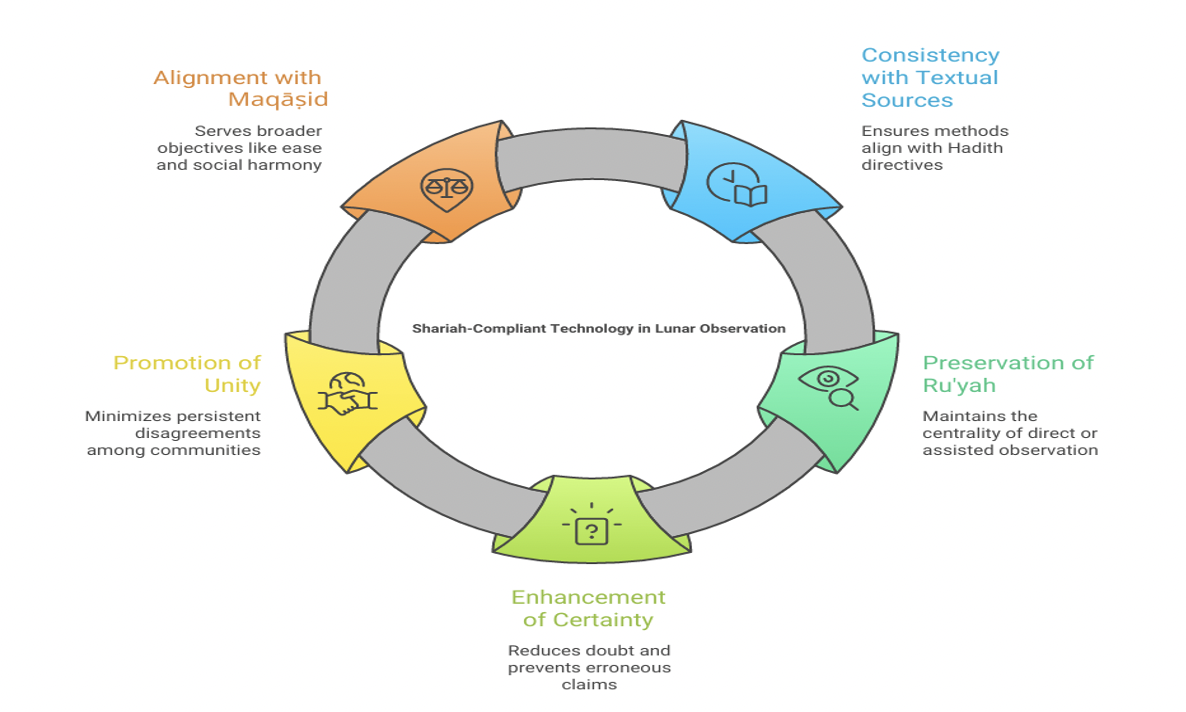
Lunar observation holds a central position in Islamic ritual life, determining the commencement of key acts of worship such as Ramadan, Eid al-Fitr, and Hajj. Rooted in Prophetic guidance, particularly the well-known injunction to “fast upon sighting the moon and break the fast upon sighting it,” traditional practices have historically relied on direct visual observation (ru’yah) or the completion of thirty days (istikmāl). However, the advancement of modern astronomical science and digital technologies has introduced new methods of lunar calculation and observation, generating ongoing debates within the Muslim world regarding their legitimacy and compatibility with the Sunnah. The persistence of differing lunar dates across regions highlights a critical problem: the lack of methodological consensus between traditional jurisprudential interpretations and contemporary scientific capabilities. This study aims to critically examine Prophetic guidance on lunar observation in light of contemporary technological developments, seeking to explore whether modern tools can be harmonized with the objectives and principles of the Sunnah. The research adopts a qualitative analytical approach, integrating naqli (textual) sources—primarily Hadith literature and classical juristic opinions—with ‘aqli (rational) analysis derived from contemporary astronomical studies and technological applications. Relevant literature from both Islamic jurisprudence and modern science is systematically reviewed to construct a balanced evaluative framework. The findings indicate that while the Prophetic emphasis on ru’yah underscores simplicity, accessibility, and communal participation, it does not inherently preclude the use of technological aids. Instead, many contemporary scholars argue that astronomical calculations and observational technologies can serve as complementary tools to enhance accuracy and reduce uncertainty, provided they do not contradict established Shariah principles. The study also reveals that rigid dichotomies between ru’yah and hisāb are increasingly being reconsidered in favor of integrative approaches. In conclusion, the paper argues that contemporary technologies, when applied within a Shariah-compliant framework, can support rather than replace Prophetic guidance. A balanced integration of revelation and scientific knowledge is essential for promoting unity, consistency, and informed decision-making in lunar observation practices across the Muslim world.